Slovak
Slovak ( SLOH-va(h)k; endonym: slovenčina [ˈslɔʋent͡ʂina] or slovenský jazyk [ˈslɔʋenskiː ˈjazik] ), is a West Slavic language of the Czech–Slovak group, written in Latin script. It is part of the Indo-European language family, and is one of the Slavic languages, which are part of the larger Balto-Slavic branch. Spoken by approximately five million people as a native language, primarily ethnic Slovaks, it serves as the official language of Slovakia and one of the 24 official languages of the European Union. Slovak is closely related to Czech, to the point of very high mutual intelligibility, as well as to Polish. Like other Slavic languages, Slovak is a fusional language with a complex system of morphology and relatively flexible word order. Its vocabulary has been extensively influenced by Latin and German, as well as other Slavic languages.
Translate in Slovak ↗Slovak language is primarily spoken in Slovakia. The country's constitution declared it the official language of the state (štátny jazyk): (1) Na území Slovenskej republiky je štátnym jazykom slovenský jazyk. (2) Používanie iných jazykov než štátneho jazyka v úradnom styku ustanoví zákon. (1) The Slovak language is the official language on the territory of the Slovak Republic. (2) The use of languages other than the official language in official communication shall be laid down by law. Constitution of Slovakia, Article 6. Beside that, national minorities and ethnic groups also have explicit permission to use their distinct languages. Slovakia is a country with an established language policy concerning its official language.
Europe
Present-day use
Slovak language is primarily spoken in Slovakia. The country's constitution declared it the official language of the state (štátny jazyk): (1) Na území Slovenskej republiky je štátnym jazykom slovenský jazyk. (2) Používanie iných jazykov než štátneho jazyka v úradnom styku ustanoví zákon. (1) The Slovak language is the official language on the territory of the Slovak Republic. (2) The use of languages other than the official language in official communication shall be laid down by law. Constitution of Slovakia, Article 6. Beside that, national minorities and ethnic groups also have explicit permission to use their distinct languages. Slovakia is a country with an established language policy concerning its official language.
Origins
The captured article does not contain a separate origins section. See the historical account and linked source.
Development
The Czech–Slovak group developed within West Slavic in the high medieval period, and the standardization of Czech and Slovak within the Czech–Slovak dialect continuum emerged in the early modern period. In the later mid-19th century, the modern Slovak alphabet and written standard became codified by Ľudovít Štúr and reformed by Martin Hattala. The Moravian dialects spoken in the western part of the country along the border with the Czech Republic are also sometimes classified as Slovak, although some of their western variants are closer to Czech; they nonetheless form the bridge dialects between the two languages.
Writing
Slovak uses the Latin script with small modifications that include the four diacritics (ˇ, ´, ¨, ˆ) placed above certain letters (a-á,ä; c-č; d-ď; dz-dž; e-é; i-í; l-ľ,ĺ; n-ň; o-ó,ô; r-ŕ; s-š; t-ť; u-ú; y-ý; z-ž) Letters displayed in Italic are used in loanwords and foreign names. The primary principle of Slovak spelling is the phonemic principle. The secondary principle is the morphological principle: forms derived from the same stem are written in the same way even if they are pronounced differently. An example of this principle is the assimilation rule (see below). The tertiary principle is the etymological principle, which can be seen in the use of i after certain consonants and of y after other consonants, although both i and y are usually pronounced the same way. Finally, the rarely applied grammatical principle occurs when, for example, the basic singular form and plural form of masculine adjectives are written differently with no difference in pronunciation (e.g. pekný = nice – singular versus pekní = nice – plural). Such spellings are most often remnants of differences in pronunciation that were present in Proto-Slavic (in Polish, where the vowel merger did not occur, piękny and piękni and in Czech pěkný and pěkní are pronounced differently). Most loanwords from foreign languages are respelt using Slovak principles either immediately or later. For example, "weekend" is spelled víkend, "software" – softvér, "gay" – gej (both not exclusively), and "quality" is spelled kvalita. Personal and geographical names from other languages using Latin alphabets keep their original spelling unless a Slovak exonym exists (e.g. Londýn for "London"). Slovak features some heterophonic homographs (words with identical spelling but different pronunciation and meaning), the most common examples being krásne /ˈkraːsnɛ/ (beautiful) versus krásne /ˈkraːsɲɛ/ (beautifully).
Beyond the typeface.
Signs, manuscripts, published pages and contextual photographs, with their place, period, source and reuse terms. Captions identify historical spellings, regional examples, community references and character imagery.
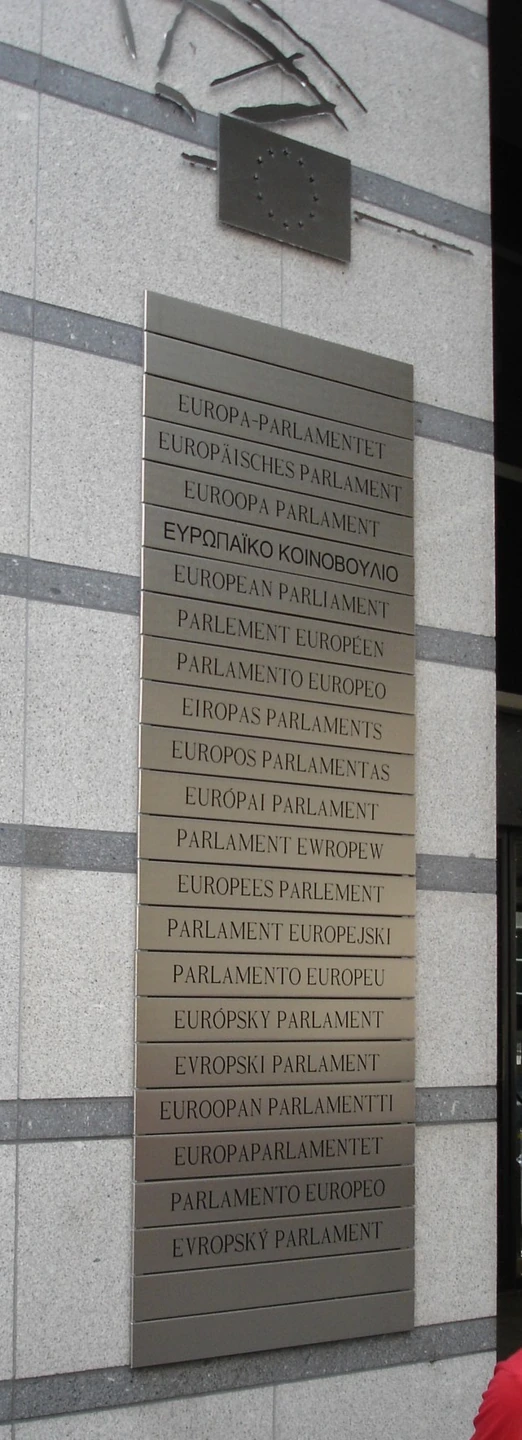
Slovak on a multilingual European Parliament sign, photographed in 2006. Language identification follows the source description; not independently transcribed.
Saved in Babelbook · resized display copy. Select the image to open it independently of its source.
Nuno Nogueira · Source ↗Public domain (author dedication) ↗View the local visual field note
Representative reference points from Glottolog. Historical entries show reference locations, not current speakers. 1 point.
Reference & context ↗Babelbook · original editorial illustration · CC BY 4.0 · Glottolog locations; public-domain Natural Earth land
Source excerpts, selected, shortened and where noted editorially corrected from Slovak language by Wikipedia contributors. Retrieved 2026-10-05. CC BY-SA 4.0. These excerpts are not an independently verified scholarly history; missing accounts are identified above.
Read further in the source
History
The Czech–Slovak group developed within West Slavic in the high medieval period, and the standardization of Czech and Slovak within the Czech–Slovak dialect continuum emerged in the early modern period. In the later mid-19th century, the modern Slovak alphabet and written standard became codified by Ľudovít Štúr and reformed by Martin Hattala. The Moravian dialects spoken in the western part of the country along the border with the Czech Republic are also sometimes classified as Slovak, although some of their western variants are closer to Czech; they nonetheless form the bridge dialects between the two languages.
Geographic distribution and status
Slovak language is primarily spoken in Slovakia. The country's constitution declared it the official language of the state (štátny jazyk):
(1) Na území Slovenskej republiky je štátnym jazykom slovenský jazyk. (2) Používanie iných jazykov než štátneho jazyka v úradnom styku ustanoví zákon. (1) The Slovak language is the official language on the territory of the Slovak Republic. (2) The use of languages other than the official language in official communication shall be laid down by law. Constitution of Slovakia, Article 6. Beside that, national minorities and ethnic groups also have explicit permission to use their distinct languages. Slovakia is a country with an established language policy concerning its official language.
Dialects
There are many Slovak dialects, which are divided into the following four basic groups:
Western Slovak dialects (Trenčín, Trnava, Nitra, Záhorie) Central Slovak dialects (in Liptov, Orava, Turiec, Tekov, Hont, Novohrad, Gemer and around Zvolen.) Eastern Slovak dialects (in Spiš, Šariš, Zemplín and Abov) Lowland (dolnozemské) Slovak dialects (outside Slovakia in the Pannonian Plain in Serbian Vojvodina, and in southeastern Hungary, western Romania, and the Croatian part of Syrmia) The fourth group of dialects is often not considered a separate group, but a subgroup of Central and Western Slovak dialects (see e.g. Štolc, 1968), but it is currently undergoing changes due to contact with surrounding languages (Serbo-Croatian, Romanian, and Hungarian) and long-time geographical separation from Slovakia (see the studies in Zborník Spolku vojvodinských slovakistov, e.g. Dudok, 1993). The dialect groups differ mostly in phonology, vocabulary, and tonal inflection. Syntactic differences are minor. Central Slovak forms the basis of the present-day standard language. Not all dialects are fully mutually intelligible. It may be difficult for an inhabitant of the western Slovakia to understand a dialect from eastern Slovakia and the other way around. The dialects are fragmented geographically, separated by numerous mountain ranges. The first three groups already existed in the 10th century. All of them are spoken by the Slovaks outside Slovakia, and central and western dialects form the basis of the lowland dialects (see above). The western dialects contain features common with the Moravian dialects in the Czech Republic, the southern central dialects contain a few features common with South Slavic languages, and the eastern dialects a few features common with Polish and the East Slavonic languages (cf. Štolc, 1994). Lowland dialects share some words and areal features with the languages surrounding them (Serbo-Croatian, Hungarian, and Romanian).
Orthography
Slovak uses the Latin script with small modifications that include the four diacritics (ˇ, ´, ¨, ˆ) placed above certain letters (a-á,ä; c-č; d-ď; dz-dž; e-é; i-í; l-ľ,ĺ; n-ň; o-ó,ô; r-ŕ; s-š; t-ť; u-ú; y-ý; z-ž)
Letters displayed in Italic are used in loanwords and foreign names. The primary principle of Slovak spelling is the phonemic principle. The secondary principle is the morphological principle: forms derived from the same stem are written in the same way even if they are pronounced differently. An example of this principle is the assimilation rule (see below). The tertiary principle is the etymological principle, which can be seen in the use of i after certain consonants and of y after other consonants, although both i and y are usually pronounced the same way. Finally, the rarely applied grammatical principle occurs when, for example, the basic singular form and plural form of masculine adjectives are written differently with no difference in pronunciation (e.g. pekný = nice – singular versus pekní = nice – plural). Such spellings are most often remnants of differences in pronunciation that were present in Proto-Slavic (in Polish, where the vowel merger did not occur, piękny and piękni and in Czech pěkný and pěkní are pronounced differently). Most loanwords from foreign languages are respelt using Slovak principles either immediately or later. For example, "weekend" is spelled víkend, "software" – softvér, "gay" – gej (both not exclusively), and "quality" is spelled kvalita. Personal and geographical names from other languages using Latin alphabets keep their original spelling unless a Slovak exonym exists (e.g. Londýn for "London"). Slovak features some heterophonic homographs (words with identical spelling but different pronunciation and meaning), the most common examples being krásne /ˈkraːsnɛ/ (beautiful) versus krásne /ˈkraːsɲɛ/ (beautifully).