Somali
Somali ( sə-MAH-lee, soh-; Latin script: Af Soomaali, Wadaad: اف صومالِ, Osmanya: 𐒖𐒍 𐒈𐒝𐒑𐒛𐒐𐒘 [af soːmaːli]) is a Cushitic language belonging to wider Afroasiatic language family. Somali is spoken primarily in Greater Somalia, and the Somali diaspora as a mother tongue. It is an official language in Somalia, Somaliland, and Ethiopia. It serves as a national language in Djibouti, and is also a recognised minority language in Kenya. The language is officially written with the Somali Latin alphabet, although an Arabic alphabet and several indigenous scripts (Osmanya, Kaddare and Borama) are used informally.
Translate in Somali ↗The Somali language is spoken in Somali inhabited areas of Somalia, Djibouti, Ethiopia, Kenya, Yemen and by members of the Somali diaspora. It is also spoken as an adoptive language by a few ethnic minority groups and individuals in Somali majority regions. Somali is the most widely spoken Cushitic language in the region followed by Oromo and Afar. As of 2021, there are approximately 24 million speakers of Somali, spread in Greater Somalia of which around 17 million reside in Somalia. The language is spoken by an estimated 95% of the country's inhabitants, and also by a majority of the population in Djibouti. Following the start of the Somali Civil War in the early 1990s, the Somali-speaking diaspora increased in size, with newer Somali speech communities forming in parts of the Middle East, North America and Europe. Constitutionally, Somali and Arabic are the two official languages of Somalia. Somali has been an official national language since January 1973, when the Supreme Revolutionary Council (SRC) declared it the Somali Democratic Republic's primary language of administration and education. Somali was thereafter established as the main language of academic instruction in forms 1 through 4, following preparatory work by the government-appointed Somali Language Committee. It later expanded to include all 12 forms in 1979. In 1972, the SRC adopted a Latin orthography as the official national alphabet over several other writing scripts that were then in use. Concurrently, the Italian-language daily newspaper Stella d'Ottobre ("The October Star") was nationalized, renamed to Xiddigta Oktoobar, and began publishing in Somali. The state-run Radio Mogadishu has also broadcast in Somali since 1951.
Sub-Saharan Africa
Present-day use
Constitutionally, Somali and Arabic are the two official languages of Somalia. Somali has been an official national language since January 1973, when the Supreme Revolutionary Council (SRC) declared it the Somali Democratic Republic's primary language of administration and education. Somali was thereafter established as the main language of academic instruction in forms 1 through 4, following preparatory work by the government-appointed Somali Language Committee. It later expanded to include all 12 forms in 1979. In 1972, the SRC adopted a Latin orthography as the official national alphabet over several other writing scripts that were then in use. Concurrently, the Italian-language daily newspaper Stella d'Ottobre ("The October Star") was nationalized, renamed to Xiddigta Oktoobar, and began publishing in Somali. The state-run Radio Mogadishu has also broadcast in Somali since 1951. Additionally, other regional public networks like Somaliland National TV and Puntland TV and Radio and, as well as Eastern Television Network and Horn Cable Television, among other private broadcasters, air programs in Somali. Somali is recognized as an official working language in the Somali Region of Ethiopia. Although it is not an official language of Djibouti, it constitutes a major national language there. Somali is used in television and radio broadcasts, with the government-operated Radio Djibouti transmitting programs in the language from 1943 onwards. The Kenya Broadcasting Corporation also broadcasts in the Somali language in its Iftin FM Programmes. The language is spoken in the Somali territories within North Eastern Kenya, namely Wajir County, Garissa County and Mandera County. The Somali language is regulated by the Regional Somali Language Academy, an intergovernmental institution established in June 2013 in Djibouti City by the governments of Djibouti, Somalia and Ethiopia.
Origins
The captured article does not contain a separate origins section. See the historical account and linked source.
Development
The captured article does not contain a distinct historical account. No chronology has been invented.
Writing
Archaeological excavations and research in Somalia uncovered ancient inscriptions in a distinct writing system. In an 1878 report to the Royal Geographical Society of Great Britain, the scientist Johann Maria Hildebrandt noted upon visiting the area that "we know from ancient authors that these districts, at present so desert, were formerly populous and civilised[...] I also discovered ancient ruins and rock-inscriptions both in pictures and characters[...] These have hitherto not been deciphered." According to the 1974 report for Ministry of Information and National Guidance, this script represents the earliest written attestation of Somali. Much more recently, the Somali archaeologist Sada Mire has published ancient inscriptions found throughout Somalia. As for much of Somali linguistic history the language was not widely used for literature, Mire's publications however prove that writing as a technology was not foreign nor scarce in the region. These pieces of writing are from the Semitic Himyarite and Sabaean languages that were largely spoken in what is modern day Yemen —"there is an extensive and ancient relationship between the people and cultures of both sides of the Red Sea coast" Mire posits. Yet, while many more such ancient inscriptions are yet to be found or analyzed, many have been "bulldozed by developers, as the Ministry of Tourism could not buy the land or stop the destruction". Besides Ahmed's Latin script, other orthographies that have been used for centuries for writing Somali include the long-established Arabic script and Wadaad's writing. According to Bogumił Andrzejewski, this usage was limited to Somali clerics and their associates, as sheikhs preferred to write in liturgical Arabic Various such historical manuscripts in Somali nonetheless exist, which mainly consist of Islamic poems (qasidas), recitations and chants. Among these texts are the Somali poems by Sheikh Uways and Sheikh Ismaaciil Faarah.
Beyond the typeface.
Signs, manuscripts, published pages and contextual photographs, with their place, period, source and reuse terms. Captions identify historical spellings, regional examples, community references and character imagery.
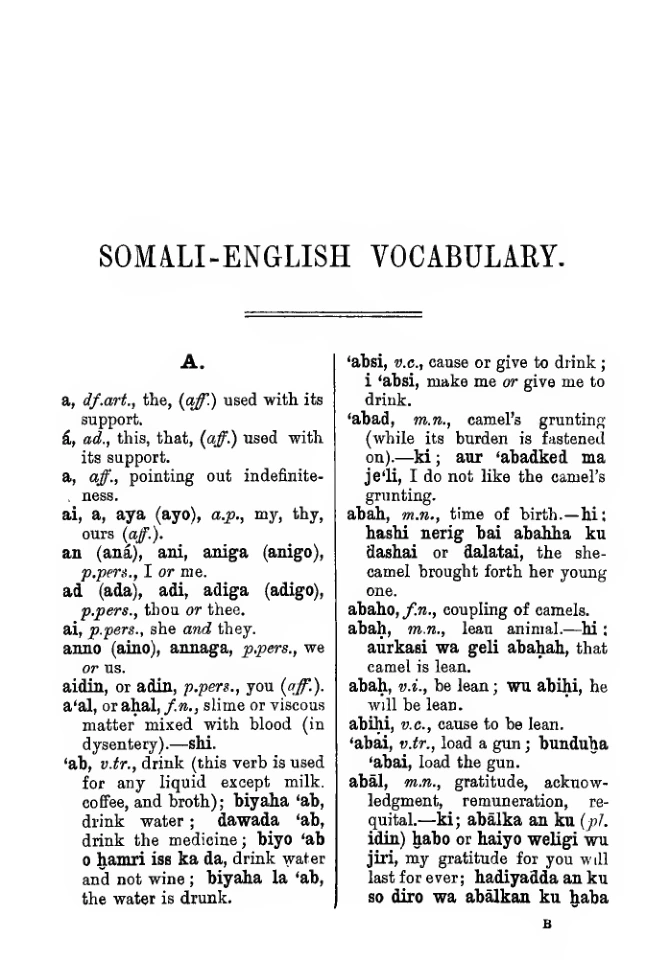
Opening vocabulary page of the 1897 Somali-English dictionary, showing Somali words and phrases alongside English glosses. The author’s historical phonetic Roman transcription predates modern standard Somali orthography.
Saved in Babelbook · resized display copy. Select the image to open it independently of its source.
Évangéliste de Larajasse (1855–1913) · Source ↗Public domain ↗View the local visual field note
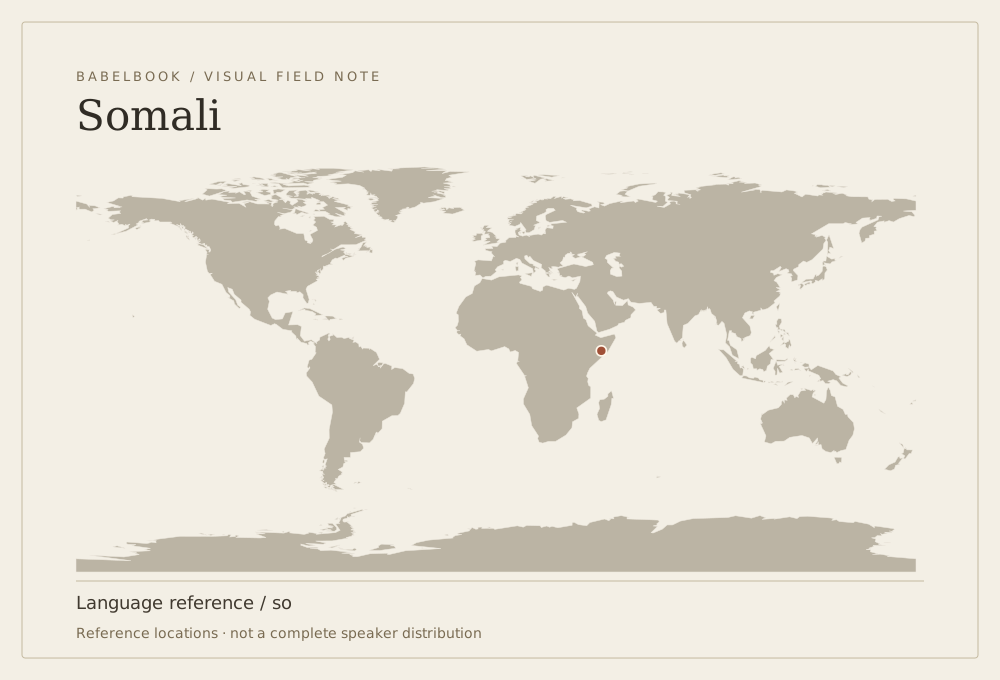
Representative reference points from Glottolog. Historical entries show reference locations, not current speakers. 1 point.
Reference & context ↗Babelbook · original editorial illustration · CC BY 4.0 · Glottolog locations; public-domain Natural Earth land
Source excerpts, selected, shortened and where noted editorially corrected from Somali language by Wikipedia contributors. Retrieved 2026-10-05. CC BY-SA 4.0. These excerpts are not an independently verified scholarly history; missing accounts are identified above.
Read further in the source
Geographic distribution of Somali
The Somali language is spoken in Somali inhabited areas of Somalia, Djibouti, Ethiopia, Kenya, Yemen and by members of the Somali diaspora. It is also spoken as an adoptive language by a few ethnic minority groups and individuals in Somali majority regions. Somali is the most widely spoken Cushitic language in the region followed by Oromo and Afar. As of 2021, there are approximately 24 million speakers of Somali, spread in Greater Somalia of which around 17 million reside in Somalia. The language is spoken by an estimated 95% of the country's inhabitants, and also by a majority of the population in Djibouti. Following the start of the Somali Civil War in the early 1990s, the Somali-speaking diaspora increased in size, with newer Somali speech communities forming in parts of the Middle East, North America and Europe.
Official status
Constitutionally, Somali and Arabic are the two official languages of Somalia. Somali has been an official national language since January 1973, when the Supreme Revolutionary Council (SRC) declared it the Somali Democratic Republic's primary language of administration and education. Somali was thereafter established as the main language of academic instruction in forms 1 through 4, following preparatory work by the government-appointed Somali Language Committee. It later expanded to include all 12 forms in 1979. In 1972, the SRC adopted a Latin orthography as the official national alphabet over several other writing scripts that were then in use. Concurrently, the Italian-language daily newspaper Stella d'Ottobre ("The October Star") was nationalized, renamed to Xiddigta Oktoobar, and began publishing in Somali. The state-run Radio Mogadishu has also broadcast in Somali since 1951. Additionally, other regional public networks like Somaliland National TV and Puntland TV and Radio and, as well as Eastern Television Network and Horn Cable Television, among other private broadcasters, air programs in Somali. Somali is recognized as an official working language in the Somali Region of Ethiopia. Although it is not an official language of Djibouti, it constitutes a major national language there. Somali is used in television and radio broadcasts, with the government-operated Radio Djibouti transmitting programs in the language from 1943 onwards. The Kenya Broadcasting Corporation also broadcasts in the Somali language in its Iftin FM Programmes. The language is spoken in the Somali territories within North Eastern Kenya, namely Wajir County, Garissa County and Mandera County. The Somali language is regulated by the Regional Somali Language Academy, an intergovernmental institution established in June 2013 in Djibouti City by the governments of Djibouti, Somalia and Ethiopia. It is officially mandated with preserving the Somali language. As of 2025, Somali, Afar and Oromo are the only 3 Cushitic languages available on Google Translate.
Writing system
Archaeological excavations and research in Somalia uncovered ancient inscriptions in a distinct writing system. In an 1878 report to the Royal Geographical Society of Great Britain, the scientist Johann Maria Hildebrandt noted upon visiting the area that "we know from ancient authors that these districts, at present so desert, were formerly populous and civilised[...] I also discovered ancient ruins and rock-inscriptions both in pictures and characters[...] These have hitherto not been deciphered." According to the 1974 report for Ministry of Information and National Guidance, this script represents the earliest written attestation of Somali. Much more recently, the Somali archaeologist Sada Mire has published ancient inscriptions found throughout Somalia. As for much of Somali linguistic history the language was not widely used for literature, Mire's publications however prove that writing as a technology was not foreign nor scarce in the region. These pieces of writing are from the Semitic Himyarite and Sabaean languages that were largely spoken in what is modern day Yemen —"there is an extensive and ancient relationship between the people and cultures of both sides of the Red Sea coast" Mire posits. Yet, while many more such ancient inscriptions are yet to be found or analyzed, many have been "bulldozed by developers, as the Ministry of Tourism could not buy the land or stop the destruction". Besides Ahmed's Latin script, other orthographies that have been used for centuries for writing Somali include the long-established Arabic script and Wadaad's writing. According to Bogumił Andrzejewski, this usage was limited to Somali clerics and their associates, as sheikhs preferred to write in liturgical Arabic Various such historical manuscripts in Somali nonetheless exist, which mainly consist of Islamic poems (qasidas), recitations and chants. Among these texts are the Somali poems by Sheikh Uways and Sheikh Ismaaciil Faarah. The rest of the existing historical literature in Somali principally consists of translations of documents from Arabic. Since then a number of writing systems have been used for transcribing Somali. Of these, the Somali Latin alphabet, officially adopted in 1972, is the most widely used and recognised as official orthography of the state. The script was developed by a number of leading scholars of Somali, including Musa Haji Ismail Galal, B. W. Andrzejewski and Shire Jama Ahmed specifically for transcribing Somali, and uses all letters of the English Latin alphabet except p, v and z. There are no diacritics or other special characters except the use of the apostrophe for the glottal stop, which does not occur word-initially. There are three consonant digraphs: DH, KH and SH. Tone is not marked, and tense and lax vowels (which may really be a tongue root distinction) are not distinguished. Writing systems developed in the twentieth century include the Osmanya, Borama, and Kaddare alphabets, which were invented by Osman Yusuf Kenadid, Abdurahman Sheikh Nuur, and Hussein Sheikh Ahmed Kaddare, respectively.