Albanian
Albanian (endonym: shqip [ʃcip] , gjuha shqipe [ˈɟuha ˈʃcipɛ] , or arbërisht [aɾbəˈɾiʃt]) is an Indo-European language and the only surviving representative of the Albanic branch, which belongs to the Paleo-Balkan group. It is the native language of the Albanian people. Standard Albanian is the official language of Albania and Kosovo, and a co-official language in North Macedonia and Montenegro, where it is the primary language of significant Albanian minority communities. Albanian is recognized as a minority language in Italy, Croatia, Romania, and Serbia. It is also spoken by long-established communities in Greece, and by the Albanian diaspora, which is generally concentrated in the Americas, Europe, and Oceania. Albanian is estimated to have as many as 7.5 million native speakers. Albanian and other Paleo-Balkan languages had their formative core in the Balkans after the Indo-European migrations in the region. Albanian in antiquity is often thought to have been an Illyrian language for obvious geographic and historical reasons, or otherwise an unmentioned Balkan Indo-European language that was closely related to Illyrian and Messapic. The Indo-European subfamily that gave rise to Albanian is called Albanoid in reference to a specific ethnolinguistically pertinent and historically compact language group.
Translate in Albanian ↗The language is spoken by approximately 6 million people in the Balkans, primarily in Albania, Kosovo, North Macedonia, Serbia, Montenegro and Greece. However, due to old communities in Italy (originating from Skanderbeg's times) and the large Albanian diaspora, the worldwide total of speakers is much higher than in Southern Europe and numbers approximately 7.5 million. The following table provides data on the number of native Albanian speakers by country, according to the most recent publicly available sources. The number of speakers is presented as an absolute value for the total population, obtained by projecting the valid answers to the total population (thus not taking into account unanswered questionnaires, missing data or excluded age ranges).
Europe
Present-day use
The captured source does not contain a separate current-use account.
Origins
The captured article does not contain a separate origins section. See the historical account and linked source.
Development
The captured article does not contain a distinct historical account. No chronology has been invented.
Writing
The Albanian language has been written using many alphabets since the earliest records from the 15th century. The history of Albanian language orthography is closely related to the cultural orientation and knowledge of certain foreign languages among Albanian writers. The earliest written Albanian records come from the Gheg area in makeshift spellings based on Italian or Greek. Originally, the Tosk dialect was written in the Greek alphabet and the Gheg dialect was written in the Latin script. Both dialects had also been written in the Ottoman Turkish version of the Arabic script, Cyrillic, and some local alphabets (Elbasan, Vithkuqi, Todhri, Veso Bey, Jan Vellara and others, see original Albanian alphabets). More specifically, the writers from northern Albania and under the influence of the Catholic Church used Latin letters, those in southern Albania and under the influence of the Greek Orthodox church used Greek letters, while others throughout Albania and under the influence of Islam used Arabic letters. There were initial attempts to create an original Albanian alphabet during the 1750–1850 period. These attempts intensified after the League of Prizren and culminated with the Congress of Manastir held by Albanian intellectuals from 14 to 22 November 1908, in Manastir (present day Bitola), which decided on which alphabet to use, and what the standardised spelling would be for standard Albanian. This is how the literary language remains. The alphabet is the Latin alphabet with the addition of the letters ⟨ë⟩, ⟨ç⟩, and nine digraphs: dh, gj, ll, nj, rr, sh, th, xh and zh. According to Robert Elsie: The hundred years between 1750 and 1850 were an age of astounding orthographic diversity in Albania. In this period, the Albanian language was put to writing in at least ten different alphabets – most certainly a record for European languages. ...
Beyond the typeface.
Signs, manuscripts, published pages and contextual photographs, with their place, period, source and reuse terms. Captions identify historical spellings, regional examples, community references and character imagery.
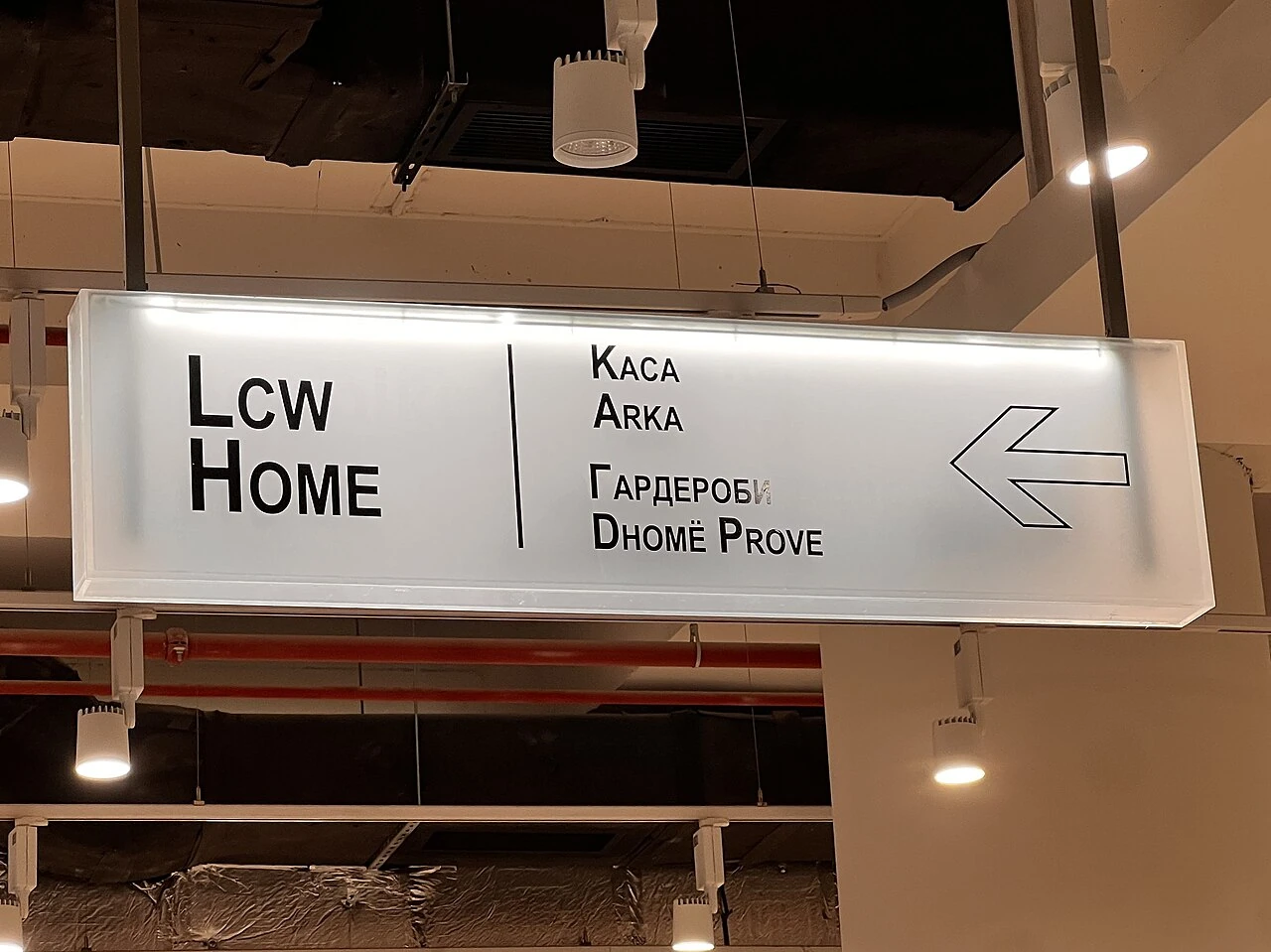
Bilingual Macedonian–Albanian sign in the LC Waikiki clothing shop at Diamond Mall, Skopje, photographed in August 2026. Language identification follows Commons descriptions or categories; not independently transcribed.
Saved in Babelbook · resized display copy. Select the image to open it independently of its source.
Bdx · Source ↗CC0 1.0 ↗View the local visual field note
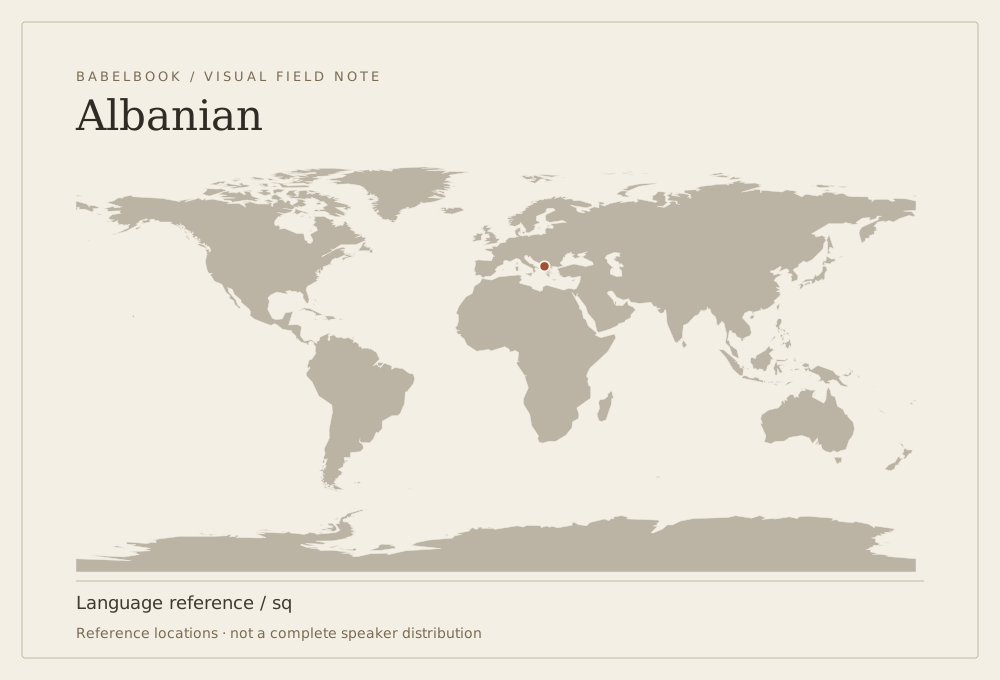
Representative reference points from Glottolog. Historical entries show reference locations, not current speakers. 1 point.
Reference & context ↗Babelbook · original editorial illustration · CC BY 4.0 · Glottolog locations; public-domain Natural Earth land
Source excerpts, selected, shortened and where noted editorially corrected from Albanian language by Wikipedia contributors. Retrieved 2026-10-05. CC BY-SA 4.0. These excerpts are not an independently verified scholarly history; missing accounts are identified above.
Read further in the source
Geographic distribution
The language is spoken by approximately 6 million people in the Balkans, primarily in Albania, Kosovo, North Macedonia, Serbia, Montenegro and Greece. However, due to old communities in Italy (originating from Skanderbeg's times) and the large Albanian diaspora, the worldwide total of speakers is much higher than in Southern Europe and numbers approximately 7.5 million.
Number of native speakers
The following table provides data on the number of native Albanian speakers by country, according to the most recent publicly available sources. The number of speakers is presented as an absolute value for the total population, obtained by projecting the valid answers to the total population (thus not taking into account unanswered questionnaires, missing data or excluded age ranges).
Dialects
The Albanian language has two distinct dialects, Tosk which is spoken in the south, and Gheg spoken in the north. Standard Albanian is based on the Tosk dialect. The Shkumbin River is the rough dividing line between the two dialects. Gheg is divided into four sub-dialects: Northwest Gheg, Northeast Gheg, Central Gheg and Southern Gheg. It is primarily spoken in northern Albania, Kosovo, and throughout Montenegro and northwestern North Macedonia. One fairly divergent dialect is the Upper Reka dialect, which is however classified as Central Gheg. There is also a diaspora dialect in Croatia, the Arbanasi dialect. Tosk is divided into five sub-dialects, including Northern Tosk (the most numerous in speakers), Labërisht, Cham, Arvanitika, and Arbëresh. Tosk is spoken in southern Albania, southwestern North Macedonia and northern and southern Greece. Cham Albanian is spoken in North-western Greece, while Arvanitika is spoken by the Arvanites in southern Greece. In addition, Arbëresh is spoken by the Arbëreshë people, descendants of 15th and 16th century migrants who settled in southeastern Italy, in small communities in the regions of Sicily and Calabria. These settlements originated from the (Arvanites) communities probably of Peloponnese known as Morea in the Middle Ages. Among them the Arvanites call themselves Arbëror and sometime Arbëresh. The Arbëresh dialect is closely related to the Arvanites dialect with more Italian vocabulary absorbed during different periods of time.
Orthography
The Albanian language has been written using many alphabets since the earliest records from the 15th century. The history of Albanian language orthography is closely related to the cultural orientation and knowledge of certain foreign languages among Albanian writers. The earliest written Albanian records come from the Gheg area in makeshift spellings based on Italian or Greek. Originally, the Tosk dialect was written in the Greek alphabet and the Gheg dialect was written in the Latin script. Both dialects had also been written in the Ottoman Turkish version of the Arabic script, Cyrillic, and some local alphabets (Elbasan, Vithkuqi, Todhri, Veso Bey, Jan Vellara and others, see original Albanian alphabets). More specifically, the writers from northern Albania and under the influence of the Catholic Church used Latin letters, those in southern Albania and under the influence of the Greek Orthodox church used Greek letters, while others throughout Albania and under the influence of Islam used Arabic letters. There were initial attempts to create an original Albanian alphabet during the 1750–1850 period. These attempts intensified after the League of Prizren and culminated with the Congress of Manastir held by Albanian intellectuals from 14 to 22 November 1908, in Manastir (present day Bitola), which decided on which alphabet to use, and what the standardised spelling would be for standard Albanian. This is how the literary language remains. The alphabet is the Latin alphabet with the addition of the letters ⟨ë⟩, ⟨ç⟩, and nine digraphs: dh, gj, ll, nj, rr, sh, th, xh and zh. According to Robert Elsie:
The hundred years between 1750 and 1850 were an age of astounding orthographic diversity in Albania. In this period, the Albanian language was put to writing in at least ten different alphabets – most certainly a record for European languages. ... the diverse forms in which this old Balkan language was recorded, from the earliest documents to the beginning of the twentieth century ... consist of adaptations of the Latin, Greek, Arabic, and Cyrillic alphabets and (what is even more interesting) a number of locally invented writing systems. Most of the latter alphabets have now been forgotten and are unknown, even to the Albanians themselves.
Standard Albanian
Since World War II, standard Albanian used in Albania has been based on the Tosk dialect. Kosovo and other areas where Albanian is official adopted the Tosk standard in 1969.
Elbasan-based standard
Until the early 20th century, Albanian writing developed in three main literary traditions: Gheg, Tosk, and Arbëreshë. Throughout this time, a Gheg subdialect spoken around Elbasan served as lingua franca among the Albanians, but was less prevalent in writing. The Congress of Manastir of Albanian writers held in 1908 recommended the use of the Elbasan subdialect for literary purposes and as a basis of a unified national language. While technically classified as a southern Gheg variety, the Elbasan speech is closer to Tosk in phonology and practically a hybrid between other Gheg subdialects and literary Tosk. Between 1916 and 1918, the Albanian Literary Commission met in Shkodër under the leadership of Luigj Gurakuqi with the purpose of establishing a unified orthography for the language. The commission, made up of representatives from the north and south of Albania, reaffirmed the Elbasan subdialect as the basis of a national tongue. The rules published in 1917 defined spelling for the Elbasan variety for official purposes. The commission did not, however, discourage publications in one of the dialects, but rather laid a foundation for Gheg and Tosk to gradually converge into one. When the Congress of Lushnje met in the aftermath of World War I to form a new Albanian government, the 1917 decisions of the Literary Commission were upheld. The Elbasan subdialect remained in use for administrative purposes and many new writers embraced it for creative writing. Gheg and Tosk continued to develop freely and interaction between the two dialects increased.
Tosk standard
At the end of World War II, however, the new communist regime radically imposed the use of the Tosk dialect in all facets of life in Albania: administration, education, and literature. Most Communist leaders were Tosks from the south. Standardisation was directed by the Albanian Institute of Linguistics and Literature of the Academy of Sciences of Albania. Two dictionaries were published in 1954: an Albanian language dictionary and a Russian–Albanian dictionary. New orthography rules were eventually published in 1967 and in 1973 with the Drejtshkrimi i gjuhës shqipe (Orthography of the Albanian Language). Until 1968, Kosovo and other Albanian-speaking areas in Yugoslavia followed the 1917 standard based on the Elbasan dialect, though it was gradually infused with Gheg elements in an effort to develop a Kosovan language separate from communist Albania's Tosk-based standard. Albanian intellectuals in the former Yugoslavia consolidated the 1917 standard twice in the 1950s, culminating with a thorough codification of orthographic rules in 1964. The rules already provided for a balanced variety that accounted for both Gheg and Tosk dialects, but only lasted through 1968. Viewing divergences with Albania as a threat to their identity, Kosovars arbitrarily adopted the Tosk project that Tirana had published the year before. Although it was never intended to serve outside of Albania, the project became the "unified literary language" in 1972, when approved by a rubberstamp Orthography Congress. Only about 1 in 9 participants were from Kosovo. The Congress, held at Tirana, authorized the orthography rules that came out the following year, in 1973. More recent dictionaries from the Albanian government are Fjalori Drejtshkrimor i Gjuhës Shqipe (1976) (Orthographic Dictionary of the Albanian Language) and Dictionary of Today's Albanian language (Fjalori i Gjuhës së Sotme Shqipe) (1980). Prior to World War II, dictionaries consulted by developers of the standard have included Lexikon tis Alvanikis glossis (Albanian: Fjalori i Gjuhës Shqipe (Kostandin Kristoforidhi, 1904), Fjalori i Bashkimit (1908), and Fjalori i Gazullit (1941).