Serbian
Serbian is the standard variety of the Serbo-Croatian language mainly used by Serbs. It is the national official language and literary standard of Serbia, one of the official languages in Bosnia-Herzegovina and Kosovo, and a recognized minority language in numerous countries. Serbian is based on the most widespread supradialect of Serbo-Croatian, Shtokavian (more specifically on the dialects of Šumadija-Vojvodina and Eastern Herzegovina), which is also the basis of other Serbo-Croatian standard varieties: Croatian, Bosnian, and Montenegrin. Serbian is a rare example of synchronic digraphia, using both Cyrillic and Latin scripts.
Translate in Serbian ↗The Serbian language holds status of official or recognized minority language in ten countries, where over 7 million people have declared it as their mother tongue. It serves as the official language of Serbia, where it is the native tongue of 84% of the population. Serbian is a co-official language in Bosnia-Herzegovina and Kosovo, where it is spoken almost exclusively by the ethnic Serb population, representing roughly one-third and 5% of the total population in each entity, respectively. In Montenegro, Serbian remains the most widely spoken language, with 43% of the population declaring it as their mother tongue, despite its legal status as a recognized minority language; it is declared mother tongue not only by ethnic Serbs but also by approximately one-quarter of those identifying as Montenegrins. Furthermore, Serbian enjoys recognized minority language status in Croatia, North Macedonia, Romania, Hungary, the Czech Republic, and Slovakia. The language is also represented among the Serb diaspora in Europe and overseas. Countries with significant numbers of speakers include Germany, Austria, United States, France, Switzerland, Canada, Australia, and Sweden.
Europe
Present-day use
During the 16th and 17th centuries, Serbian Church Slavic language continued to be used as the liturgical and literary language within the Serbian Patriarchate of Peć, and those traditions continued up to the beginning of the 18th century. In works of the early modern Serbian printing, from the end of the 15th century to the middle of the 17th century, liturgical contents were printed in Serbian Church Slavic, while colophons with introductions were composed under the influence of Serbian vernacular language, that was commonly used both in official and private epistolography. During the 18th century, among Eastern Orthodox Serbs in the Habsburg Monarchy, various influences from the earlier Russian ecclesiastical and literary reforms (known as the Nikon's reforms) were accepted within the Serbian Orthodox Metropolitanate of Karlovci, thus leading to several major changes: Serbian redaction of the Church Slavic was gradually replaced in liturgical use by the official (synodical, or neo-Moscowian) Russian Church Slavonic redaction, and those changes also influenced the Serbian literary language, making it more distinctive from the common Serbian vernacular language. The use of Russian-Slavonic language among Serbs consequently led to the creation of a specific Slavonic-Serbian language (also known as Slavo-Serbian, a hybrid language that was used during the second half of the 18th century and the first half of the 19th century by Serbian educated elites. In the early 19th century, Vuk Karadžić reformed the Serbian literary language by basing it on the vernacular folk speech, adopting the principle 'Write as you speak.' He also standardized the Serbian Cyrillic alphabet by following strict phonemic principles on the Johann Christoph Adelung's model and Jan Hus's Czech alphabet. Karadžić's reforms of the Serbian literary language modernized it and distanced it from the Slavonic-Serbian and Church Slavonic, bringing it closer to common folk speech.
Origins
The captured article does not contain a separate origins section. See the historical account and linked source.
Development
The history of the Serbian language traces its origins through successive stages of differentiation within the South Slavic subgroup of Slavic languages. This process intensified after the Slavic migrations of the 6th and 7th centuries, leading to the emergence of Serbian alongside other South Slavic languages. As the ancestor of all Slavic languages, the Proto-Slavic language emerged between approximately 1500 and 1000 BC in the southern portion of the Proto-Balto-Slavic linguistic area. Linguistic evidence, such as the consistent preservation of vocabulary related to local hydrology, flora, and fauna across modern Slavic languages, supports this location, roughly corresponding to areas of eastern Poland, southern Belarus, and northwestern Ukraine during classical antiquity (encompassing the Vistula, Bug, Dnieper, and Pripyat river basins). The language reached its peak in the 5th and 6th centuries, expanding rapidly westward, southward, eastward, and northward during Slavic migrations. Dialectal differentiation began during this period, though mutual intelligibility persisted; by the 8th century, a largely uniform Proto-Slavic was spoken from Thessaloniki in the south to Veliky Novgorod in the north. The final pan-dialectal changes occurred in the 9th century, after which individual Slavic languages gradually emerged. A degree of general Slavic mutual intelligibility continued for several centuries, as evidenced by the missionary work of Cyril and Methodius, who used a South Slavic dialect from the Thessaloniki region to evangelize Slavs in Great Moravia.
Writing
Serbian language uses both Cyrillic (ћирилица, ćirilica) and Latin script (латиница, latinica). Serbian is a rare language with active digraphia, a situation where all literate members of a society have two interchangeable writing systems available to them. Serbian Cyrillic, widely regarded as a key symbol of Serb cultural identity, was devised in 1819 by Serbian linguist Vuk Karadžić, who designed it according to strict phonemic principles (one letter per sound). The Latin alphabet used for Serbian was designed by the Croatian linguist Ljudevit Gaj in the 1830s based on the Czech system with a one-to-one grapheme-phoneme correlation between the Cyrillic and Latin orthographies, resulting in a parallel orthographic system. In Serbia, the Constitution designates Serbian Cyrillic as the official script, mandating its application in the legal and administrative domains. However, the law does not regulate scripts in standard language, or standard language itself by any means, leaving the choice of script as a matter of personal preference and to the free will in all aspects of life (publishing, media, trade and commerce, etc.), except in the legal and government sphere, where Cyrillic is required. In general, the alphabets are used interchangeably; media and publishers typically select one alphabet or the other. In the public sphere, with logos, outdoor signage and retail packaging, the Latin script predominates, although both scripts are commonly seen. Traffic signs and directional signs, as well as place names on roads are written with both Cyrillic and Latin script. To most Serbs, the Latin script tends to imply a cosmopolitan or neutral attitude, while Cyrillic appeals to a more traditional or vintage sensibility.
Beyond the typeface.
Signs, manuscripts, published pages and contextual photographs, with their place, period, source and reuse terms. Captions identify historical spellings, regional examples, community references and character imagery.
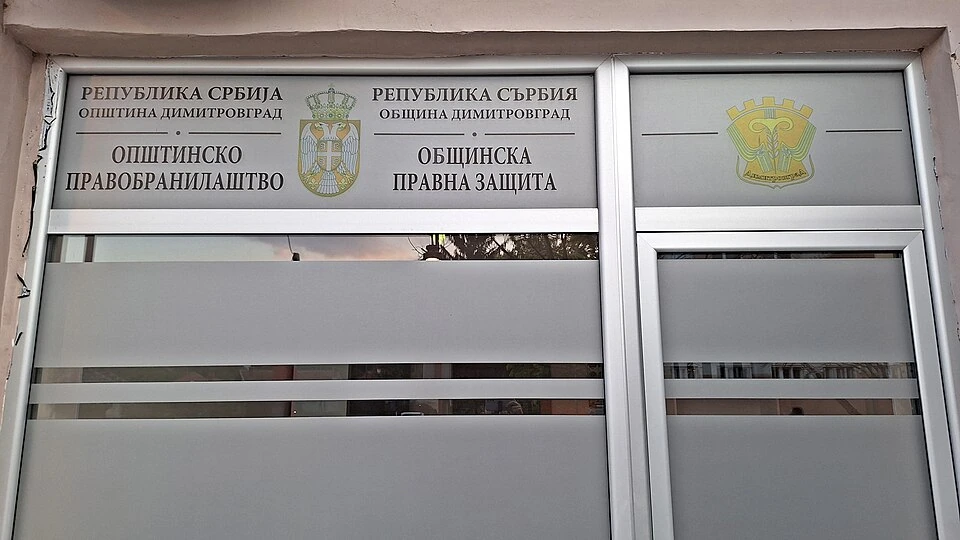
Serbian and Bulgarian sign on a municipal building in Dimitrovgrad. Language identification follows the source description; not independently transcribed.
Saved in Babelbook · resized display copy. Select the image to open it independently of its source.
Apokar · Source ↗CC BY-SA 4.0 ↗View the local visual field note
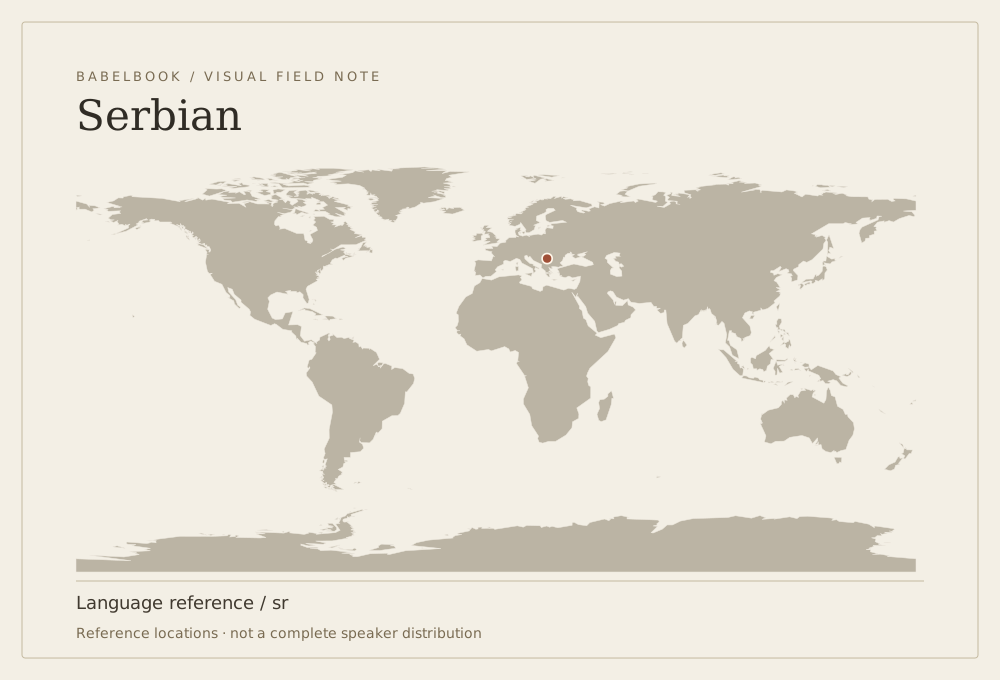
Representative reference points from Glottolog. Historical entries show reference locations, not current speakers. 1 point.
Reference & context ↗Babelbook · original editorial illustration · CC BY 4.0 · Glottolog locations; public-domain Natural Earth land
Source excerpts, selected, shortened and where noted editorially corrected from Serbian language by Wikipedia contributors. Retrieved 2026-10-05. CC BY-SA 4.0. These excerpts are not an independently verified scholarly history; missing accounts are identified above.
Read further in the source
History
The history of the Serbian language traces its origins through successive stages of differentiation within the South Slavic subgroup of Slavic languages. This process intensified after the Slavic migrations of the 6th and 7th centuries, leading to the emergence of Serbian alongside other South Slavic languages. As the ancestor of all Slavic languages, the Proto-Slavic language emerged between approximately 1500 and 1000 BC in the southern portion of the Proto-Balto-Slavic linguistic area. Linguistic evidence, such as the consistent preservation of vocabulary related to local hydrology, flora, and fauna across modern Slavic languages, supports this location, roughly corresponding to areas of eastern Poland, southern Belarus, and northwestern Ukraine during classical antiquity (encompassing the Vistula, Bug, Dnieper, and Pripyat river basins). The language reached its peak in the 5th and 6th centuries, expanding rapidly westward, southward, eastward, and northward during Slavic migrations. Dialectal differentiation began during this period, though mutual intelligibility persisted; by the 8th century, a largely uniform Proto-Slavic was spoken from Thessaloniki in the south to Veliky Novgorod in the north. The final pan-dialectal changes occurred in the 9th century, after which individual Slavic languages gradually emerged. A degree of general Slavic mutual intelligibility continued for several centuries, as evidenced by the missionary work of Cyril and Methodius, who used a South Slavic dialect from the Thessaloniki region to evangelize Slavs in Great Moravia. The loss of weak jers (reduced vowels ъ and ь), occurring regionally between the 10th and 12th centuries, marks the conventional end of Proto-Slavic, coinciding with the appearance of written records showing significant divergences and the development of distinct recensions. The language used in works of Cyril and Methodius, and their later followers, became known as the Old Church Slavonic (also Old Slavonic, or Old Slavic). As the earliest attested Slavic literary language, it was codified in the 9th century based on the South Slavic dialects spoken around Thessaloniki, using the Glagolitic and later Cyrillic scripts for translating biblical and liturgical texts. During the Middle Ages, it served as the primary literary and liturgical language for most Slavic peoples, influencing the development of subsequent vernacular literary traditions.
Geographic distribution
The Serbian language holds status of official or recognized minority language in ten countries, where over 7 million people have declared it as their mother tongue. It serves as the official language of Serbia, where it is the native tongue of 84% of the population. Serbian is a co-official language in Bosnia-Herzegovina and Kosovo, where it is spoken almost exclusively by the ethnic Serb population, representing roughly one-third and 5% of the total population in each entity, respectively. In Montenegro, Serbian remains the most widely spoken language, with 43% of the population declaring it as their mother tongue, despite its legal status as a recognized minority language; it is declared mother tongue not only by ethnic Serbs but also by approximately one-quarter of those identifying as Montenegrins. Furthermore, Serbian enjoys recognized minority language status in Croatia, North Macedonia, Romania, Hungary, the Czech Republic, and Slovakia. The language is also represented among the Serb diaspora in Europe and overseas. Countries with significant numbers of speakers include Germany, Austria, United States, France, Switzerland, Canada, Australia, and Sweden.
Differences from other Serbo-Croatian standard varieties
Serbian is a standard variety of Serbo-Croatian with other standard varieties being Bosnian, Croatian, and Montenegrin. These varieties are based on the same Shtokavian supradialect and are fully mutually intelligible - speakers can understand each other without difficulty, with intelligibility often exceeding that of variants in other pluricentric languages like English, German, or Spanish. The differences are minor and comparable to regional variants of English (e.g., British vs. American English) rather than separate languages like Spanish and Italian. Grammar, syntax, and core vocabulary are nearly identical.
Writing system
Serbian language uses both Cyrillic (ћирилица, ćirilica) and Latin script (латиница, latinica). Serbian is a rare language with active digraphia, a situation where all literate members of a society have two interchangeable writing systems available to them. Serbian Cyrillic, widely regarded as a key symbol of Serb cultural identity, was devised in 1819 by Serbian linguist Vuk Karadžić, who designed it according to strict phonemic principles (one letter per sound). The Latin alphabet used for Serbian was designed by the Croatian linguist Ljudevit Gaj in the 1830s based on the Czech system with a one-to-one grapheme-phoneme correlation between the Cyrillic and Latin orthographies, resulting in a parallel orthographic system. In Serbia, the Constitution designates Serbian Cyrillic as the official script, mandating its application in the legal and administrative domains. However, the law does not regulate scripts in standard language, or standard language itself by any means, leaving the choice of script as a matter of personal preference and to the free will in all aspects of life (publishing, media, trade and commerce, etc.), except in the legal and government sphere, where Cyrillic is required. In general, the alphabets are used interchangeably; media and publishers typically select one alphabet or the other. In the public sphere, with logos, outdoor signage and retail packaging, the Latin script predominates, although both scripts are commonly seen. Traffic signs and directional signs, as well as place names on roads are written with both Cyrillic and Latin script. To most Serbs, the Latin script tends to imply a cosmopolitan or neutral attitude, while Cyrillic appeals to a more traditional or vintage sensibility. According to a 2014 poll, 47% of the population uses the Latin alphabet more frequently, 36% primarily uses Cyrillic, while 16% uses both alphabets equally. Serbian Cyrillic is also script in official use in both Montenegro and Bosnia-Herzegovina, alongside the Latin alphabet.
Dialects
Serbian is based on Shtokavian, the prestige supradialect of Serbo-Croatian. The primary subdivisions of Shtokavian are based on two principles: one is the way the old Slavic phoneme yat has changed (in the case of Serbian, Ekavian or Ijekavian), second in different accents (whether the subdialect is Old-Shtokavian or Neo-Shtokavian).
in Ekavian pronunciation (ekavski [ěːkaʋskiː]), yat has conflated into the vowel e. Ekavian is dominant among speakers of Serbian in Serbia, Kosovo, North Macedonia, Romania, and Hungary. in Ijekavian pronunciation (ijekavski [ijěːkaʋskiː]), yat has come to be pronounced ije. Ijekavian is dominant among speakers of Serbian in Bosnia-Herzegovina, Montenegro, and Croatia. The dialects of Shtokavian, regarded traditionally as Serbian, include:
Šumadija–Vojvodina (Ekavian, Neo-Shtokavian): central and northern Serbia Eastern Herzegovinian (Ijekavian/Ekavian, Neo-Shtokavian): southwestern Serbia, western half of Montenegro, Bosnia-Herzegovina, Croatia Kosovo–Resava (Ekavian, Old-Shtokavian): eastern-central Serbia, northern Kosovo Smederevo–Vršac (Ekavian, Old-Shtokavian): northern-central Serbia Prizren–Timok (Ekavian, Old-Shtokavian): southeastern Serbia, eastern Kosovo Zeta–Raška (Ijekavian, Old-Shtokavian): eastern half of Montenegro, southwestern Serbia