Swati
Swazi or Swati, also known natively as siSwati, is a Bantu language of the Nguni group spoken in Eswatini (formerly Swaziland) and South Africa by the Swati people. The number of speakers is estimated to be in the region of 4.7 million including first and second language speakers. The language is taught in Eswatini and some South African schools in Mpumalanga, particularly former KaNgwane areas. Swati is an official language of Eswatini (along with English), and is also one of the twelve official languages of South Africa. The official term is "siSwati" among native speakers; in English, Zulu, Ndebele or Xhosa it may be referred to as Swazi. Swati is most closely related to the other Tekela languages, like Phuthi and Northern Transvaal (Sumayela) Ndebele, but is also very close to the Zunda languages: Zulu, Southern Ndebele, Northern Ndebele, and Xhosa.
Translate in Swati ↗Swazi or Swati, also known natively as siSwati, is a Bantu language of the Nguni group spoken in Eswatini (formerly Swaziland) and South Africa by the Swati people. The number of speakers is estimated to be in the region of 4.7 million including first and second language speakers. The language is taught in Eswatini and some South African schools in Mpumalanga, particularly former KaNgwane areas. Swati is an official language of Eswatini (along with English), and is also one of the twelve official languages of South Africa. The official term is "siSwati" among native speakers; in English, Zulu, Ndebele or Xhosa it may be referred to as Swazi. Swati is most closely related to the other Tekela languages, like Phuthi and Northern Transvaal (Sumayela) Ndebele, but is also very close to the Zunda languages: Zulu, Southern Ndebele, Northern Ndebele, and Xhosa.
Sub-Saharan Africa
Present-day use
The captured source does not contain a separate current-use account.
Origins
The captured article does not contain a separate origins section. See the historical account and linked source.
Development
The captured article does not contain a distinct historical account. No chronology has been invented.
Writing
Latin or customary script (catalog classification; see the source for context).
Beyond the typeface.
Signs, manuscripts, published pages and contextual photographs, with their place, period, source and reuse terms. Captions identify historical spellings, regional examples, community references and character imagery.
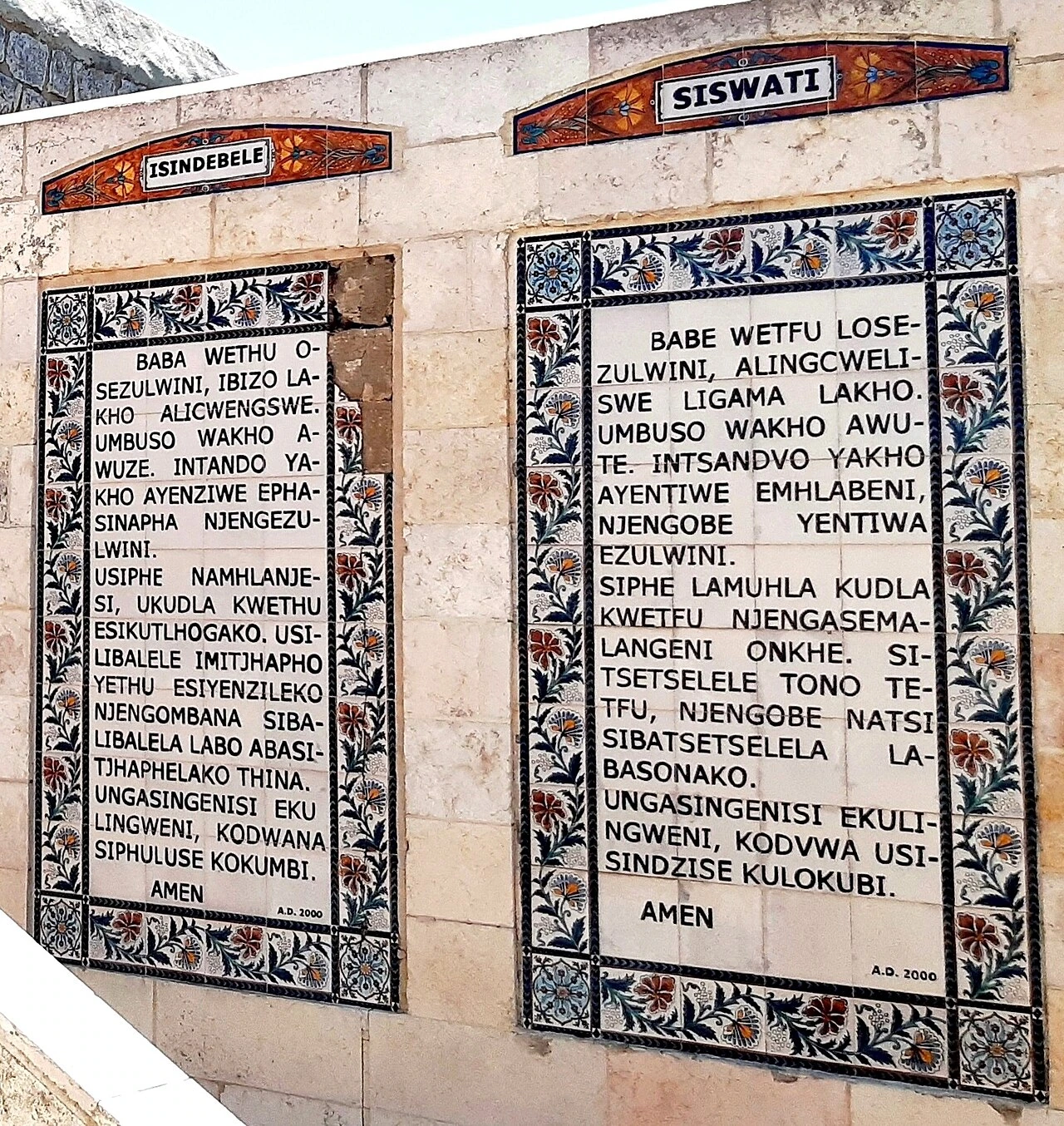
Prayer tablets at the Pater Noster church in Jerusalem, photographed on 1 August 2024. Commons explicitly identifies Southern Ndebele and Swati in this pair. This is religious writing displayed outside Africa; not independently transcribed.
Saved in Babelbook · resized display copy. Select the image to open it independently of its source.
Zeller Zalmanson Pikiwiki Israel · Source ↗CC BY 2.5 ↗View the local visual field note
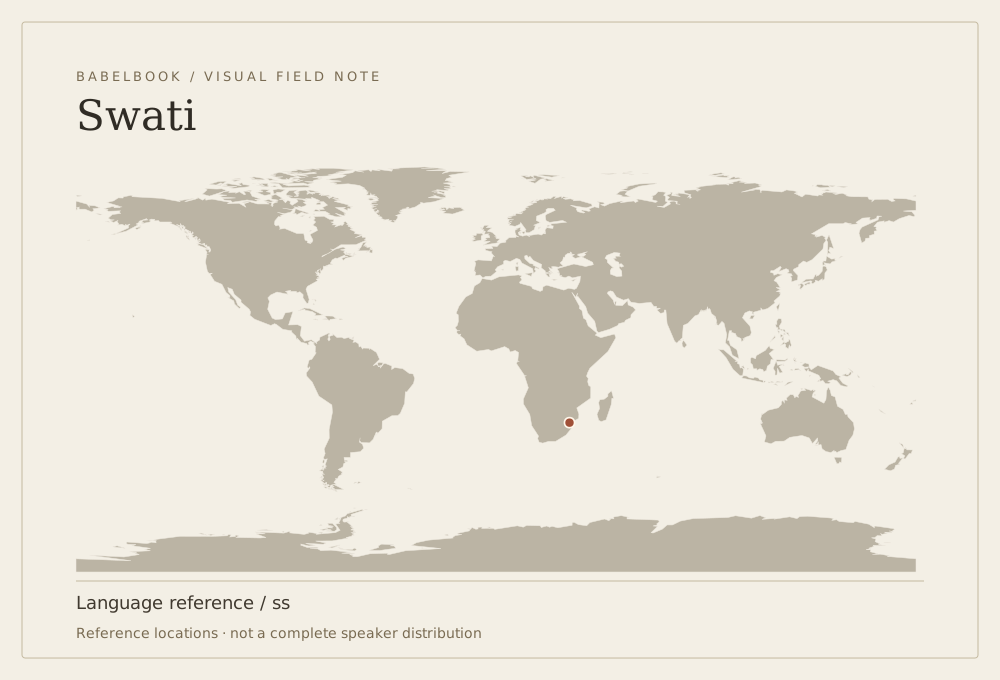
Representative reference points from Glottolog. Historical entries show reference locations, not current speakers. 1 point.
Reference & context ↗Babelbook · original editorial illustration · CC BY 4.0 · Glottolog locations; public-domain Natural Earth land
Source excerpts, selected, shortened and where noted editorially corrected from Swazi language by Wikipedia contributors. Retrieved 2026-10-05. CC BY-SA 4.0. These excerpts are not an independently verified scholarly history; missing accounts are identified above.
Read further in the source
Dialects
The Swati spoken in Eswatini can be divided into four dialects corresponding to the four administrative regions of the country: Hhohho, Lubombo, Manzini, and Shiselweni. Swati has at least two varieties: the standard, prestige variety spoken mainly in the north, centre and southwest of the country, and a less prestigious variety spoken elsewhere. In the far south, especially in towns such as Nhlangano and Hlatikhulu, the variety of the language spoken is significantly influenced by Zulu. Many Swazis (plural emaSwati, singular liSwati), including those in the south who speak this variety, do not regard it as 'proper' Swati. This is what may be referred to as the second dialect in the country. The sizeable number of Swati speakers in South Africa (mainly in the Mpumalanga province, and in Soweto) are considered by Eswatini Swati speakers to speak a non-standard form of the language. Unlike the variant in the south of Eswatini, the Mpumalanga variety appears to be less influenced by Zulu, and is thus considered closer to standard Swati. However, this Mpumalanga variety is distinguishable by distinct intonation, and perhaps distinct tone patterns. Intonation patterns (and informal perceptions of 'stress') in Mpumalanga Swazi are often considered discordant to the Swazi ear. This South African variety of Swati is considered to exhibit influence from other South African languages spoken close to Swati. A feature of the standard prestige variety of Swati (spoken in the north and centre of Eswatini) is the royal style of slow, heavily stressed enunciation, which is anecdotally claimed to have a 'mellifluous' feel to its hearers.