Southern Sotho
Sotho (), also known as Sesotho (), Southern Sotho, or Sesotho sa Borwa, is a Southern Bantu language spoken in Lesotho, as its national language, and South Africa, where it is an official language. Like all Bantu languages, Sesotho is an agglutinative language, using numerous affixes and derivational and inflexional rules to build complete words.
Translate in Southern Sotho ↗According to the South African National Census of 2011, there were almost four million first language Sesotho speakers recorded in South Africa – approximately eight per cent of the population. Most Sesotho speakers in South Africa reside in Free State and Gauteng. Sesotho is also the main language spoken by the people of Lesotho, where, according to 1993 data, it was spoken by about 1,493,000 people, or 85% of the population. The census fails to record other South Africans for whom Sesotho is a second or third language. Such speakers are found in all major residential areas of Metropolitan Municipalities – such as Johannesburg, and the Vaal Triangle – where multilingualism and polylectalism are very high. Sesotho is one of the twelve official languages of South Africa, one of the two official languages of Lesotho and one of the sixteen official languages of Zimbabwe.
Sub-Saharan Africa
Present-day use
Sesotho is one of the twelve official languages of South Africa, one of the two official languages of Lesotho and one of the sixteen official languages of Zimbabwe.
Origins
The captured article does not contain a separate origins section. See the historical account and linked source.
Development
The captured article does not contain a distinct historical account. No chronology has been invented.
Writing
Latin or customary script (catalog classification; see the source for context).
Beyond the typeface.
Signs, manuscripts, published pages and contextual photographs, with their place, period, source and reuse terms. Captions identify historical spellings, regional examples, community references and character imagery.
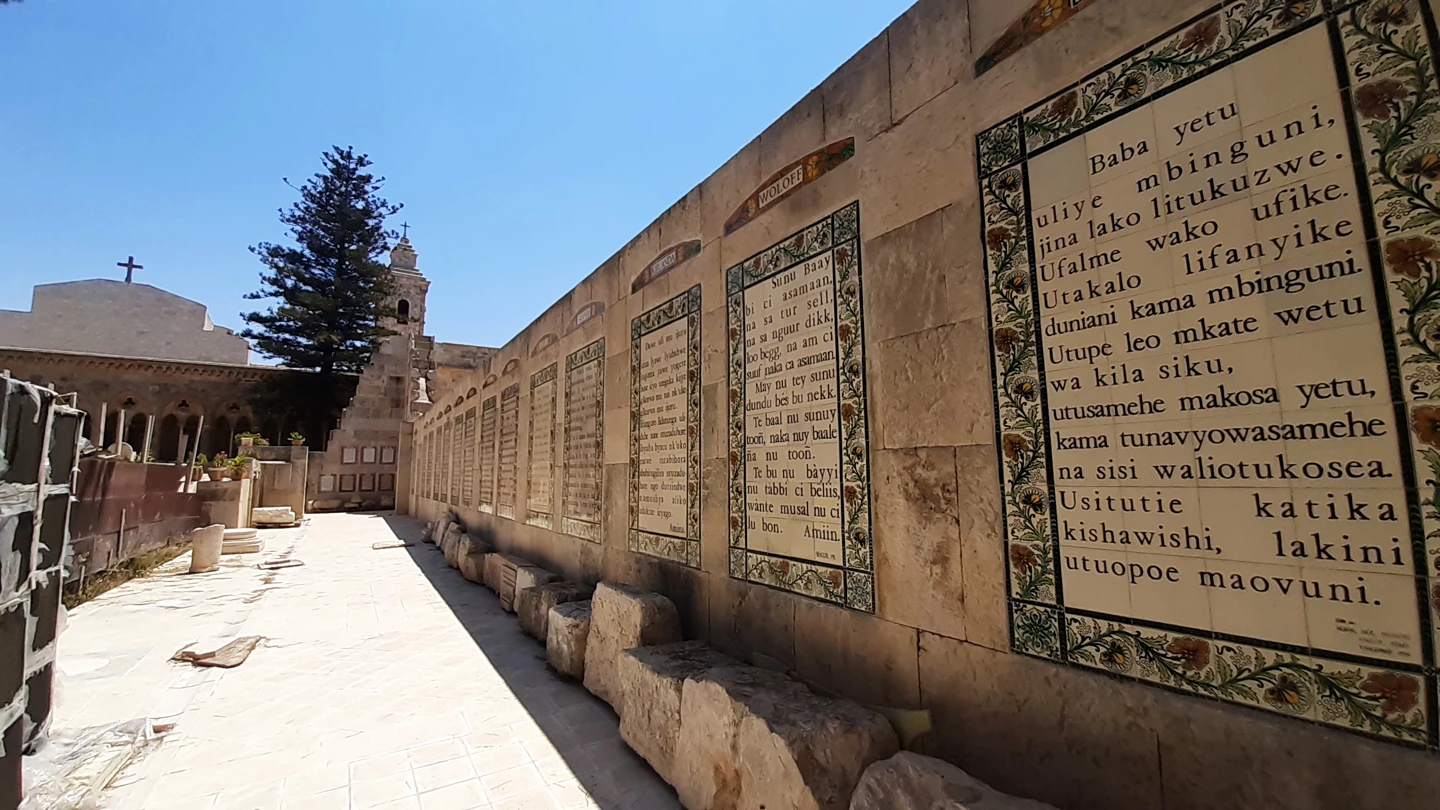
Prayer tablets at the Pater Noster church in Jerusalem, photographed on 1 August 2024. Commons explicitly classifies the photograph under Wolof, Sotho and Swahili signs. Multiple language panels share this image; not independently transcribed.
Saved in Babelbook · resized display copy. Select the image to open it independently of its source.
Zeller Zalmanson Pikiwiki Israel · Source ↗CC BY 2.5 ↗View the local visual field note
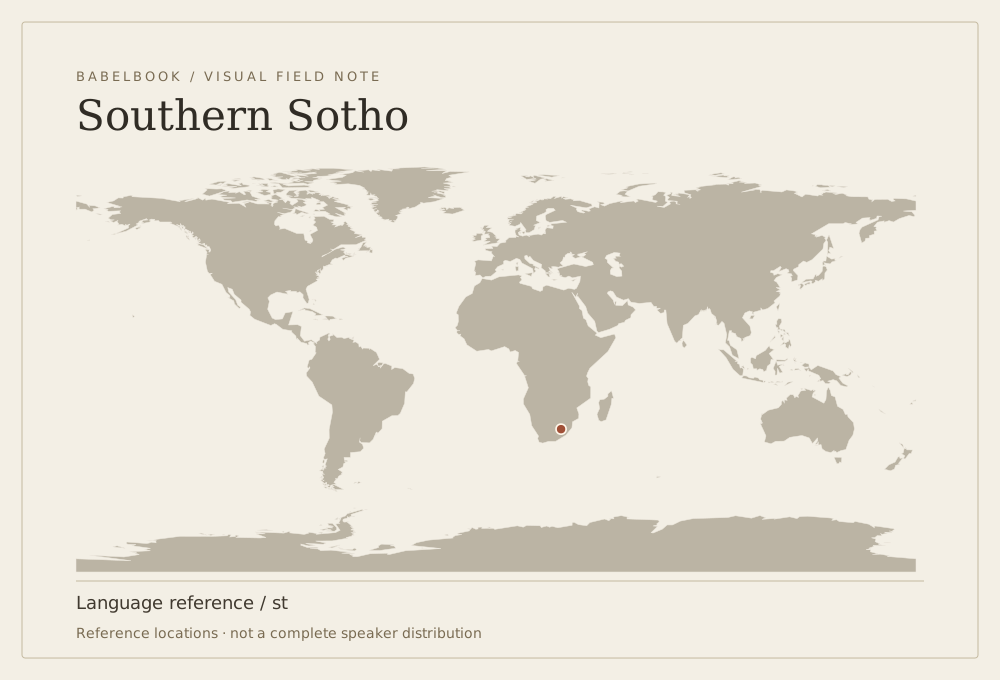
Representative reference points from Glottolog. Historical entries show reference locations, not current speakers. 1 point.
Reference & context ↗Babelbook · original editorial illustration · CC BY 4.0 · Glottolog locations; public-domain Natural Earth land
Source excerpts, selected, shortened and where noted editorially corrected from Sotho language by Wikipedia contributors. Retrieved 2026-10-05. CC BY-SA 4.0. These excerpts are not an independently verified scholarly history; missing accounts are identified above.
Read further in the source
Dialects
Except for faint lexical variation within Lesotho, and for marked lexical variation between the Lesotho/Free State variety and that of the large urban townships to the north (such as Soweto) due to heavy borrowing from neighbouring languages, there is no discernible dialect variation in this language. However, one point that seems to often confuse authors who attempt to study the dialectology of Sesotho is the term Basotho, which can variously mean "Sotho–Tswana speakers", "Southern Sotho and Northern Sotho speakers", "Sesotho speakers", and "residents of Lesotho." The Nguni language Phuthi has been heavily influenced by Sesotho; its speakers have mixed Nguni and Sotho–Tswana ancestry. It seems that it is sometimes treated erroneously as a dialect of Sesotho called "Sephuthi." However, Phuthi is mutually unintelligible with standard Sesotho and thus cannot in any sense be termed a dialect of it. Additionally, being derived from a language or dialect very closely related to modern Sesotho, the Zambian Sotho–Tswana language Lozi is also sometimes cited as a modern dialect of Sesotho named Serotse or Sekololo. The oral history of the Basotho and Northern Sotho peoples (as contained in their liboko) states that 'Mathulare, a daughter of the chief of the Bafokeng nation (an old and respected people), was married to chief Tabane of the (Southern) Bakgatla (a branch of the Bahurutse, who are one of the most ancient of the Sotho–Tswana tribes), and bore the founders of five tribes: Bapedi (by Mopedi), Makgolokwe (by Kgetsi), Baphuthing (by Mophuthing, and later the Mzizi of Dlamini, connected with the present-day Ndebele), Batlokwa (by Kgwadi), and Basia (by Mosia). These were the first peoples to be called "Basotho", before many of their descendants and other peoples came together to form Moshoeshoe I's nation in the early 19th century. The situation is even further complicated by various historical factors, such as members of parent clans joining their descendants or various clans calling themselves by the same names (because they honour the same legendary ancestor or have the same totem). An often repeated story is that when the modern Basotho nation was established by King Moshoeshoe I, his own "dialect" Sekwena was chosen over two other popular variations Setlokwa and Setaung and that these two still exist as "dialects" of modern Sesotho. The inclusion of Setlokwa in this scenario is confusing, as the modern language named "Setlokwa" is a Northern Sesotho language spoken by descendants of the same Batlokwa whose attack on the young chief Moshoeshoe's settlement during Lifaqane (led by the famous widow Mmanthatisi) caused them to migrate to present-day Lesotho. On the other hand, Doke & Mofokeng claims that the tendency of many Sesotho speakers to say for example ke ronngwe [kʼɪʀʊŋ̩ŋʷe] instead of ke romilwe [kʼɪʀuˌmilʷe] when forming the perfect of the passive of verbs ending in -ma [mɑ] (as well as forming their perfects with -mme [m̩me] instead of -mile [mile]) is "a relic of the extinct Tlokwa dialect".
Geographic distribution
According to the South African National Census of 2011, there were almost four million first language Sesotho speakers recorded in South Africa – approximately eight per cent of the population. Most Sesotho speakers in South Africa reside in Free State and Gauteng. Sesotho is also the main language spoken by the people of Lesotho, where, according to 1993 data, it was spoken by about 1,493,000 people, or 85% of the population. The census fails to record other South Africans for whom Sesotho is a second or third language. Such speakers are found in all major residential areas of Metropolitan Municipalities – such as Johannesburg, and the Vaal Triangle – where multilingualism and polylectalism are very high.
Official status
Sesotho is one of the twelve official languages of South Africa, one of the two official languages of Lesotho and one of the sixteen official languages of Zimbabwe.