Sundanese
Sundanese ( SUN-də-NEEZ; endonym: Basa Sunda, Sundanese script: ᮘᮞ ᮞᮥᮔ᮪ᮓ, Pegon script: بَاسَا سُوْندَا, pronounced [basa sʊnda]) is an Austronesian language spoken in Java, primarily by the Sundanese. It has approximately 32 million native speakers in the western third of Java; they represent about 15% of Indonesia's total population.
Translate in Sundanese ↗Sundanese is mainly spoken on the west side of the island of Java, in an area known as Tatar Sunda (Pasundan). However, Sundanese is also spoken in the western part of Central Java, especially in Brebes and Cilacap Regency, because these areas were previously under the control of the Galuh Kingdom. Many place names in Cilacap are still Sundanese names such as Dayeuhluhur, Cimanggu, Cipari, even as far as Banyumas, such as Cilongok, Cingebul, Gumelar, and others. Until 1600 AD, Sundanese was the state language in the kingdoms of Salakanagara, Tarumanagara, Sunda, Galuh, Pajajaran, and Sumedang Larang. During this period, Sundanese was heavily influenced by the Sanskrit language as seen in the Ciaruteun inscription written at the time of King Purnawarman, using the Pallava script. Sundanese at that time was used in the fields of state, art, and daily life, many religious books were written in Sundanese and used Old Sundanese script such as the Sanghyang Siksa Kandang Karesian Manuscript, Carita Parahyangan, Amanat Galunggung, and Guru Talapakan. In addition, according to some Sundanese language experts until around the 6th century, the area of speech reached around the Dieng Plateau in Central Java, based on the name "Dieng" which is considered the name Sundanese (from the origin of the word dihyang which is an Old Sundanese word). Along with transmigration and immigration carried out by the Sundanese ethnics, speakers of this language have spread beyond the island of Java. For example, in Lampung, South Sumatra, Bengkulu, Riau, West Kalimantan, Southeast Sulawesi, and even outside the country of Indonesia, such as Taiwan, Japan, Australia, and other countries, a significant number of ethnic Sundanese live in areas outside the Pasundan.
Southeast Asia
Present-day use
The captured source does not contain a separate current-use account.
Origins
The captured article does not contain a separate origins section. See the historical account and linked source.
Development
Sundanese is mainly spoken on the west side of the island of Java, in an area known as Tatar Sunda (Pasundan). However, Sundanese is also spoken in the western part of Central Java, especially in Brebes and Cilacap Regency, because these areas were previously under the control of the Galuh Kingdom. Many place names in Cilacap are still Sundanese names such as Dayeuhluhur, Cimanggu, Cipari, even as far as Banyumas, such as Cilongok, Cingebul, Gumelar, and others. Until 1600 AD, Sundanese was the state language in the kingdoms of Salakanagara, Tarumanagara, Sunda, Galuh, Pajajaran, and Sumedang Larang. During this period, Sundanese was heavily influenced by the Sanskrit language as seen in the Ciaruteun inscription written at the time of King Purnawarman, using the Pallava script. Sundanese at that time was used in the fields of state, art, and daily life, many religious books were written in Sundanese and used Old Sundanese script such as the Sanghyang Siksa Kandang Karesian Manuscript, Carita Parahyangan, Amanat Galunggung, and Guru Talapakan. In addition, according to some Sundanese language experts until around the 6th century, the area of speech reached around the Dieng Plateau in Central Java, based on the name "Dieng" which is considered the name Sundanese (from the origin of the word dihyang which is an Old Sundanese word). Along with transmigration and immigration carried out by the Sundanese ethnics, speakers of this language have spread beyond the island of Java. For example, in Lampung, South Sumatra, Bengkulu, Riau, West Kalimantan, Southeast Sulawesi, and even outside the country of Indonesia, such as Taiwan, Japan, Australia, and other countries, a significant number of ethnic Sundanese live in areas outside the Pasundan.
Writing
The language has been written in different writing systems throughout history. The earliest attested documents of the Sundanese language were written in the Old Sundanese script (Aksara Sunda Kuno). After the arrival of Islam, the Pegon script is also used, usually for religious purposes. The Latin script then began to be used after the arrival of Europeans. In modern times, most of Sundanese literature is written in Latin script. Meanwhile, the regional governments of West Java and Banten have been actively promoting the use of Standard Sundanese script (Aksara Sunda Baku) in public places and on road signs. Although Pegon script is now mostly used in pesantrens (Islamic boarding schools) and Sundanese Islamic literature, it can still occasionally be seen in public places and on road signs in certain areas, such as Lembang and Tasikmalaya.
Beyond the typeface.
Signs, manuscripts, published pages and contextual photographs, with their place, period, source and reuse terms. Captions identify historical spellings, regional examples, community references and character imagery.
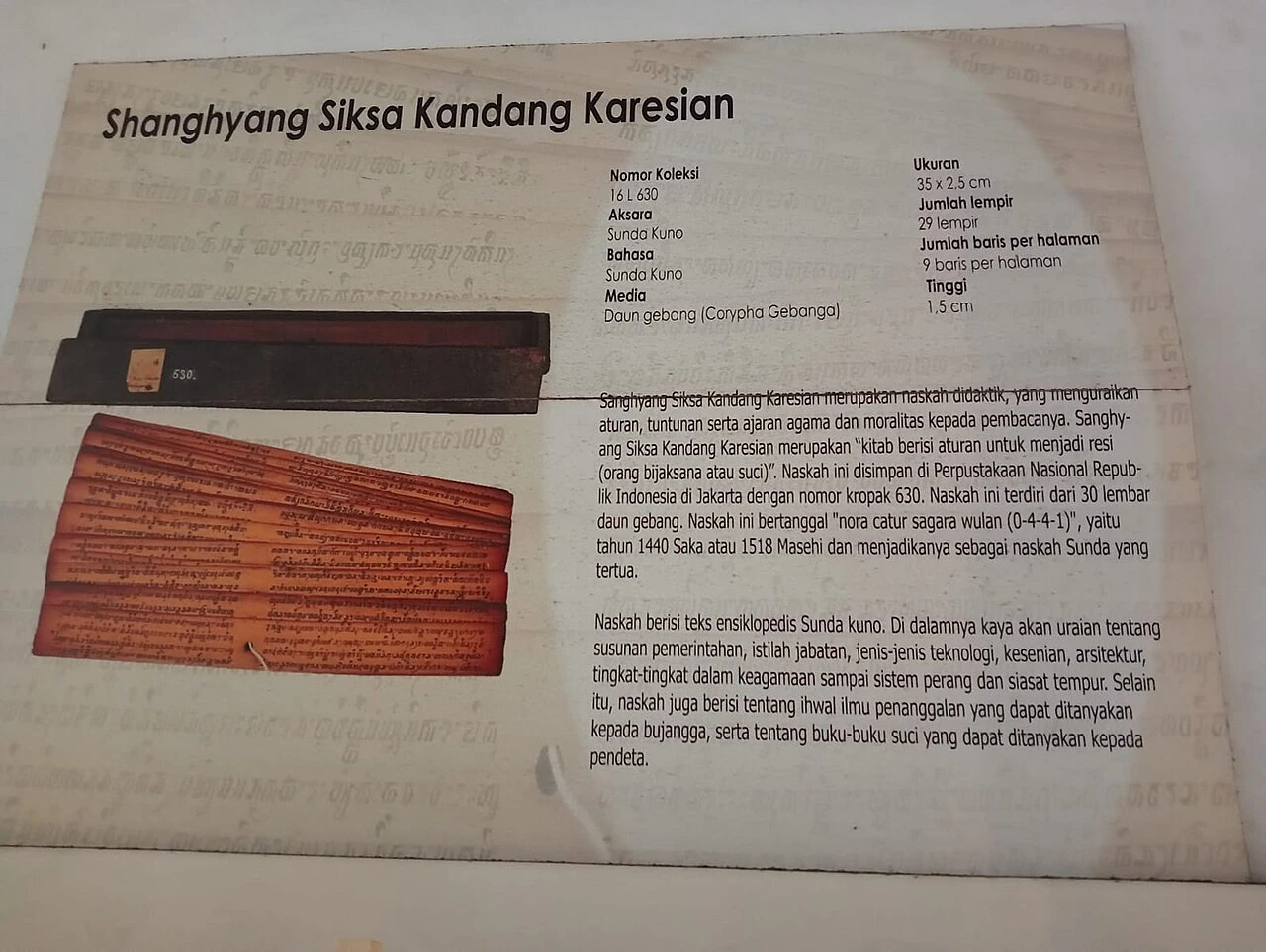
A photograph identified as the Sanghyang Siksa Kandang Karesian manuscript. It represents historical Old Sundanese, not a modern Sundanese document.
Saved in Babelbook · resized display copy. Select the image to open it independently of its source.
Assyari374 · Source ↗CC0 1.0 ↗View the local visual field note
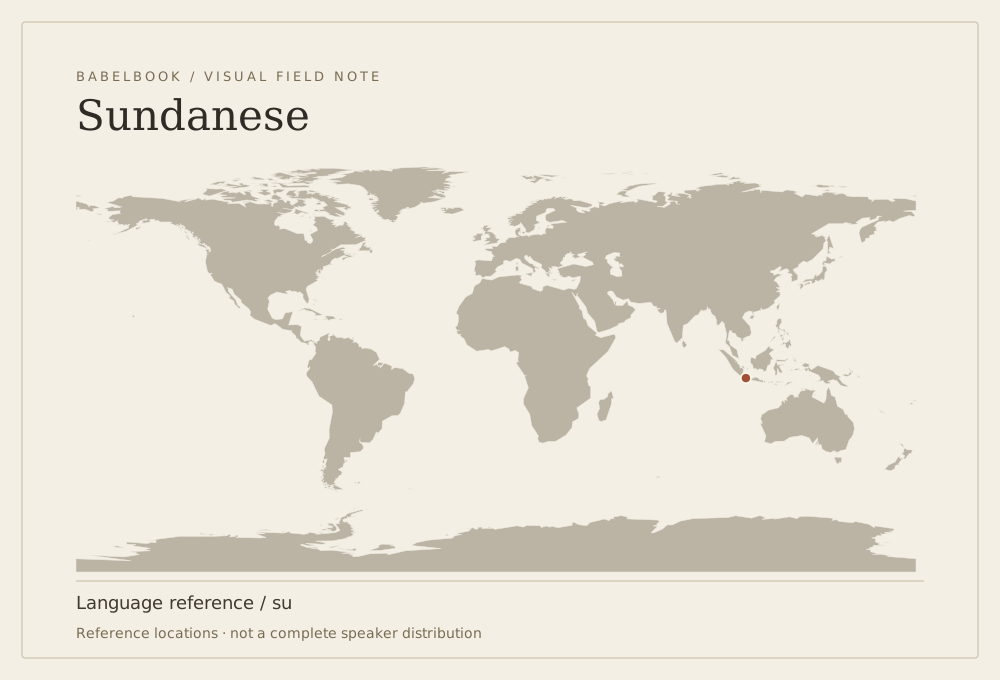
Representative reference points from Glottolog. Historical entries show reference locations, not current speakers. 1 point.
Reference & context ↗Babelbook · original editorial illustration · CC BY 4.0 · Glottolog locations; public-domain Natural Earth land
Source excerpts, selected, shortened and where noted editorially corrected from Sundanese language by Wikipedia contributors. Retrieved 2026-10-05. CC BY-SA 4.0. These excerpts are not an independently verified scholarly history; missing accounts are identified above.
Read further in the source
History and distribution
Sundanese is mainly spoken on the west side of the island of Java, in an area known as Tatar Sunda (Pasundan). However, Sundanese is also spoken in the western part of Central Java, especially in Brebes and Cilacap Regency, because these areas were previously under the control of the Galuh Kingdom. Many place names in Cilacap are still Sundanese names such as Dayeuhluhur, Cimanggu, Cipari, even as far as Banyumas, such as Cilongok, Cingebul, Gumelar, and others. Until 1600 AD, Sundanese was the state language in the kingdoms of Salakanagara, Tarumanagara, Sunda, Galuh, Pajajaran, and Sumedang Larang. During this period, Sundanese was heavily influenced by the Sanskrit language as seen in the Ciaruteun inscription written at the time of King Purnawarman, using the Pallava script. Sundanese at that time was used in the fields of state, art, and daily life, many religious books were written in Sundanese and used Old Sundanese script such as the Sanghyang Siksa Kandang Karesian Manuscript, Carita Parahyangan, Amanat Galunggung, and Guru Talapakan. In addition, according to some Sundanese language experts until around the 6th century, the area of speech reached around the Dieng Plateau in Central Java, based on the name "Dieng" which is considered the name Sundanese (from the origin of the word dihyang which is an Old Sundanese word). Along with transmigration and immigration carried out by the Sundanese ethnics, speakers of this language have spread beyond the island of Java. For example, in Lampung, South Sumatra, Bengkulu, Riau, West Kalimantan, Southeast Sulawesi, and even outside the country of Indonesia, such as Taiwan, Japan, Australia, and other countries, a significant number of ethnic Sundanese live in areas outside the Pasundan.
Dialects
Sundanese has several dialects, conventionally described according to the locations of the people:
Baduy dialect, spoken by Baduy people in Lebak, but it is often considered as separate language. Western dialect, spoken in the provinces of Banten, the western part of Bogor Regency (especially in Greater Jasinga area), and some parts of Lampung. Northern dialect, spoken in Bogor Regency, and northwestern coastal areas of West Java. Southern or Priangan dialect, spoken in Sukabumi, Sumedang, Cianjur, Bandung, Garut, and Tasikmalaya. Mid-east dialect, spoken in Cirebon, Majalengka, and southern part of Indramayu. Northeast dialect, spoken in Kuningan (West Java) and Brebes (Central Java). Southeast dialect, spoken in Ciamis, Pangandaran, Banjar, and Cilacap (Central Java). The Priangan dialect, which covers the largest area where Sundanese people lives (Parahyangan in Sundanese), is the most widely spoken type of Sundanese language, taught in elementary till senior-high schools (equivalent to twelfth-year school grade) in West Java and Banten Province.
Writing system
The language has been written in different writing systems throughout history. The earliest attested documents of the Sundanese language were written in the Old Sundanese script (Aksara Sunda Kuno). After the arrival of Islam, the Pegon script is also used, usually for religious purposes. The Latin script then began to be used after the arrival of Europeans. In modern times, most of Sundanese literature is written in Latin script. Meanwhile, the regional governments of West Java and Banten have been actively promoting the use of Standard Sundanese script (Aksara Sunda Baku) in public places and on road signs. Although Pegon script is now mostly used in pesantrens (Islamic boarding schools) and Sundanese Islamic literature, it can still occasionally be seen in public places and on road signs in certain areas, such as Lembang and Tasikmalaya.