Sumerian
Sumerian was the language of ancient Sumer. It is the oldest attested language, dating back to at least 3100 BC, perhaps earlier. It is a local language isolate, thus unrelated to any other known language, that was spoken exclusively in ancient Mesopotamia, in the area that is now modern-day Iraq. Sumerian is read from left to right, from the top; however early inscriptions were read top to bottom from the right. Akkadian, a Semitic language, gradually replaced Sumerian as the primary spoken language in the area c. 2000 BC (the exact date is debated), but Sumerian continued to be used as a sacred, ceremonial, literary, and scientific language in Akkadian-speaking Mesopotamian states, such as Assyria and Babylonia, until the 1st century AD. Afterwards, it seems to have fallen into obscurity until the 19th century, when Assyriologists began deciphering the cuneiform inscriptions and excavated tablets that had been left by its speakers. In spite of its extinction, Sumerian exerted a significant influence on the languages of the area. The cuneiform script, originally used for Sumerian, was widely adopted by numerous regional languages such as its fellow Mesopotamian Akkadian, as well as Elamite, Eblaite, Amorite, Hittite, Hurrian, Luwian, Aramaic and Urartian; it similarly inspired the Old Persian alphabet which was used to write the eponymous language. The influence was perhaps the greatest on Akkadian, whose grammar and vocabulary were significantly influenced by Sumerian, and vice versa.
Translate in Sumerian ↗Sumerian was the language of ancient Sumer. It is the oldest attested language, dating back to at least 3100 BC, perhaps earlier. It is a local language isolate, thus unrelated to any other known language, that was spoken exclusively in ancient Mesopotamia, in the area that is now modern-day Iraq. Sumerian is read from left to right, from the top; however early inscriptions were read top to bottom from the right. Akkadian, a Semitic language, gradually replaced Sumerian as the primary spoken language in the area c. 2000 BC (the exact date is debated), but Sumerian continued to be used as a sacred, ceremonial, literary, and scientific language in Akkadian-speaking Mesopotamian states, such as Assyria and Babylonia, until the 1st century AD. Afterwards, it seems to have fallen into obscurity until the 19th century, when Assyriologists began deciphering the cuneiform inscriptions and excavated tablets that had been left by its speakers. In spite of its extinction, Sumerian exerted a significant influence on the languages of the area. The cuneiform script, originally used for Sumerian, was widely adopted by numerous regional languages such as its fellow Mesopotamian Akkadian, as well as Elamite, Eblaite, Amorite, Hittite, Hurrian, Luwian, Aramaic and Urartian; it similarly inspired the Old Persian alphabet which was used to write the eponymous language. The influence was perhaps the greatest on Akkadian, whose grammar and vocabulary were significantly influenced by Sumerian, and vice versa.
Global / other
Present-day use
The captured source does not contain a separate current-use account.
Origins
The captured article does not contain a separate origins section. See the historical account and linked source.
Development
Pictographic proto-writing was used in Mesopotamia starting in c. 3300 BC. It is unclear what underlying language it encoded, if any. By c. 2800 BC, some tablets began using syllabic elements that clearly indicated a relation to the Sumerian language. Around 2600 BC, cuneiform symbols were developed using a wedge-shaped stylus to impress the shapes into wet clay. This cuneiform ("wedge-shaped") mode of writing co-existed with the proto-cuneiform archaic mode. Deimel (1922) lists 870 signs used in the Early Dynastic IIIa period (26th century). In the same period the large set of logographic signs had been simplified into a logosyllabic script comprising several hundred signs. Rosengarten (1967) lists 468 signs used in Sumerian (pre-Sargonian) Lagash. The cuneiform script was adapted to Akkadian writing beginning in the mid-third millennium. Over the long period of bilingual overlap of active Sumerian and Akkadian usage the two languages influenced each other, as reflected in numerous loanwords and even word order changes.
Writing
Sumerian writing expressed pronunciation only roughly. It was often morphophonemic, so much of the allomorphic variation could be ignored. Especially in earlier Sumerian, coda consonants were also often ignored in spelling; e.g. /mung̃areš/ 'they put it here' could be written 𒈬𒃻𒌷 mu-g̃ar-re2. The use of VC signs for that purpose, producing more elaborate spellings such as 𒈬𒌦𒃻𒌷𒌍 mu-un-g̃ar-re2-eš3, became more common only in the Neo-Sumerian and especially in the Old Babylonian period. Conversely, an intervocalic consonant, especially at the end of a morpheme followed by a vowel-initial morpheme, was usually "repeated" by the use of a CV sign for the same consonant; e.g. 𒊬 sar "write" – 𒊬𒊏 sar-ra "written". This results in orthographic gemination that is usually reflected in Sumerological transliteration, but does not actually designate any phonological phenomenon such as length. It is also relevant in this context that, as explained above, many morpheme-final consonants seem to have been elided unless followed by a vowel at various stages in the history of Sumerian. These are traditionally termed Auslauts in Sumerology and may or may not be expressed in transliteration: e.g. the logogram 𒊮 for /šag/ > /ša(g)/ "heart" may be transliterated as šag4 or as ša3. Thus, when the following consonant appears in front of a vowel, it can be said to be expressed only by the next sign: for example, 𒊮𒂵 šag4-ga "in the heart" can also be interpreted as ša3-ga. Of course, when a CVC sound sequence is expressed by a sequence of signs with the sound values CV-VC, that does not necessarily indicate a long vowel or a sequence of identical vowels either. To mark such a thing, so-called "plene" writings with an additional vowel sign repeating the preceding vowel were used, although that never came to be done systematically. A typical plene writing involved a sequence such as (C)V-V(-VC/CV), e.g.
Beyond the typeface.
Signs, manuscripts, published pages and contextual photographs, with their place, period, source and reuse terms. Captions identify historical spellings, regional examples, community references and character imagery.
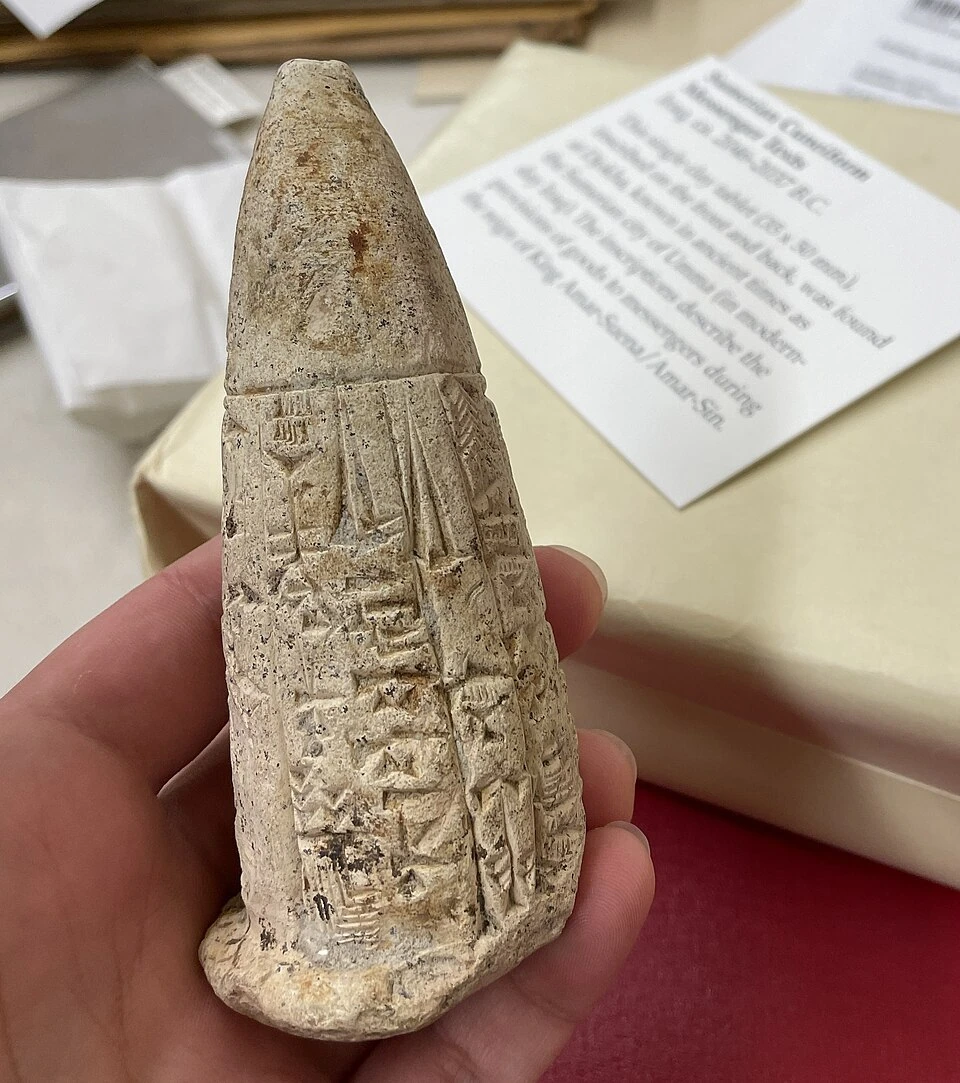
Clay tablet recording provisions for messengers during Amar-Suena’s reign. Commons identifies it as Sumerian in the file title and language category. Not independently transcribed.
Saved in Babelbook · resized display copy. Select the image to open it independently of its source.
Invisible Fig · Source ↗CC BY-SA 4.0 ↗View the local visual field note
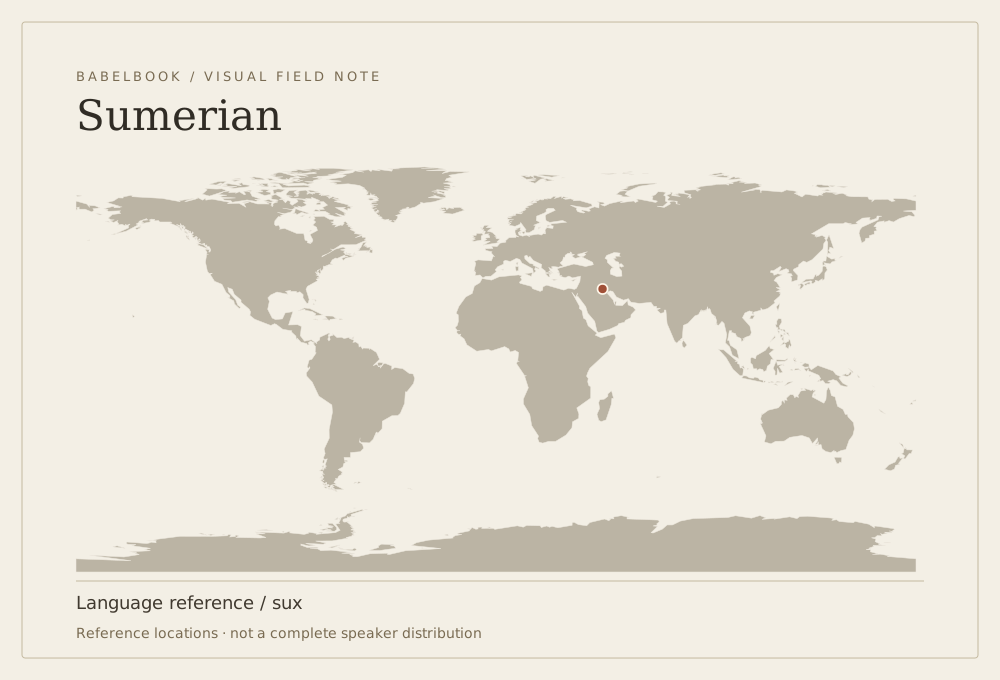
Representative reference points from Glottolog. Historical entries show reference locations, not current speakers. 1 point.
Reference & context ↗Babelbook · original editorial illustration · CC BY 4.0 · Glottolog locations; public-domain Natural Earth land
Source excerpts, selected, shortened and where noted editorially corrected from Sumerian language by Wikipedia contributors. Retrieved 2026-10-05. CC BY-SA 4.0. These excerpts are not an independently verified scholarly history; missing accounts are identified above.
Read further in the source
Orthography
Sumerian writing expressed pronunciation only roughly. It was often morphophonemic, so much of the allomorphic variation could be ignored. Especially in earlier Sumerian, coda consonants were also often ignored in spelling; e.g. /mung̃areš/ 'they put it here' could be written 𒈬𒃻𒌷 mu-g̃ar-re2. The use of VC signs for that purpose, producing more elaborate spellings such as 𒈬𒌦𒃻𒌷𒌍 mu-un-g̃ar-re2-eš3, became more common only in the Neo-Sumerian and especially in the Old Babylonian period. Conversely, an intervocalic consonant, especially at the end of a morpheme followed by a vowel-initial morpheme, was usually "repeated" by the use of a CV sign for the same consonant; e.g. 𒊬 sar "write" – 𒊬𒊏 sar-ra "written". This results in orthographic gemination that is usually reflected in Sumerological transliteration, but does not actually designate any phonological phenomenon such as length. It is also relevant in this context that, as explained above, many morpheme-final consonants seem to have been elided unless followed by a vowel at various stages in the history of Sumerian. These are traditionally termed Auslauts in Sumerology and may or may not be expressed in transliteration: e.g. the logogram 𒊮 for /šag/ > /ša(g)/ "heart" may be transliterated as šag4 or as ša3. Thus, when the following consonant appears in front of a vowel, it can be said to be expressed only by the next sign: for example, 𒊮𒂵 šag4-ga "in the heart" can also be interpreted as ša3-ga. Of course, when a CVC sound sequence is expressed by a sequence of signs with the sound values CV-VC, that does not necessarily indicate a long vowel or a sequence of identical vowels either. To mark such a thing, so-called "plene" writings with an additional vowel sign repeating the preceding vowel were used, although that never came to be done systematically. A typical plene writing involved a sequence such as (C)V-V(-VC/CV), e.g. 𒂼𒀀 ama-a for /amaa/ < {ama-e} "the mother (ergative case)"). Sumerian texts vary in the degree to which they use logograms or opt for syllabic (phonetic) spellings instead: e.g. the word 𒃻 g̃ar "put" may also be written phonetically as 𒂷𒅈 g̃a2-ar. They also vary in the degree to which allomorphic variation was expressed, e.g. 𒁀𒄄𒌍 ba-gi4-eš or 𒁀𒄄𒅖 ba-gi4-iš for "they returned". While early Sumerian writing was highly logographic, there was a tendency towards more phonetic spelling in the Neo-Sumerian period. Consistent syllabic spelling was employed when writing down the Emesal dialect (since the usual logograms would have been read in Emegir by default), for the purpose of teaching the language and often in recording incantations. As already mentioned, texts written in the Archaic Sumerian period are difficult to interpret, because they often omit grammatical elements and determinatives. In addition, many literary-mythological texts from that period use a special orthographic style called UD.GAL.NUN, which seems to be based on substitution of certain signs or groups of signs for others. For example, the three signs 𒌓 UD, 𒃲 GAL and 𒉣 NUN, which the system is named for, are substituted for 𒀭 AN, 𒂗 EN, and 𒆤 LIL2 respectively, producing the name of the god den-lil2. The motivation for this practice is mysterious; it has been suggested that it was a kind of cryptography. Texts written in UD.GAL.NUN are still understood very poorly and only partially. However, recent research by Annette Zgoll about the Sumerian term me shows that this hermetic style is typical of Mesopotamian ritual texts.
Dialects
The standard variety of Sumerian was Emegir (𒅴𒂠: eme-gir15). A notable variety or sociolect was Emesal (𒅴𒊩: eme-sal), possibly to be interpreted as "fine tongue" or "high-pitched voice". Other apparent terms for registers or dialects were eme-galam "high tongue", eme-si-sa2 "straight tongue", eme-te-na2 "oblique[?] tongue", emesukudda, emesuha, emesidi and emeku. Recently, a regional differentiation into a Northern and a Southern Sumerian dialect area has been posited.