Swedish
Swedish (endonym: svenska [ˈsvɛ̂nːska] ) is a North Germanic language from the Indo-European language family, spoken predominantly in Sweden and parts of Finland. It has at least 10 million native speakers, making it the fourth most spoken Germanic language, and the first among its type in the Nordic countries overall. Swedish, like the other Nordic languages, is a descendant of Old Norse, the common language of the Germanic peoples living in Scandinavia during the Viking Age. It is largely mutually intelligible with Norwegian and Danish, although the degree of mutual intelligibility is dependent on the dialect and accent of the speaker. Standard Swedish, spoken by most Swedes, is the national language that evolved from the Central Swedish dialects in the 19th century, and was well established by the beginning of the 20th century. While distinct regional varieties and rural dialects still exist, the written language is uniform and standardized. In addition to being the native language of the Finland-Swedish minority, Swedish is the most widely spoken second language in Finland and has co-official language status in the country. Swedish was long spoken in parts of Estonia, although the current status of the Estonian Swedish speakers is almost extinct. It is also used in the Swedish diaspora, most notably in Oslo, Norway, with more than 50,000 Swedish residents.
Translate in Swedish ↗Swedish is the sole official national language of Sweden, and one of two in Finland (alongside Finnish). As of 2006, it was the sole native language of 83% of Swedish residents. In 2007, around 5.5% (c. 290,000) of the population of Finland were native speakers of Swedish, partially due to a decline following the Russian annexation of Finland after the Finnish War 1808–1809. The Fenno-Swedish-speaking minority is concentrated in the coastal areas and archipelagos of southern and western Finland. In some of these areas, Swedish is the predominant language; in 19 municipalities, 16 of which are located in Åland, Swedish is the sole official language. Åland county is an autonomous region of Finland. According to a rough estimation, as of 2010 there were up to 300,000 Swedish-speakers living outside Sweden and Finland. The largest populations were in the United States (up to 100,000), the UK, Spain and Germany (c. 30,000 each) and a large proportion of the remaining 100,000 in the Scandinavian countries, France, Switzerland, Belgium, the Netherlands, Canada and Australia. Over three million people speak Swedish as a second language, with about 2,410,000 of those in Finland. According to a survey by the European Commission, 44% of respondents from Finland who did not have Swedish as a native language considered themselves to be proficient enough in Swedish to hold a conversation. Due to the close relation between the Scandinavian languages, a considerable proportion of speakers of Danish and especially Norwegian are able to understand Swedish. There is considerable migration between the Nordic countries, but owing to the similarity between the cultures and languages (with the exception of Finnish), expatriates generally assimilate quickly and do not stand out as a group. According to the 2000 United States Census, some 67,000 people over the age of five were reported as Swedish speakers, though without any information on the degree of language proficiency.
Europe
Present-day use
Modern Swedish (Swedish: nysvenska) begins with the advent of the printing press and the European Reformation. After assuming power, the new monarch Gustav Vasa ordered a Swedish translation of the Bible. The New Testament was published in 1526, followed by a full Bible translation in 1541, usually referred to as the Gustav Vasa Bible, a translation deemed so successful and influential that, with revisions incorporated in successive editions, it remained the most common Bible translation until 1917. The main translators were Laurentius Andreæ and the brothers Laurentius and Olaus Petri. The Vasa Bible is often considered to be a reasonable compromise between old and new; while not adhering to the colloquial spoken language of its day, it was not overly conservative in its use of archaic forms. It was a major step towards a more consistent Swedish orthography. It established the use of the vowels "å", "ä", and "ö", and the spelling "ck" in place of "kk", distinguishing it clearly from the Danish Bible, perhaps intentionally, given the ongoing rivalry between the countries. All three translators came from central Sweden, which is generally seen as adding specific Central Swedish features to the new Bible. Though it might seem as if the Bible translation set a very powerful precedent for orthographic standards, spelling actually became more inconsistent during the remainder of the century. It was not until the 17th century that spelling began to be discussed, around the time when the first grammars were written. Capitalization during this time was not standardized. It depended on the authors and their background. Those influenced by German capitalized all nouns, while others capitalized more sparsely. It is also not always apparent which letters are capitalized owing to the Gothic or blackletter typeface that was used to print the Bible.
Origins
The captured article does not contain a separate origins section. See the historical account and linked source.
Development
The captured article does not contain a distinct historical account. No chronology has been invented.
Writing
The Swedish alphabet is a 29-letter alphabet, using the 26-letter ISO basic Latin alphabet plus the three additional letters ⟨å⟩, ⟨ä⟩, and ⟨ö⟩ constructed in the 16th century by writing ⟨o⟩ and ⟨e⟩ on top of an ⟨a⟩, and an ⟨e⟩ on top of an ⟨o⟩. Though these combinations are historically modified versions of ⟨a⟩ and ⟨o⟩ according to the English range of usage for the term diacritic, these three characters are not considered to be diacritics within the Swedish application, but rather separate letters, and are independent letters following ⟨z⟩. Before the release of the 13th edition of Svenska Akademiens ordlista in April 2006, ⟨w⟩ was treated as merely a variant of ⟨v⟩ used only in names (such as "Wallenberg") and foreign words ("bowling"), and so was both sorted and pronounced as a ⟨v⟩. Other diacritics (to use the broader English term usage referenced here) are unusual in Swedish; ⟨é⟩ is sometimes used to indicate that the stress falls on a terminal syllable containing ⟨e⟩, especially when the stress changes the meaning (ide vs. idé, "winter lair" vs. "idea") as well as in some names, like Kastrén; occasionally other acute accents and, less often, grave accents can be seen in names and some foreign words. The letter ⟨à⟩ is used to refer to unit cost (a loan from the French), equivalent to the at sign (⟨@⟩) in English. The German ⟨ü⟩ is treated as a variant of ⟨y⟩ and sometimes retained in foreign names and words, e. g., müsli ("muesli/granola"). A proper diaeresis may very exceptionally be seen in elaborated style (for instance: "Aïda"). The German convention of writing ⟨ä⟩ and ⟨ö⟩ as ⟨ae⟩ and ⟨oe⟩ if the characters are unavailable is an unusual convention for speakers of modern Swedish.
Beyond the typeface.
Signs, manuscripts, published pages and contextual photographs, with their place, period, source and reuse terms. Captions identify historical spellings, regional examples, community references and character imagery.
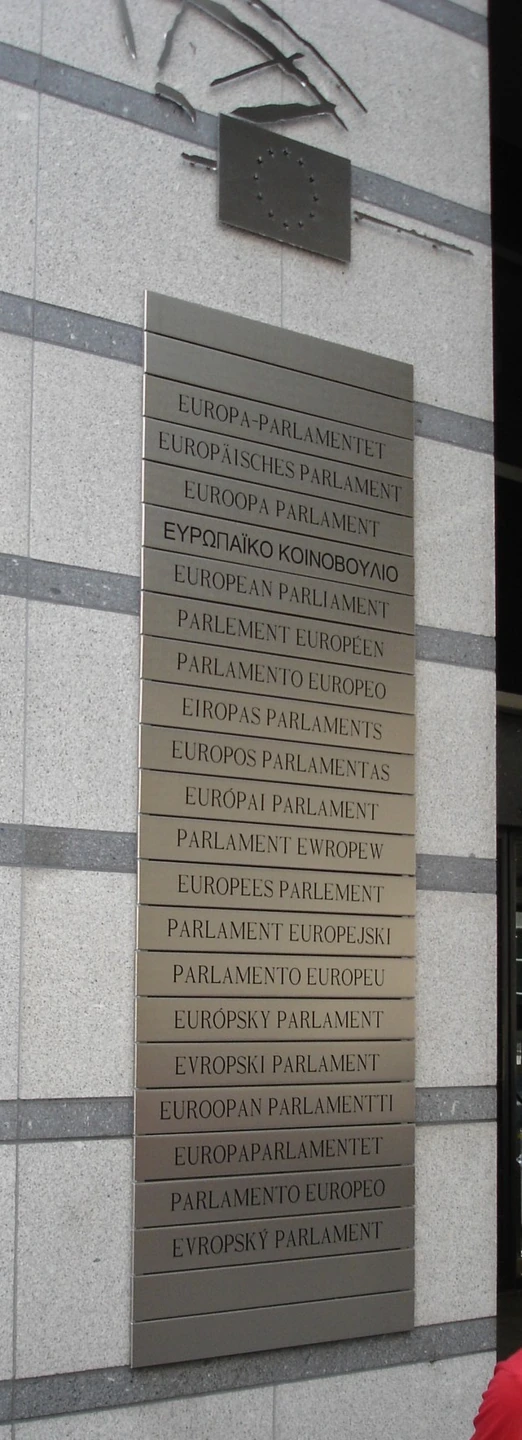
Swedish on a multilingual European Parliament sign, photographed in 2006. Language identification follows the source description; not independently transcribed.
Saved in Babelbook · resized display copy. Select the image to open it independently of its source.
Nuno Nogueira · Source ↗Public domain (author dedication) ↗View the local visual field note
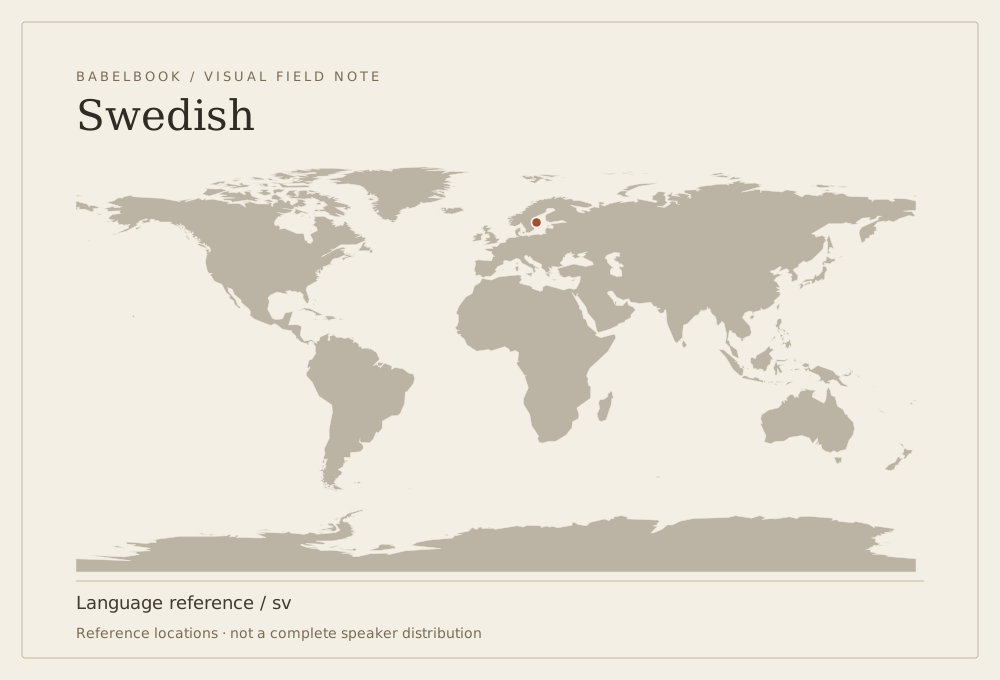
Representative reference points from Glottolog. Historical entries show reference locations, not current speakers. 1 point.
Reference & context ↗Babelbook · original editorial illustration · CC BY 4.0 · Glottolog locations; public-domain Natural Earth land
Source excerpts, selected, shortened and where noted editorially corrected from Swedish language by Wikipedia contributors. Retrieved 2026-10-05. CC BY-SA 4.0. These excerpts are not an independently verified scholarly history; missing accounts are identified above.
Read further in the source
Geographic distribution
Swedish is the sole official national language of Sweden, and one of two in Finland (alongside Finnish). As of 2006, it was the sole native language of 83% of Swedish residents. In 2007, around 5.5% (c. 290,000) of the population of Finland were native speakers of Swedish, partially due to a decline following the Russian annexation of Finland after the Finnish War 1808–1809. The Fenno-Swedish-speaking minority is concentrated in the coastal areas and archipelagos of southern and western Finland. In some of these areas, Swedish is the predominant language; in 19 municipalities, 16 of which are located in Åland, Swedish is the sole official language. Åland county is an autonomous region of Finland. According to a rough estimation, as of 2010 there were up to 300,000 Swedish-speakers living outside Sweden and Finland. The largest populations were in the United States (up to 100,000), the UK, Spain and Germany (c. 30,000 each) and a large proportion of the remaining 100,000 in the Scandinavian countries, France, Switzerland, Belgium, the Netherlands, Canada and Australia. Over three million people speak Swedish as a second language, with about 2,410,000 of those in Finland. According to a survey by the European Commission, 44% of respondents from Finland who did not have Swedish as a native language considered themselves to be proficient enough in Swedish to hold a conversation. Due to the close relation between the Scandinavian languages, a considerable proportion of speakers of Danish and especially Norwegian are able to understand Swedish. There is considerable migration between the Nordic countries, but owing to the similarity between the cultures and languages (with the exception of Finnish), expatriates generally assimilate quickly and do not stand out as a group. According to the 2000 United States Census, some 67,000 people over the age of five were reported as Swedish speakers, though without any information on the degree of language proficiency. Similarly, there were 16,915 reported Swedish speakers in Canada from the 2001 census. Although there are no certain numbers, some 40,000 Swedes are estimated to live in the London area in the United Kingdom. Outside Sweden and Finland, there are about 40,000 active learners enrolled in Swedish language courses. In the United States, particularly during the 19th and early 20th centuries, there was a significant Swedish-speaking immigrant population. This was notably true in states like Minnesota, where many Swedish immigrants settled. By 1940, approximately 6% of Minnesota's population spoke Swedish. Although the use of Swedish has significantly declined, it is not uncommon to find older generations and communities that still retain some use and knowledge of the language, particularly in rural communities like Lindström and Scandia.
Official status
Swedish is the official main language of Sweden. Swedish is also one of two official languages of Finland. In Sweden, it has long been used in local and state government, and most of the educational system, but remained only a de facto primary language with no official status in law until 2009. A bill was proposed in 2005 that would have made Swedish an official language, but failed to pass by the narrowest possible margin (145–147) due to a pairing-off failure. A proposal for a broader language law, designating Swedish as the main language of the country and bolstering the status of the minority languages, was submitted by an expert committee to the Swedish Ministry of Culture in March 2008. It was subsequently enacted by the Riksdag, and entered into effect on 1 July 2009. Swedish is the sole official language of Åland (an autonomous province under the sovereignty of Finland), where the vast majority of the 26,000 inhabitants speak Swedish as a first language. In Finland as a whole, Swedish is one of the two "national" languages, with the same official status as Finnish (spoken by the majority) at the state level and an official language in some municipalities. Swedish is one of the official languages of the European Union, and one of the working languages of the Nordic Council. Under the Nordic Language Convention, citizens of the Nordic countries speaking Swedish have the opportunity to use their native language when interacting with official bodies in other Nordic countries without being liable for interpretation or translation costs.
Writing system
The Swedish alphabet is a 29-letter alphabet, using the 26-letter ISO basic Latin alphabet plus the three additional letters ⟨å⟩, ⟨ä⟩, and ⟨ö⟩ constructed in the 16th century by writing ⟨o⟩ and ⟨e⟩ on top of an ⟨a⟩, and an ⟨e⟩ on top of an ⟨o⟩. Though these combinations are historically modified versions of ⟨a⟩ and ⟨o⟩ according to the English range of usage for the term diacritic, these three characters are not considered to be diacritics within the Swedish application, but rather separate letters, and are independent letters following ⟨z⟩. Before the release of the 13th edition of Svenska Akademiens ordlista in April 2006, ⟨w⟩ was treated as merely a variant of ⟨v⟩ used only in names (such as "Wallenberg") and foreign words ("bowling"), and so was both sorted and pronounced as a ⟨v⟩. Other diacritics (to use the broader English term usage referenced here) are unusual in Swedish; ⟨é⟩ is sometimes used to indicate that the stress falls on a terminal syllable containing ⟨e⟩, especially when the stress changes the meaning (ide vs. idé, "winter lair" vs. "idea") as well as in some names, like Kastrén; occasionally other acute accents and, less often, grave accents can be seen in names and some foreign words. The letter ⟨à⟩ is used to refer to unit cost (a loan from the French), equivalent to the at sign (⟨@⟩) in English. The German ⟨ü⟩ is treated as a variant of ⟨y⟩ and sometimes retained in foreign names and words, e. g., müsli ("muesli/granola"). A proper diaeresis may very exceptionally be seen in elaborated style (for instance: "Aïda"). The German convention of writing ⟨ä⟩ and ⟨ö⟩ as ⟨ae⟩ and ⟨oe⟩ if the characters are unavailable is an unusual convention for speakers of modern Swedish. Despite the availability of all these characters in the Swedish national top-level Internet domain and other such domains, Swedish sites are frequently labelled using ⟨a⟩ and ⟨o⟩, based on visual similarity, though Swedish domains could be registered using the characters ⟨å⟩, ⟨ä⟩, and ⟨ö⟩ from 2003. In Swedish orthography, the colon is used in a similar manner as in English, with some exceptions: the colon is used for some abbreviations, such as 3:e for tredje ("third") and S:t for Sankt ("Saint"), and for all types of endings that can be added to numbers, letters and abbreviations, such as a:et ("the a") and CD:n ("the CD"), or the genitive form USA:s ("USA's").
Dialects
According to a traditional division of Swedish dialects, there are six main groups of dialects:
Norrland dialects Finland Swedish Svealand dialects Gotland dialects Götaland dialects South Swedish dialects The traditional definition of a Swedish dialect has been a local variant that has not been heavily influenced by the standard language and that can trace a separate development all the way back to Old Norse. Many of the genuine rural dialects, such as those of Orsa in Dalarna or Närpes in Österbotten, have very distinct phonetic and grammatical features, such as plural forms of verbs or archaic case inflections. These dialects can be near-incomprehensible to a majority of Swedes, and most of their speakers are also fluent in Standard Swedish. The different dialects are often so localized that they are limited to individual parishes and are referred to by Swedish linguists as sockenmål (lit., "parish speech"). They are generally separated into six major groups, with common characteristics of prosody, grammar and vocabulary. One or several examples from each group are given here. Though each example is intended to be also representative of the nearby dialects, the actual number of dialects is several hundred if each individual community is considered separately. This type of classification, however, is based on a somewhat romanticized nationalist view of ethnicity and language. The idea that only rural variants of Swedish should be considered "genuine" is not generally accepted by modern scholars. No dialects, no matter how remote or obscure, remained unchanged or undisturbed by a minimum of influences from surrounding dialects or the standard language, especially not from the late 19th century onwards with the advent of mass media and advanced forms of transport. The differences are today more accurately described by a scale that runs from "standard language" to "rural dialect" where the speech even of the same person may vary from one extreme to the other depending on the situation. All Swedish dialects with the exception of the highly diverging forms of speech in Dalarna, Norrbotten and, to some extent, Gotland can be considered to be part of a common, mutually intelligible dialect continuum. This continuum may also include Norwegian and some Danish dialects.
Standard Swedish
Standard Swedish is the language used by virtually all Swedes and most Swedish-speaking Finns. It is called rikssvenska or standardsvenska ("Standard Swedish") in Sweden. In Finland, högsvenska ("High Swedish") is used for the Finnish variant of standard Swedish and rikssvenska refers to Swedish as spoken in Sweden in general. In a poll conducted in 2005 by the Swedish Retail Institute (Handelns Utredningsinstitut), the attitudes of Swedes to the use of certain dialects by salesmen revealed that 54% believed that rikssvenska was the variety they would prefer to hear when speaking with salesmen over the phone, even though dialects such as gotländska or skånska were provided as alternatives in the poll.