Swahili
Swahili, also known as Kiswahili, is a Bantu language of the Atlantic–Congo language family, originally spoken by the Swahili people, who are found primarily in Tanzania, Kenya, and Mozambique (along the East African coast and adjacent littoral islands). Estimates of the number of Swahili speakers, including both native and second-language speakers, generally range from 40 million to 200 million. Most native speakers reside in Tanzania and Kenya. About 40% of Swahili vocabulary consists of Arabic loanwords, including the name of the language itself (سَوَاحِلي sawāḥilī, a plural adjectival form of an Arabic word meaning 'of the coasts'). Swahili also has a significant number of loanwords from Portuguese, English and German. The Arabic loanwords date from the era of contact between Arab slave traders and the Bantu inhabitants of the east coast of Africa, which was also the time period when Swahili emerged as a lingua franca in the region. Due to concerted efforts by the governments of Tanzania and Kenya, Swahili is one of three official languages (alongside English and French) of the East African Community (EAC) countries, which are Kenya, Tanzania, Burundi, the Democratic Republic of the Congo, Rwanda, Somalia, South Sudan, and Uganda. It is the lingua franca of other areas in the African Great Lakes region and East and Southern Africa. Swahili is also one of the working languages of the African Union and of the Southern African Development Community.
Translate in Swahili ↗Swahili, also known as Kiswahili, is a Bantu language of the Atlantic–Congo language family, originally spoken by the Swahili people, who are found primarily in Tanzania, Kenya, and Mozambique (along the East African coast and adjacent littoral islands). Estimates of the number of Swahili speakers, including both native and second-language speakers, generally range from 40 million to 200 million. Most native speakers reside in Tanzania and Kenya. About 40% of Swahili vocabulary consists of Arabic loanwords, including the name of the language itself (سَوَاحِلي sawāḥilī, a plural adjectival form of an Arabic word meaning 'of the coasts'). Swahili also has a significant number of loanwords from Portuguese, English and German. The Arabic loanwords date from the era of contact between Arab slave traders and the Bantu inhabitants of the east coast of Africa, which was also the time period when Swahili emerged as a lingua franca in the region. Due to concerted efforts by the governments of Tanzania and Kenya, Swahili is one of three official languages (alongside English and French) of the East African Community (EAC) countries, which are Kenya, Tanzania, Burundi, the Democratic Republic of the Congo, Rwanda, Somalia, South Sudan, and Uganda. It is the lingua franca of other areas in the African Great Lakes region and East and Southern Africa. Swahili is also one of the working languages of the African Union and of the Southern African Development Community. The East African Community created an institution called the East African Kiswahili Commission (EAKC) which began operations in 2015.
Sub-Saharan Africa
Present-day use
The captured source does not contain a separate current-use account.
Origins
The word "Swahili" comes from an Arabic name for the area, meaning "coasts": The core of the Swahili language originates in Bantu languages of the coast of East Africa. Much of Swahili's Bantu vocabulary has cognates in the Unguja, Pemba, and Mijikenda languages and, to a lesser extent, other East African Bantu languages. While opinions vary on the specifics, it has been historically purported that about 16–20% of the Swahili vocabulary is derived from loan words, the vast majority Arabic, but also other contributing languages, including Persian, Hindustani, Portuguese, and Malay. The South Cushitic languages preceded the Bantu languages in today's Tanzania and Kenya, and have left many loanwords in Bantu languages in the interior of the countries, but they had very little direct impact on Swahili or the other Sabaki languages spoken on the coast. Omani Arabic is the source of most Arabic loanwords in Swahili. In the text "Early Swahili History Reconsidered", however, Thomas Spear noted that Swahili retains a large amount of grammar, vocabulary, and sounds inherited from the Sabaki language. In fact, while taking account of daily vocabulary, using lists of one hundred words, 72–91% were inherited from the Sabaki language (which is reported as a parent language) whereas 4–17% were loan words from other African languages. Only 2–8% were from non-African languages, and Arabic loan words constituted a fraction of that. According to other sources, about 40% of the Swahili vocabulary comes from Arabic. What also remained unconsidered was that a good number of the borrowed terms had Bantu equivalents. The preferred use of Arabic loan words is prevalent along the coast, where local people, in a cultural show of proximity to, or descent from, Arab culture, would rather use loan words, whereas the people in the interior tend to use the Bantu equivalents.
Development
The captured article does not contain a distinct historical account. No chronology has been invented.
Writing
Swahili is now written in the Latin alphabet. There are a few digraphs for native sounds, ch, sh, ng' and ny; q and x are not used, c is not used apart from the digraph ch, unassimilated English loans and, occasionally, as a substitute for k in advertisements. There are also several digraphs for Arabic sounds, which many speakers outside of ethnic Swahili areas have trouble differentiating. The language used to be primarily written in the Ajami script, which is an Arabic script. Much literature was produced in this script. With the introduction of Latin, the use of Ajami script has been diminished significantly. However, the language continues to have a tradition of being written in Arabic script. Starting from the later half of the 19th century, continuing into the 20th century, and going on in the 21st century, a process of "Swahilization" of the Arabic Script has been underway by Swahili scribes and scholars. The first of such attempts was done by Mwalimu Sikujua, a scholar and poet from Mombasa. However, the spread of a standardized indigenous variation of Arabic script for Swahili was hampered by the colonial takeover of East Africa by the United Kingdom and Germany. The usage of Arabic script was suppressed in German East Africa and to a lesser extent in British East Africa. Nevertheless, well into the 1930s and 1940s, rural literacy rate in Arabic script as well as a local preference to write Swahili in the Arabic script (an unmodified version as opposed to proposals such as that of Mwalimu Sikujua) was relatively high. There were also differences in orthographic conventions between cities and authors and over the centuries, some quite precise but others different enough to cause difficulties with intelligibility. Thus despite a lack of official governmental backing, attempts at standardization and Swahilization of the Arabic script continued into the 20th century.
Beyond the typeface.
Signs, manuscripts, published pages and contextual photographs, with their place, period, source and reuse terms. Captions identify historical spellings, regional examples, community references and character imagery.
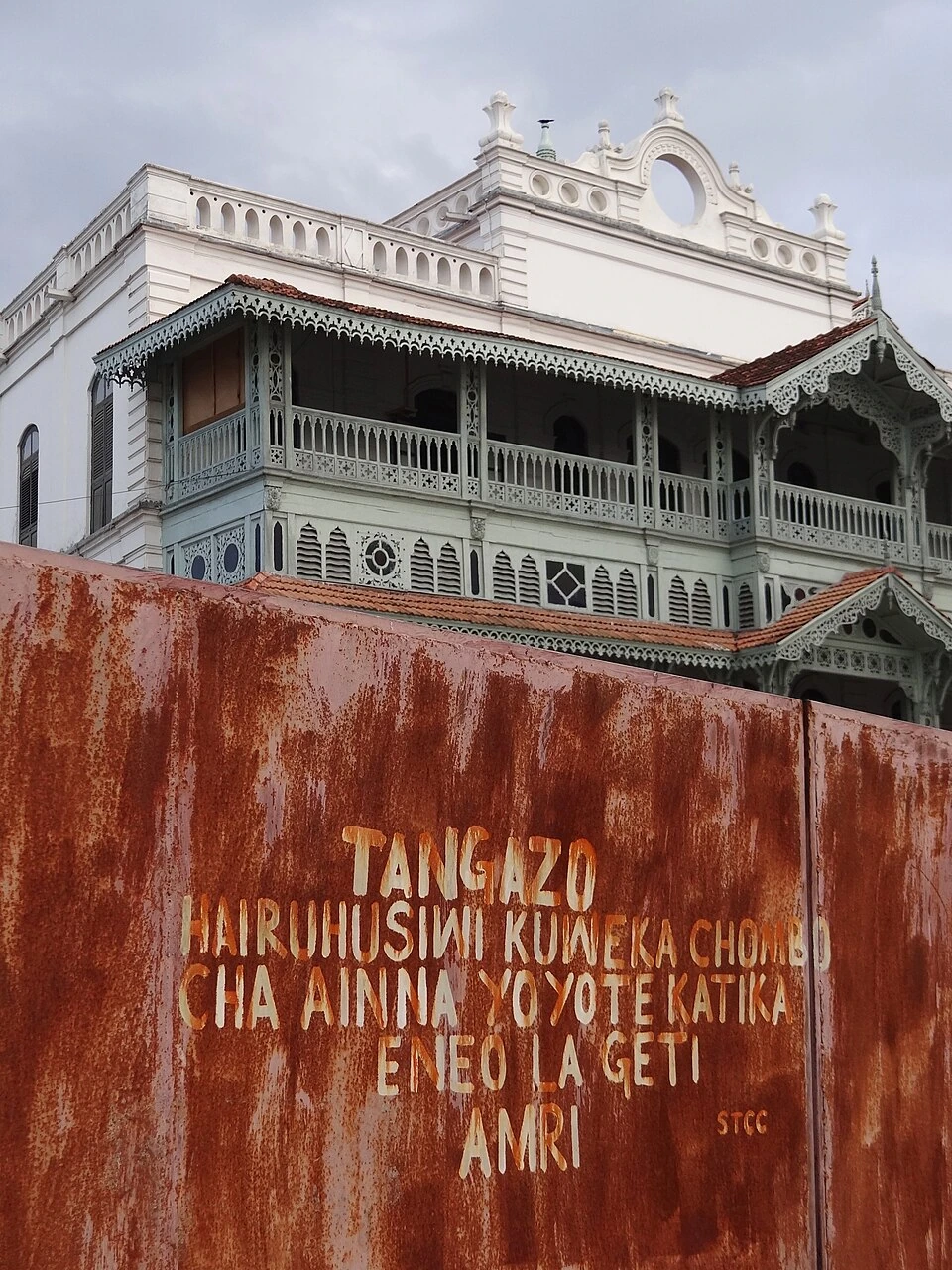
Swahili sign on a facade in Stone Town, Zanzibar, photographed in 2013. Source-identified language; displayed without additional cropping.
Saved in Babelbook · resized display copy. Select the image to open it independently of its source.
Adam Jones · Source ↗CC BY-SA 2.0 ↗View the local visual field note
Representative reference points from Glottolog. Historical entries show reference locations, not current speakers. 2 points.
Reference & context ↗Babelbook · original editorial illustration · CC BY 4.0 · Glottolog locations; public-domain Natural Earth land
Source excerpts, selected, shortened and where noted editorially corrected from Swahili by Wikipedia contributors. Retrieved 2026-10-05. CC BY-SA 4.0. These excerpts are not an independently verified scholarly history; missing accounts are identified above.
Read further in the source
Origin
The core of the Swahili language originates in Bantu languages of the coast of East Africa. Much of Swahili's Bantu vocabulary has cognates in the Unguja, Pemba, and Mijikenda languages and, to a lesser extent, other East African Bantu languages. While opinions vary on the specifics, it has been historically purported that about 16–20% of the Swahili vocabulary is derived from loan words, the vast majority Arabic, but also other contributing languages, including Persian, Hindustani, Portuguese, and Malay. The South Cushitic languages preceded the Bantu languages in today's Tanzania and Kenya, and have left many loanwords in Bantu languages in the interior of the countries, but they had very little direct impact on Swahili or the other Sabaki languages spoken on the coast.
Omani Arabic is the source of most Arabic loanwords in Swahili. In the text "Early Swahili History Reconsidered", however, Thomas Spear noted that Swahili retains a large amount of grammar, vocabulary, and sounds inherited from the Sabaki language. In fact, while taking account of daily vocabulary, using lists of one hundred words, 72–91% were inherited from the Sabaki language (which is reported as a parent language) whereas 4–17% were loan words from other African languages. Only 2–8% were from non-African languages, and Arabic loan words constituted a fraction of that. According to other sources, about 40% of the Swahili vocabulary comes from Arabic. What also remained unconsidered was that a good number of the borrowed terms had Bantu equivalents. The preferred use of Arabic loan words is prevalent along the coast, where local people, in a cultural show of proximity to, or descent from, Arab culture, would rather use loan words, whereas the people in the interior tend to use the Bantu equivalents. It was originally written in Arabic script. The earliest known documents written in Swahili are letters written in Kilwa, Tanzania, in 1711 in the Arabic script that were sent to the Portuguese of Mozambique and their local allies. The original letters are preserved in the Historical Archives of Goa, India.
Orthography
Swahili is now written in the Latin alphabet. There are a few digraphs for native sounds, ch, sh, ng' and ny; q and x are not used, c is not used apart from the digraph ch, unassimilated English loans and, occasionally, as a substitute for k in advertisements. There are also several digraphs for Arabic sounds, which many speakers outside of ethnic Swahili areas have trouble differentiating. The language used to be primarily written in the Ajami script, which is an Arabic script. Much literature was produced in this script. With the introduction of Latin, the use of Ajami script has been diminished significantly. However, the language continues to have a tradition of being written in Arabic script. Starting from the later half of the 19th century, continuing into the 20th century, and going on in the 21st century, a process of "Swahilization" of the Arabic Script has been underway by Swahili scribes and scholars. The first of such attempts was done by Mwalimu Sikujua, a scholar and poet from Mombasa. However, the spread of a standardized indigenous variation of Arabic script for Swahili was hampered by the colonial takeover of East Africa by the United Kingdom and Germany. The usage of Arabic script was suppressed in German East Africa and to a lesser extent in British East Africa. Nevertheless, well into the 1930s and 1940s, rural literacy rate in Arabic script as well as a local preference to write Swahili in the Arabic script (an unmodified version as opposed to proposals such as that of Mwalimu Sikujua) was relatively high. There were also differences in orthographic conventions between cities and authors and over the centuries, some quite precise but others different enough to cause difficulties with intelligibility. Thus despite a lack of official governmental backing, attempts at standardization and Swahilization of the Arabic script continued into the 20th century.
Dialects and closely related languages
This list is based on Swahili and Sabaki: a linguistic history.
Dialects
Modern standard Swahili, written in Latin script, is based on Kiunguja, the dialect spoken in Zanzibar City. Swahili literature and poetry, traditionally written in Swahili Ajami, is based on Kiamu, the dialect of Lamu on the Kenyan Coast. But there are numerous other dialects of Swahili, some of which are mutually unintelligible, such as the following:
Old dialects
Maho (2009) considers these to be distinct languages:
Kimwani is spoken in the Kerimba Islands and northern coastal Mozambique. Chimwiini is spoken by the ethnic minorities in and around the town of Barawa on the southern coast of Somalia. Kibajuni is spoken by the Bajuni minority ethnic group on the coast and islands on both sides of the Somali–Kenyan border and in the Bajuni Islands (the northern part of the Lamu archipelago) and is also called Kitikuu and Kigunya. Socotra Swahili (extinct) Sidi, in Gujarat, India (possibly extinct) The rest of the dialects are divided by him into two groups:
Mombasa–Lamu Swahili Lamu The dialects of the Lamu group (especially Kiamu, Kipate, Kingozi) are the linguistic base of the oldest (c. 1600 CE) Swahili manuscripts and poems that reached us. They are sometimes described as "literary" dialects but they were also used for everyday life and are still spoken today except Kingozi. Kiamu is spoken in and around the island of Lamu (Amu) and have an important corpus of classical poems of the 18th and 19th centuries written in Arabic script (Kiajemi). Kipate is a local dialect of Pate Island, considered to be closest to the original dialect of Kingozi. It has also an important classical corpus of poems from the 18th and 19th centuries. Kingozi is an extinct dialect spoken on the Indian Ocean coast between Lamu and Somalia and is sometimes still used in poetry. It is often considered the source of Swahili. Academic theories about Kingozi as an old literary dialect are conflicting. It is sometimes linked to the epics of Liongo. For Sacleux, it's and old and "an exclusively literary, arcane dialect". It varies depending on the authors whose will to return to a pure form of the old language make them use Kigunya mainly (Kipate is a subdialect of Kigunya) and secondarily Kiamu and Kimvita. Knappert, on the contrary, states the existence of a literary koine in the 18th century based on the Kingozi as a prestigious and widespread dialect. The 2009 New Updated Guthrie List, a referential classification of the Bantu languages, considers kiOzi as a dialect in itself. It is not the ancestor language of Kiswahili but a member of the Lamu group (code G42a) with Kiamu, Kipate and Kisiu. This brief overview indicates that the state of research is fragmented and uncertain on the history of the kingozi. Mombasa Chijomvu is a subdialect of the Mombasa area. Kimvita is the major dialect of Mombasa (also known as "Mvita", which means "war", in reference to the many wars which were fought over it, the other major dialect alongside Kiunguja. It has an important classical corpus written in Arabic script from the 18st and 19st century. Kingare is the subdialect of the Mombasa area. Kimrima is spoken around Pangani, Vanga, Dar es Salaam, Rufiji and Mafia Island. Kiunguja is spoken in Zanzibar City and environs on Unguja (Zanzibar) Island. Kitumbatu (Pemba) dialects occupy the bulk of the island. Mambrui, Malindi Chichifundi, a dialect of the southern Kenya coast. Chwaka Kivumba, a dialect of the southern Kenya coast. Nosse Be (Madagascar) Pemba Swahili Kipemba is a local dialect of the Pemba Island. Kitumbatu and Kimakunduchi are the countryside dialects of the island of Zanzibar. Kimakunduchi is a recent renaming of "Kihadimu"; the old name means "serf" and so is considered pejorative. Makunduchi Mafia, Mbwera Kilwa (extinct) Kimgao used to be spoken around Kilwa District and to the south. Maho includes the various Comorian dialects as a third group. Most other authorities consider Comorian to be a Sabaki language, distinct from Swahili.