Classical Syriac
The Syriac language (, SIRR-ee-ak; Classical Syriac: ܠܫܢܐ ܣܘܪܝܝܐ, romanized: Leššānā Suryāyā), also known natively in its spoken form in early Syriac literature as Edessan (Urhāyā), the Mesopotamian language (Nahrāyā) and Aramaic (Aramāyā), is an Eastern Middle Aramaic dialect based on the Aramaic dialect of Edessa. Classical Syriac is the academic term used to refer to the dialect's literary usage and standardization, distinguishing it from other Aramaic dialects also known as 'Syriac', 'Assyrian', or 'Syrian'. In its West-Syriac tradition, Classical Syriac is often known as leššōnō kṯoḇonōyō (lit. 'the written language or the book language') or simply kṯoḇonōyō, or kṯowonōyō, while in its East-Syriac tradition, it is known as leššānā ʔatīqā (lit. 'the old language') or saprāyā (lit. 'scribal or literary'). It emerged during the first century AD from a local Eastern Aramaic dialect that was spoken in the ancient Neo-Assyrian kingdom and region of Osroene, centered in the city of Edessa (Urhai). During the Early Christian period, it became the main literary language of various Aramaic-speaking Christian communities in the historical regions of Ancient Syria, Assyria and throughout the Near East. As a liturgical language of Syriac Christianity, it gained a prominent role among Eastern Christian communities that used both Eastern Syriac and Western Syriac rites. Following the spread of Syriac Christianity, it also became a liturgical language of eastern Christian communities as far as India and China.
Translate in Classical Syriac ↗Syriac was the local dialect of Aramaic in Edessa, and evolved under the influence of the Church of the East and the Syriac Orthodox Church into its current form. Before Arabic became the dominant language, Syriac was a major language among Christian communities in the Middle East, Central Asia and the Malabar Coast in India, and remains so among the Syriac Christians to this day. It has been found as far afield as Hadrian's Wall in Great Britain, with inscriptions written by Aramaic-speaking soldiers of the Roman Empire. Revivals of literary Syriac in recent times have led to some success with the creation of newspapers in written Syriac (ܟܬܒܢܝܐ Kṯāḇānāyā), similar to the use of Modern Standard Arabic has been employed since the early decades of the 20th century. Modern forms of literary Syriac have also been used not only in religious literature but also in secular genres, often with Assyrian nationalistic themes. Syriac is spoken as the liturgical language of the Syriac Orthodox Church, as well as by some of its adherents. Syriac has been recognised as an official minority language in Iraq. It is also taught in some public schools in Iraq, Syria, Palestine, Israel, Sweden, Augsburg (Germany) and Kerala (India). In 2014, an Assyrian nursery school could finally be opened in Yeşilköy, Istanbul, after waging a lawsuit against the Ministry of National Education which had denied it permission, but was required to respect non-Muslim minority rights as specified in the Treaty of Lausanne. In August 2016, the Ourhi Centre was founded by the Assyrian community in the city of Qamishli, to educate teachers in order to make Syriac an additional language to be taught in public schools in the Jazira Region of the Autonomous Administration of North and East Syria, which then started with the 2016/17 academic year. In April 2023, a team of AI researchers completed the first AI translation model and website for classical Syriac.
Middle East & North Africa
Present-day use
Revivals of literary Syriac in recent times have led to some success with the creation of newspapers in written Syriac (ܟܬܒܢܝܐ Kṯāḇānāyā), similar to the use of Modern Standard Arabic has been employed since the early decades of the 20th century. Modern forms of literary Syriac have also been used not only in religious literature but also in secular genres, often with Assyrian nationalistic themes. Syriac is spoken as the liturgical language of the Syriac Orthodox Church, as well as by some of its adherents. Syriac has been recognised as an official minority language in Iraq. It is also taught in some public schools in Iraq, Syria, Palestine, Israel, Sweden, Augsburg (Germany) and Kerala (India). In 2014, an Assyrian nursery school could finally be opened in Yeşilköy, Istanbul, after waging a lawsuit against the Ministry of National Education which had denied it permission, but was required to respect non-Muslim minority rights as specified in the Treaty of Lausanne. In August 2016, the Ourhi Centre was founded by the Assyrian community in the city of Qamishli, to educate teachers in order to make Syriac an additional language to be taught in public schools in the Jazira Region of the Autonomous Administration of North and East Syria, which then started with the 2016/17 academic year. In April 2023, a team of AI researchers completed the first AI translation model and website for classical Syriac.
Origins
During the first three centuries of the Common Era, a local Aramaic dialect spoken in the Kingdom of Osroene, centered in Edessa, to the east of the Euphrates, started to gain prominence and regional significance. There are about eighty extant early inscriptions, written in Old-Edessan Aramaic, dated to the first three centuries AD, with the earliest inscription being dated to the 6th year AD, and the earliest parchment to 243 AD. All of these early examples of the language are non-Christian. As a language of public life and administration in the region of Osroene, Edessan Aramaic was gradually given a relatively coherent form, style and grammar that is lacking in other Aramaic dialects of the same period. Since Old-Edessan Aramaic later developed into Classical Syriac, it was retroactively labeled by western scholars as "Old Syrian/Syriac" or "Proto-Syrian/Syriac", although the linguistic homeland of the language in the region of Osroene, was never part of contemporary (Roman) Syria.
Development
The history of the Syriac language is divided into several successive periods, defined primarily by linguistic, and also by cultural criteria. Some terminological and chronological distinctions exist between different classifications, that were proposed among scholars. "Old Syriac" (Old-Edessan Aramaic), represents the earliest stage in development of the language, that emerged by the beginning of the first century AD as the main Aramaic dialect in the region of Osroene, centered in Edessa, and continued to develop during the next two or three centuries, gradually gaining wider regional significance. "Middle Syriac" (Middle-Edessan Aramaic), most commonly known as "Classical Syriac" or "Literary Syriac" (ܟܬܒܢܝܐ Kṯāḇānāyā), represents the most important period in the history of the language, marked by notable literary, liturgical and cultural development and expansion, from the third to the thirteenth century. The period is further subdivided into three stages: Early Classical Syriac (Pre-Classical Syriac), represents the earliest stage in development of Classical Syriac during the third and fourth century, preceding the later linguistic standardization. Classical Syriac (in the narrower sense of the term), represents the main, standardized stage in development of Classical Syriac, from the fourth century up to the eighth century. Late Classical Syriac (Post-Classical Syriac), represents the later, somewhat declining stage in development of Classical Syriac, from the eighth century up to the twelfth or thirteenth century. "Modern Syriac" (Neo-Syriac Aramaic) represents modern Neo-Aramaic languages. Neo-Syriac languages did not develop directly from Classical Syriac, but rather from closely related dialects, usually belonging to the same branch of Aramaic. Those dialects have long co-existed with Classical Syriac as a liturgical and literary language, and were significantly influenced by it during the late medieval and early modern period.
Writing
Syriac / Aramaic (catalog classification; see the source for context).
Beyond the typeface.
Signs, manuscripts, published pages and contextual photographs, with their place, period, source and reuse terms. Captions identify historical spellings, regional examples, community references and character imagery.
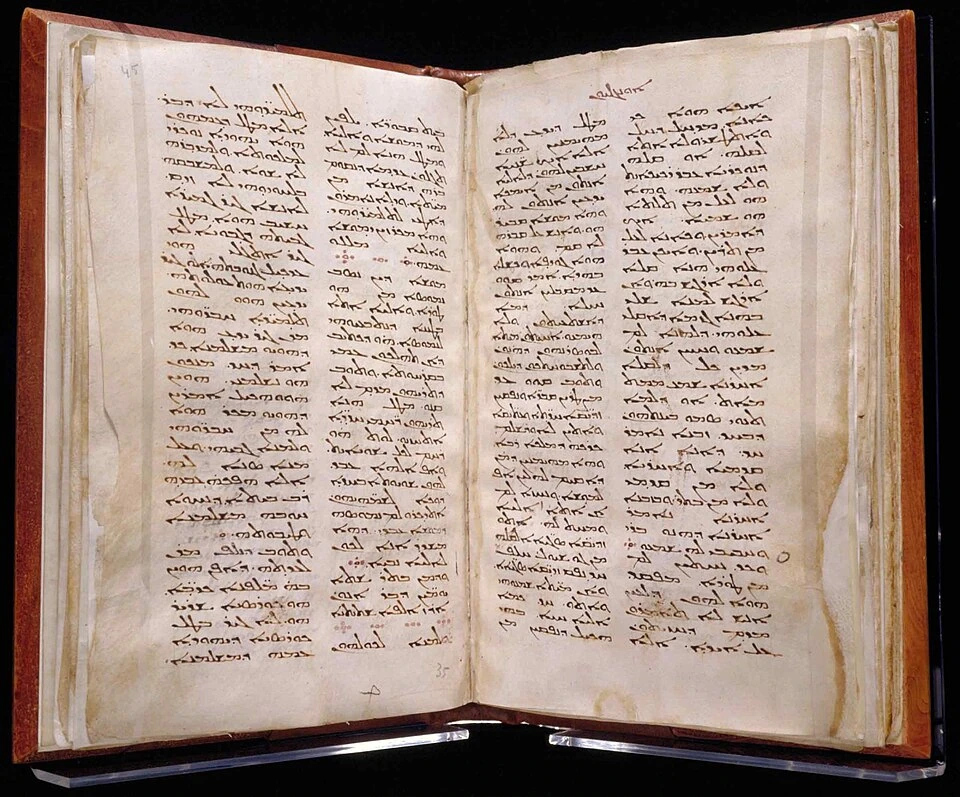
Syriac parchment manuscript, Chester Beatty Syc 709, dated to the late fifth or early sixth century. Commons and Chester Beatty identify the text as Syriac; its placement under Classical Syriac follows its historical literary context. Not independently transcribed.
Saved in Babelbook · resized display copy. Select the image to open it independently of its source.
Ephrem the Syrian (text); Chester Beatty (reproduction); scribe unidentified · Source ↗Public domain (PD-Art) ↗View the local visual field note
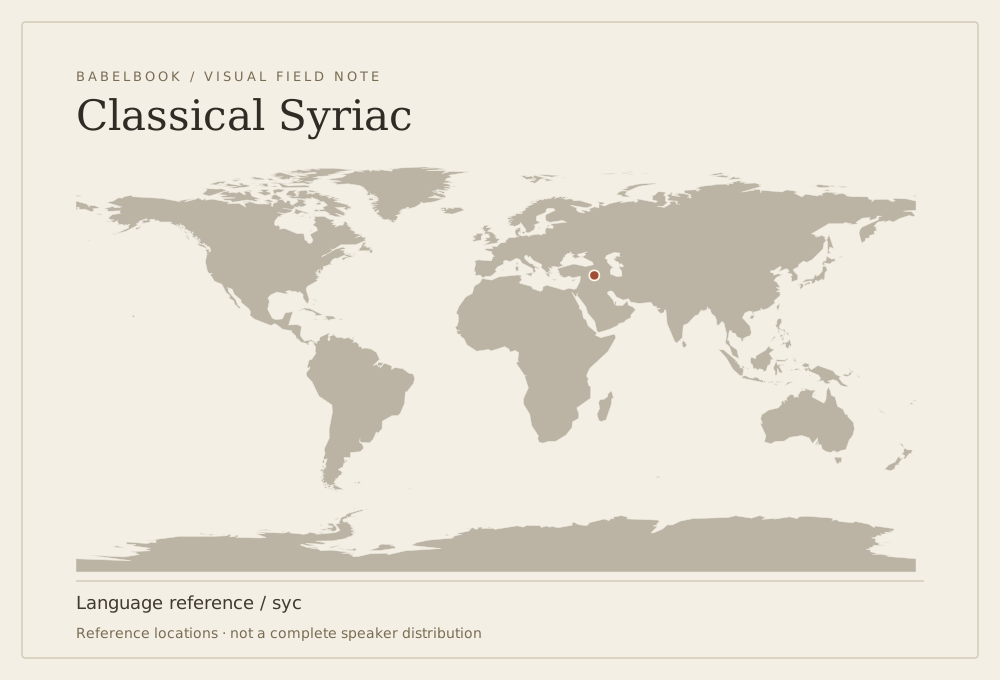
Representative reference points from Glottolog. Historical entries show reference locations, not current speakers. 1 point.
Reference & context ↗Babelbook · original editorial illustration · CC BY 4.0 · Glottolog locations; public-domain Natural Earth land
Source excerpts, selected, shortened and where noted editorially corrected from Syriac language by Wikipedia contributors. Retrieved 2026-10-05. CC BY-SA 4.0. These excerpts are not an independently verified scholarly history; missing accounts are identified above.
Read further in the source
Geographic distribution
Syriac was the local dialect of Aramaic in Edessa, and evolved under the influence of the Church of the East and the Syriac Orthodox Church into its current form. Before Arabic became the dominant language, Syriac was a major language among Christian communities in the Middle East, Central Asia and the Malabar Coast in India, and remains so among the Syriac Christians to this day. It has been found as far afield as Hadrian's Wall in Great Britain, with inscriptions written by Aramaic-speaking soldiers of the Roman Empire.
History
The history of the Syriac language is divided into several successive periods, defined primarily by linguistic, and also by cultural criteria. Some terminological and chronological distinctions exist between different classifications, that were proposed among scholars.
"Old Syriac" (Old-Edessan Aramaic), represents the earliest stage in development of the language, that emerged by the beginning of the first century AD as the main Aramaic dialect in the region of Osroene, centered in Edessa, and continued to develop during the next two or three centuries, gradually gaining wider regional significance. "Middle Syriac" (Middle-Edessan Aramaic), most commonly known as "Classical Syriac" or "Literary Syriac" (ܟܬܒܢܝܐ Kṯāḇānāyā), represents the most important period in the history of the language, marked by notable literary, liturgical and cultural development and expansion, from the third to the thirteenth century. The period is further subdivided into three stages: Early Classical Syriac (Pre-Classical Syriac), represents the earliest stage in development of Classical Syriac during the third and fourth century, preceding the later linguistic standardization. Classical Syriac (in the narrower sense of the term), represents the main, standardized stage in development of Classical Syriac, from the fourth century up to the eighth century. Late Classical Syriac (Post-Classical Syriac), represents the later, somewhat declining stage in development of Classical Syriac, from the eighth century up to the twelfth or thirteenth century. "Modern Syriac" (Neo-Syriac Aramaic) represents modern Neo-Aramaic languages. Neo-Syriac languages did not develop directly from Classical Syriac, but rather from closely related dialects, usually belonging to the same branch of Aramaic. Those dialects have long co-existed with Classical Syriac as a liturgical and literary language, and were significantly influenced by it during the late medieval and early modern period. Modern Syriac is divided into: Modern Eastern Syriac (Northeastern Neo-Aramaic), including primarily Assyrian Neo-Aramaic and Chaldean Neo-Aramaic. The term is usually not used in reference to Neo-Mandaic, another variety of Eastern Aramaic spoken by the Mandaeans. Modern Western Syriac (Central Neo-Aramaic), including (Turoyo and Mlahsô). Modern Maaloulian Syriac (Western Neo-Aramaic), particularly the dialect of Maaloula is rarely referred to as "Modern Syriac" today, though it was historically described as "Syriac" or "Neo-Syriac" by some observers, likely due to its endonym Siryon.
Origins
During the first three centuries of the Common Era, a local Aramaic dialect spoken in the Kingdom of Osroene, centered in Edessa, to the east of the Euphrates, started to gain prominence and regional significance. There are about eighty extant early inscriptions, written in Old-Edessan Aramaic, dated to the first three centuries AD, with the earliest inscription being dated to the 6th year AD, and the earliest parchment to 243 AD. All of these early examples of the language are non-Christian. As a language of public life and administration in the region of Osroene, Edessan Aramaic was gradually given a relatively coherent form, style and grammar that is lacking in other Aramaic dialects of the same period. Since Old-Edessan Aramaic later developed into Classical Syriac, it was retroactively labeled by western scholars as "Old Syrian/Syriac" or "Proto-Syrian/Syriac", although the linguistic homeland of the language in the region of Osroene, was never part of contemporary (Roman) Syria.
Current status
Revivals of literary Syriac in recent times have led to some success with the creation of newspapers in written Syriac (ܟܬܒܢܝܐ Kṯāḇānāyā), similar to the use of Modern Standard Arabic has been employed since the early decades of the 20th century. Modern forms of literary Syriac have also been used not only in religious literature but also in secular genres, often with Assyrian nationalistic themes. Syriac is spoken as the liturgical language of the Syriac Orthodox Church, as well as by some of its adherents. Syriac has been recognised as an official minority language in Iraq. It is also taught in some public schools in Iraq, Syria, Palestine, Israel, Sweden, Augsburg (Germany) and Kerala (India). In 2014, an Assyrian nursery school could finally be opened in Yeşilköy, Istanbul, after waging a lawsuit against the Ministry of National Education which had denied it permission, but was required to respect non-Muslim minority rights as specified in the Treaty of Lausanne. In August 2016, the Ourhi Centre was founded by the Assyrian community in the city of Qamishli, to educate teachers in order to make Syriac an additional language to be taught in public schools in the Jazira Region of the Autonomous Administration of North and East Syria, which then started with the 2016/17 academic year. In April 2023, a team of AI researchers completed the first AI translation model and website for classical Syriac.