Tamil
Tamil (தமிழ், Tamiḻ, pronounced [t̪amiɻ] ) is a Dravidian language spoken by the Tamil people of South Asia where they are concentrated in Tamil Nadu and Pondicherry in India and the Northern and Eastern Provinces in Sri Lanka. It is one of the longest-surviving classical languages in the world, attested since c. 300 BCE. Tamil was the lingua franca for early maritime traders in South India, with Tamil inscriptions found outside of the Indian subcontinent, such as Indonesia, Thailand, and Egypt. The language has a well-documented history with literary works like Sangam literature, consisting of over 2,000 poems. Tamil script evolved from Tamil Brahmi, and later, the vatteluttu script was used until the current script was standardized. The language has a distinct grammatical structure, with agglutinative morphology that allows for complex word formations. Tamil is the official language of the state of Tamil Nadu and union territory of Puducherry in India. It is also one of the official languages of Sri Lanka and Singapore. Tamil-speaking diaspora communities exist in several countries across the world. Tamil was the first to be recognized as a classical language of India by the Central Government in 2004.
Translate in Tamil ↗Tamil is the primary language of the majority of the people residing in Tamil Nadu, Puducherry, (in India) and in the Northern and Eastern provinces of Sri Lanka. The language is spoken among small minority groups in other states of India which include Karnataka, Telangana, Andhra Pradesh, Kerala, Maharashtra, Gujarat, Delhi, Andaman and Nicobar Islands in India and in certain regions of Sri Lanka such as Colombo and the hill country. Tamil or dialects of it were used widely in the state of Kerala as the major language of administration, literature and common usage until the 12th century CE. Tamil was also used widely in inscriptions found in southern Andhra Pradesh districts of Chittoor and Nellore until the 12th century CE. Tamil was used for inscriptions from the 10th through 14th centuries in southern Karnataka districts such as Kolar, Mysore, Mandya and Bengaluru. There are currently sizeable Tamil-speaking populations descended from colonial-era migrants in Malaysia, Singapore, Philippines, Mauritius, South Africa, Indonesia, Thailand, Burma, Brunei, and Vietnam. Tamil is used as one of the languages of education in Malaysia, along with English, Malay and Mandarin. A large community of Pakistani Tamils speakers exists in Karachi, Pakistan, which includes Tamil-speaking Hindus as well as Christians and Muslims – including some Tamil-speaking Muslim refugees from Sri Lanka. There are about 100 Tamil Hindu families in Madrasi Para colony in Karachi. They speak impeccable Tamil along with Urdu, Punjabi and Sindhi. Many in Réunion, Guyana, Fiji, Suriname, and Trinidad and Tobago have Tamil origins, but only a small number speak the language. In Reunion where the Tamil language was forbidden to be learnt and used in public space by France it is now being relearnt by students and adults.
South Asia
Present-day use
The Nannūl remains the standard normative grammar for modern literary Tamil, which therefore continues to be based on Middle Tamil of the 13th century rather than on Modern Tamil. Colloquial spoken Tamil, in contrast, shows a number of changes. The negative conjugation of verbs, for example, has fallen out of use in Modern Tamil – instead, negation is expressed either morphologically or syntactically. Modern spoken Tamil also shows a number of sound changes, in particular, a tendency to lower high vowels in initial and medial positions, and the disappearance of vowels between plosives and between a plosive and rhotic. Contact with European languages affected written and spoken Tamil. Changes in written Tamil include the use of European-style punctuation and the use of consonant clusters that were not permitted in Middle Tamil. The syntax of written Tamil has also changed, with the introduction of new aspectual auxiliaries and more complex sentence structures, and with the emergence of a more rigid word order that resembles the syntactic argument structure of English. In 1578, Portuguese Christian missionaries published a Tamil prayer book in old Tamil script named Thambiran Vanakkam, thus making Tamil the first Indian language to be printed and published. The Tamil Lexicon, published by the University of Madras, was one of the earliest dictionaries published in Indian languages. A strong strain of linguistic purism emerged in the early 20th century, culminating in the Pure Tamil Movement which called for removal of all Sanskritic elements from Tamil. It received some support from Dravidian parties. This led to the replacement of a significant number of Sanskrit loanwords by Tamil equivalents, though many others remain. According to a 2001 survey, there were 1,863 newspapers published in Tamil, of which 353 were dailies. Tamil is the official language of the Indian state of Tamil Nadu and one of the 22 languages under schedule 8 of the constitution of India.
Origins
The earliest extant Tamil literary works and their commentaries celebrate the Pandiyan Kings for the organization of long-term Tamil Sangams, which researched, developed and made amendments to the Tamil language. Although the name of the language which was developed by these Tamil Sangams is mentioned as Tamil, the period when the name "Tamil" came to be applied to the language is unclear, as is the precise etymology of the name. The earliest attested use of the name is found in Tholkappiyam, which is also the oldest extant Tamil text, dated as early as the 2nd century BCE. The Hathigumpha inscription, inscribed around a similar period (150 BCE) by Kharavela, the Jain king of Kalinga, also refers to a Tamira Samghatta (Tamil confederacy). The Samavayanga Sutra, dated to the 3rd century BCE, contains a reference to a Tamil script named 'Damili'. Southworth suggests that the name comes from tam-miḻ > tam-iḻ "self-speak", or "our own speech". Kamil Zvelebil suggests an etymology of tam-iḻ, with tam meaning "self" or "one's self", and "-iḻ" having the connotation of "unfolding sound". Alternatively, he suggests a derivation of tamiḻ < tam-iḻ < *tav-iḻ < *tak-iḻ, meaning in origin "the proper process (of speaking)". However, this is deemed unlikely by Southworth due to the contemporary use of the compound 'centamiḻ', which means refined speech in the earliest literature. The Tamil Lexicon of the University of Madras defines the word "Tamil" as "sweetness". S. V.
Development
The captured article does not contain a distinct historical account. No chronology has been invented.
Writing
About 60,000 of the approximately 100,000 inscriptions found by the Archaeological Survey of India in India are in Tamil Nadu. Of them, most are in Tamil, with only about 5 percent in other languages such as Telugu, Kannada, Sanskrit and Marathi. In 2004, a number of skeletons were found buried in earthenware urns dating from at least 696 BCE in Adichanallur. Some of these urns contained writing in Tamil Brahmi script, and some contained skeletons of Tamil origin. Between 2017 and 2018, 5,820 artifacts have been found in Keezhadi. These were sent to Beta Analytic in Miami, Florida, for Accelerator Mass Spectrometry (AMS) dating. One sample containing Tamil-Brahmi inscriptions was claimed to be dated to around 580 BCE. John Guy states that Tamil was the lingua franca for early maritime traders from India. Tamil language inscriptions written in Brahmi script have been discovered in Sri Lanka and on trade goods in Thailand and Egypt. In November 2007, an excavation at Quseir-al-Qadim (likely the classical-era port town Myos Hormos) revealed Egyptian pottery dating back to first century BCE with ancient Tamil Brahmi inscriptions. There are a number of apparent Tamil loanwords in Biblical Hebrew dating to before 500 BCE, the oldest attestation of the language. After Tamil Brahmi fell out of use, Tamil was written using a script called vaṭṭeḻuttu amongst others such as Grantha and Pallava. The current Tamil script consists of 12 vowels, 18 consonants and one special character, the āytam. The vowels and consonants combine to form 216 compound characters, giving a total of 247 characters (12 + 18 + 1 + (12 × 18)). All consonants have an inherent vowel a, as with other Indic scripts. This inherent vowel is removed by adding a tittle called a puḷḷi, to the consonantal sign. For example, ன is ṉa (with the inherent a) and ன் is ṉ (without a vowel).
Beyond the typeface.
Signs, manuscripts, published pages and contextual photographs, with their place, period, source and reuse terms. Captions identify historical spellings, regional examples, community references and character imagery.
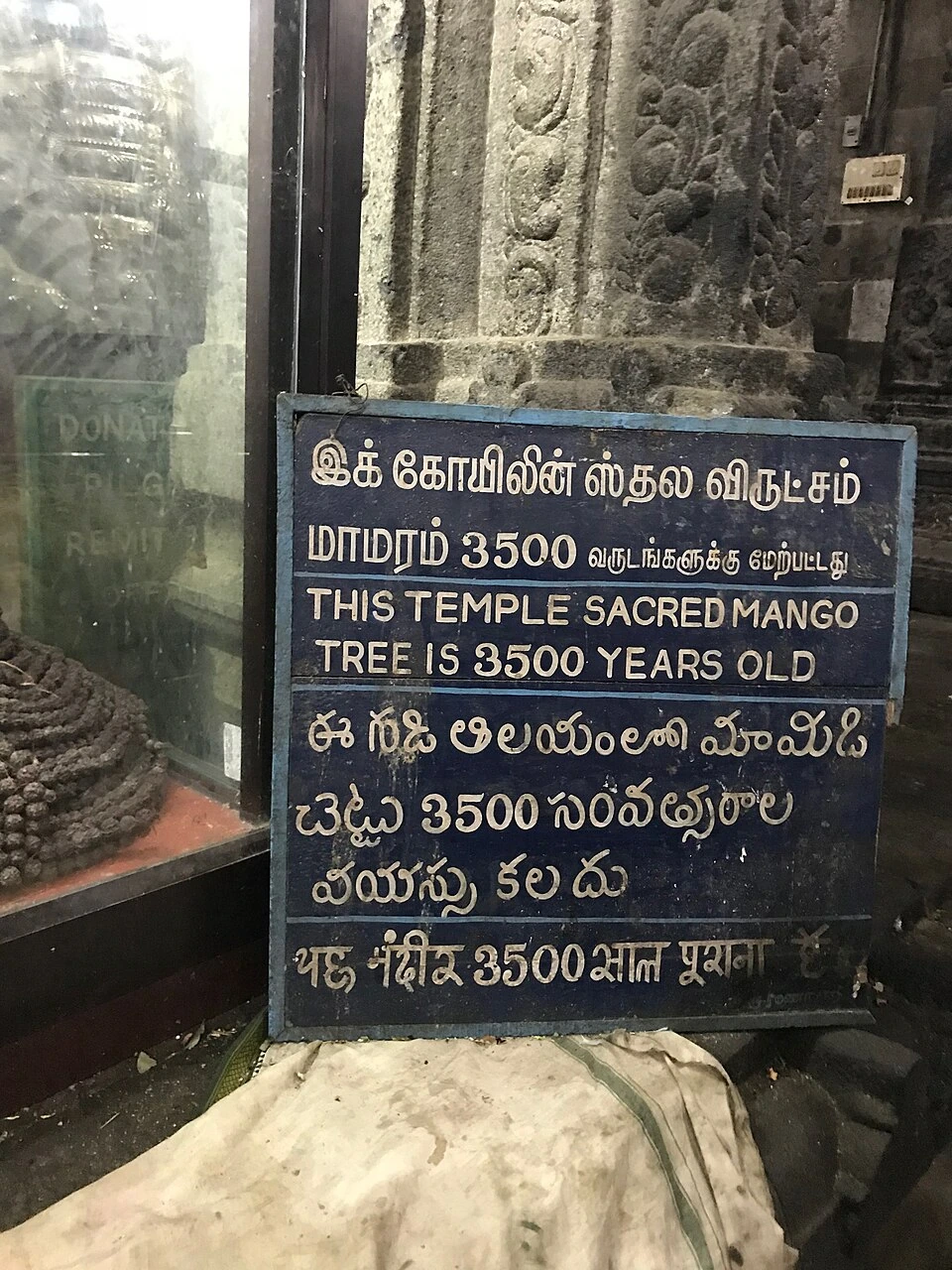
Tamil text on the multilingual mango-tree information sign at Ekambareswarar Temple, Kanchipuram, alongside Telugu, Hindi and English. Source-identified language; displayed without additional cropping.
Saved in Babelbook · resized display copy. Select the image to open it independently of its source.
Ms Sarah Welch · Source ↗CC BY-SA 4.0 ↗View the local visual field note
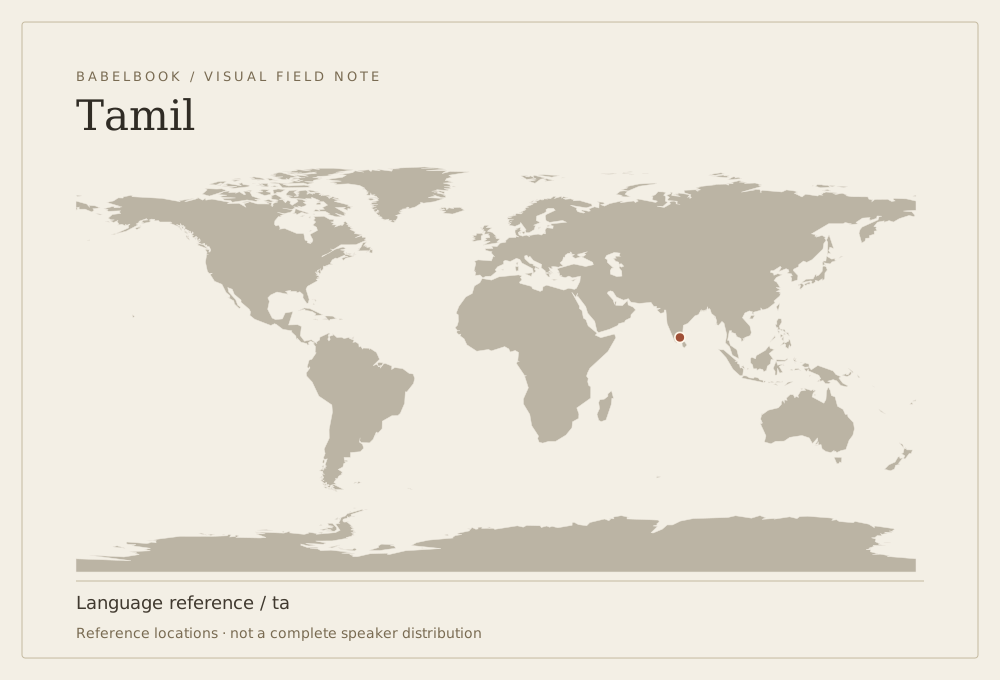
Representative reference points from Glottolog. Historical entries show reference locations, not current speakers. 1 point.
Reference & context ↗Babelbook · original editorial illustration · CC BY 4.0 · Glottolog locations; public-domain Natural Earth land
Source excerpts, selected, shortened and where noted editorially corrected from Tamil language by Wikipedia contributors. Retrieved 2026-10-05. CC BY-SA 4.0. These excerpts are not an independently verified scholarly history; missing accounts are identified above.
Read further in the source
Legendary origins
According to Hindu legend, Tamil or in personification form Tamil Thāi (Mother Tamil) was created by Lord Shiva. Murugan, revered as the Tamil God, along with sage Agastya, brought it to the people.
Historical origins
Tamil, like other Dravidian languages, ultimately descends from the Proto-Dravidian language, which was most likely spoken around the third millennium BCE, possibly in the region around the lower Godavari river basin. The material evidence suggests that the speakers of Proto-Dravidian were of the culture associated with the Neolithic complexes of South India. Scholars categorise the attested history of the language into three periods: Old Tamil (300 BCE–700 CE), Middle Tamil (700–1600) and Modern Tamil (1600–present).
Geographic distribution
Tamil is the primary language of the majority of the people residing in Tamil Nadu, Puducherry, (in India) and in the Northern and Eastern provinces of Sri Lanka. The language is spoken among small minority groups in other states of India which include Karnataka, Telangana, Andhra Pradesh, Kerala, Maharashtra, Gujarat, Delhi, Andaman and Nicobar Islands in India and in certain regions of Sri Lanka such as Colombo and the hill country. Tamil or dialects of it were used widely in the state of Kerala as the major language of administration, literature and common usage until the 12th century CE. Tamil was also used widely in inscriptions found in southern Andhra Pradesh districts of Chittoor and Nellore until the 12th century CE. Tamil was used for inscriptions from the 10th through 14th centuries in southern Karnataka districts such as Kolar, Mysore, Mandya and Bengaluru. There are currently sizeable Tamil-speaking populations descended from colonial-era migrants in Malaysia, Singapore, Philippines, Mauritius, South Africa, Indonesia, Thailand, Burma, Brunei, and Vietnam. Tamil is used as one of the languages of education in Malaysia, along with English, Malay and Mandarin. A large community of Pakistani Tamils speakers exists in Karachi, Pakistan, which includes Tamil-speaking Hindus as well as Christians and Muslims – including some Tamil-speaking Muslim refugees from Sri Lanka. There are about 100 Tamil Hindu families in Madrasi Para colony in Karachi. They speak impeccable Tamil along with Urdu, Punjabi and Sindhi. Many in Réunion, Guyana, Fiji, Suriname, and Trinidad and Tobago have Tamil origins, but only a small number speak the language. In Reunion where the Tamil language was forbidden to be learnt and used in public space by France it is now being relearnt by students and adults. Tamil is also spoken by migrants from Sri Lanka and India in Canada, the United States, the United Arab Emirates, the United Kingdom, South Africa, and Australia.
Official status
Tamil is the official language of the Indian state of Tamil Nadu and one of the 22 languages under schedule 8 of the constitution of India. It is one of the official languages of the union territories of Puducherry and the Andaman and Nicobar Islands. Tamil is also one of the official languages of Singapore. Tamil is one of the official and national languages of Sri Lanka, along with Sinhala. It was once given nominal official status in the Indian state of Haryana, purportedly as a rebuff to Punjab, though there was no attested Tamil-speaking population in the state, and was later replaced by Punjabi, in 2010. In addition, with the creation in October 2004 of a legal status for classical languages by the Government of India and following a political campaign supported by several Tamil associations, Tamil became the first legally recognised Classical language of India. The recognition was announced by the contemporaneous President of India, Abdul Kalam, who was a Tamil himself, in a joint sitting of both houses of the Indian Parliament on 6 June 2004.
Writing system
After Tamil Brahmi fell out of use, Tamil was written using a script called vaṭṭeḻuttu amongst others such as Grantha and Pallava. The current Tamil script consists of 12 vowels, 18 consonants and one special character, the āytam. The vowels and consonants combine to form 216 compound characters, giving a total of 247 characters (12 + 18 + 1 + (12 × 18)). All consonants have an inherent vowel a, as with other Indic scripts. This inherent vowel is removed by adding a tittle called a puḷḷi, to the consonantal sign. For example, ன is ṉa (with the inherent a) and ன் is ṉ (without a vowel). Many Indic scripts have a similar sign, generically called virama, but the Tamil script is somewhat different in that it nearly always uses a visible puḷḷi to indicate a 'dead consonant' (a consonant without a vowel). In other Indic scripts, it is generally preferred to use a ligature or a half form to write a syllable or a cluster containing a dead consonant, although writing it with a visible virama is also possible. The Tamil script does not differentiate voiced and unvoiced plosives. Instead, plosives are articulated with voice depending on their position in a word, in accordance with the rules of Tamil phonology. In addition to the standard characters, six characters taken from the Grantha script, which was used in the Tamil region to write Sanskrit, are sometimes used to represent sounds not native to Tamil, that is, words adopted from Sanskrit, Prakrit, and other languages. The traditional system prescribed by classical grammars for writing loan-words, which involves respelling them in accordance with Tamil phonology, remains, but is not always consistently applied. ISO 15919 is an international standard for the transliteration of Tamil and other Indic scripts into Latin characters. It uses diacritics to map the much larger set of Brahmic consonants and vowels to Latin script, and thus the alphabets of various languages, including English.