Telugu
Telugu ( ; తెలుగు, Telugu pronunciation: [ˈt̪eluɡu] ) is a Dravidian language native to the Indian states of Andhra Pradesh and Telangana, where it is also the official language. Telugu is a classical language with a recorded history of at least 2,000 years. Spoken by about 100 million people, Telugu is the most widely spoken member of the Dravidian language family, and one of the twenty-two scheduled languages of the Republic of India. It is one of the few languages that has primary official status in more than one Indian state, alongside Hindi and Bengali. Telugu is one of the languages designated as a classical language by the Government of India. It is the fourteenth most spoken native language in the world. Telugu is also spoken in the states of Karnataka, Tamil Nadu, Kerala, Maharashtra, Chhattisgarh, Odisha and the union territories of Puducherry and Andaman and Nicobar Islands, although it is not a main language in those states and only a minority speaks them. It is also spoken by members of the Telugu diaspora spread across countries like the United States, Australia, Malaysia, Mauritius, UAE, Saudi Arabia, and others. Telugu is the fastest-growing language in the United States. It is also a protected language in South Africa and is offered as an optional third language in schools in KwaZulu-Natal province. According to Mikhail S. Andronov, Telugu split from the Proto-Dravidian language around 1000 BCE. The earliest Telugu words appear in Prakrit inscriptions dating to c. 4th century BCE, found in Bhattiprolu, Andhra Pradesh.
Translate in Telugu ↗Telugu is natively spoken in the states of Andhra Pradesh and Telangana and Yanam district of Puducherry. Telugu speakers are also found in the neighbouring states of Tamil Nadu, Karnataka, Maharashtra, Odisha, Chhattisgarh, some parts of Jharkhand, and the Kharagpur region of West Bengal in India. Many Telugu immigrants are also found in the states of Andaman and Nicobar Islands, Gujarat, Goa, Bihar, Kashmir, Uttar Pradesh, Punjab, Haryana, and Rajasthan. As of 2018 7.2% of the population, Telugu is the fourth-most-spoken native language in India after Hindi, Bengali, and Marathi. In Karnataka, 7.0% of the population speak Telugu, and 5.6% in Tamil Nadu. There are more than 400,000 Telugu Americans in the United States. As of 2018, Telugu is the fastest-growing language in the United States, (especially in New Jersey and New York City), with the number of Telugu speakers in the United States increasing by 86% between 2010 and 2017. As of 2021, it is the 18th most spoken native language in the United States and the third most spoken South Asian language after Hindi and Urdu. Minority Telugus are also found in Australia, New Zealand, Bahrain, Canada, Fiji, Malaysia, Sri Lanka, Singapore, Mauritius, Myanmar, Europe (Italy, the United Kingdom), South Africa, Trinidad and Tobago, and the United Arab Emirates. Telugu is the official language of the Indian states of Andhra Pradesh and Telangana. It is one of the 22 languages under schedule 8 of the constitution of India. It is one of the official languages of the union territories of Puducherry. Telugu is a protected language in South Africa. According to the Constitution of South Africa, the Pan South African Language Board must promote and ensure respect for Telugu along with other languages.
South Asia
Present-day use
Telugu is the official language of the Indian states of Andhra Pradesh and Telangana. It is one of the 22 languages under schedule 8 of the constitution of India. It is one of the official languages of the union territories of Puducherry. Telugu is a protected language in South Africa. According to the Constitution of South Africa, the Pan South African Language Board must promote and ensure respect for Telugu along with other languages. The Government of South Africa announced that Telugu will be re-included as an official subject in the South African schools after it was removed from the curriculum in state schools. In addition, with the creation in October 2004 of a legal status for classical languages by the Government of India on 8 August 2008, Telugu was also given classical language status due to several campaigns.
Origins
Speakers of Telugu refer to it as simply Telugu or Telugoo. Older forms of the name include Teluṅgu and Tenuṅgu. Tenugu is derived from the Proto-Dravidian word *ten ('south') to mean 'the people who lived in the south/southern direction' (relative to Sanskrit- and Prakrit-speaking peoples). The name Telugu, then, is a result of an "n" to "l" alternation established in Telugu. The popular belief holds that Telugu is derived from Trilinga of Trilinga Kshetras being the land bounded by the three Lingas which is Telugu homeland. P. Chenchiah and Bhujanga Rao note that Atharvana Acharya in the 13th century wrote a grammar of Telugu, calling it the Trilinga Śabdānusāsana (or Trilinga Grammar). However, most scholars note that Atharvana's grammar was titled Atharvana Karikavali. Appa Kavi in the 17th century explicitly wrote that Telugu was derived from Trilinga. Scholar C. P. Brown made a comment that it was a "strange notion" since the predecessors of Appa Kavi had no knowledge of such a derivation. George Abraham Grierson and other linguists doubt this derivation, holding rather that Telugu was the older term and Trilinga must be the later Sanskritisation of it. If so the derivation itself must have been quite ancient because Triglyphum, Trilingum and Modogalingam are attested in ancient Greek sources, the last of which can be interpreted as a Telugu rendition of "Trilinga".
Development
Telugu, as a Dravidian language, descends from Proto-Dravidian, a proto-language. Linguistic reconstruction suggests that Proto-Dravidian was spoken around the fourth millennium BCE. Comparative linguistics confirms that Telugu belongs to the South Dravidian-II (also called South-Central Dravidian) sub-group, which also includes the non-literary languages like Gondi, Kuvi, Koya, Pengo, Konda and Manda. Proto-Telugu is the reconstructed linguistic ancestor of all the dialects and registers of Telugu. Russian linguist Mikhail S. Andronov, places the split of Telugu at c.1000 BCE. The linguistic history of Telugu is periodised as follows: Pre-historic Telugu (c. 600 BCE–200 BCE) Old Telugu (200 BCE–1000 CE) Middle Telugu (1000 CE–1600 CE) Modern Telugu (1600 CE–present)
Writing
Telugu script is an abugida comprising 60 symbols – 16 vowels, 3 vowel modifiers, and 41 consonants. Telugu has a complete set of letters that follow a system to express sounds. The script is derived from the Brahmi script like those of many other Indian languages. Telugu script is written from left to right and comprises sequences of both simple and complex characters. It is syllabic in nature – the basic units of writing are syllables. Inasmuch as the number of possible syllables is very large, syllables are composed of more basic units such as vowels ("acchu" or "swaram") and consonants ("hallu" or "vyanjanam"). Consonants in consonant clusters take shapes that are very different from the shapes they take elsewhere. Consonants are presumed pure consonants, that is, without any vowel sound in them. However, it is traditional to write and read consonants with an implied "a" vowel sound. When consonants combine with other vowel signs, the vowel part is indicated orthographically using signs known as vowel "mātras". The shapes of vowel "mātras" are also very different from the shapes of the corresponding vowels. Historically, a sentence used to end with either a single bar। ("pūrna virāmam") or a double bar॥ ("dīrgha virāmam"); in handwriting, Telugu words were not separated by spaces. However, in modern times, English punctuation (commas, semicolon, etc.) has virtually replaced the old method of punctuation. Telugu has full-zero ("anusvāra" or "sunna" ) ( ం ), half-zero ("arthanusvāra" or "candrabindu" or "ara-sunna" ) (ఁ) and visarga ( ః ) to convey various shades of nasal sounds. [la] and [La], [ra] and [Ra] are differentiated. Telugu has ĉ [t͡s] and ĵ [d͡z], which are not represented in Sanskrit. These writings were mostly written by the Vishnukudinas, Telugu Chodas, and the Chalukyas. This is the first writing entirely written in Telugu. It was written by Renati Choda king Dhanunjaya. in 575 CE.
Beyond the typeface.
Signs, manuscripts, published pages and contextual photographs, with their place, period, source and reuse terms. Captions identify historical spellings, regional examples, community references and character imagery.
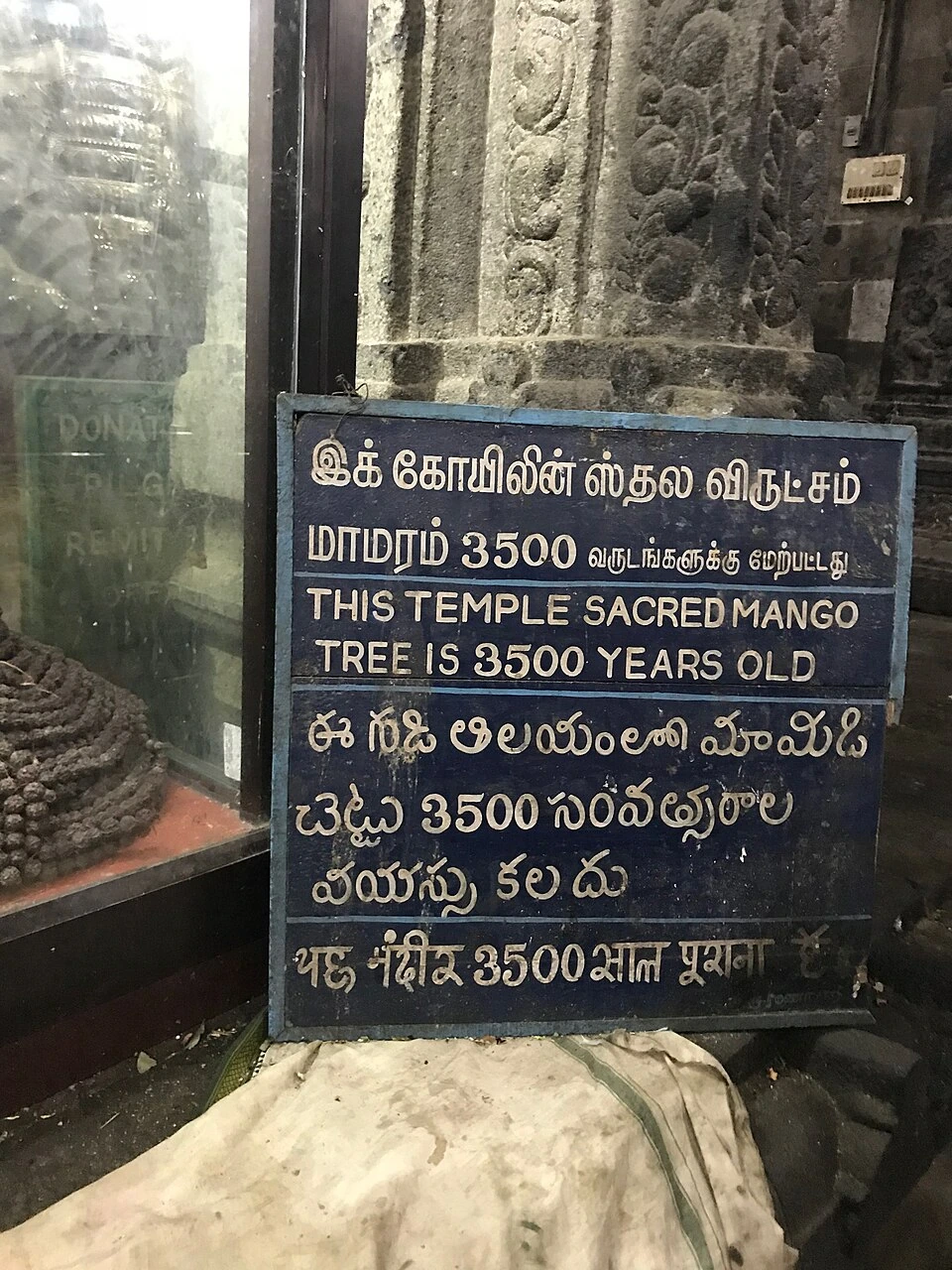
Telugu text on the multilingual mango-tree information sign at Ekambareswarar Temple, Kanchipuram, alongside Tamil, Hindi and English. Source-identified language; displayed without additional cropping.
Saved in Babelbook · resized display copy. Select the image to open it independently of its source.
Ms Sarah Welch · Source ↗CC BY-SA 4.0 ↗View the local visual field note
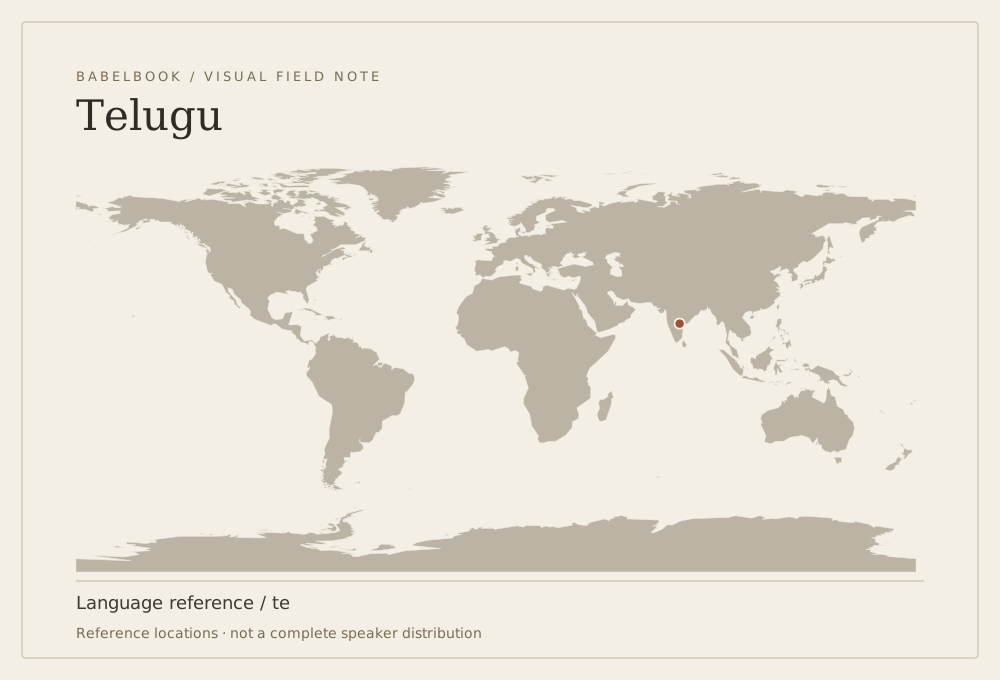
Representative reference points from Glottolog. Historical entries show reference locations, not current speakers. 1 point.
Reference & context ↗Babelbook · original editorial illustration · CC BY 4.0 · Glottolog locations; public-domain Natural Earth land
Source excerpts, selected, shortened and where noted editorially corrected from Telugu language by Wikipedia contributors. Retrieved 2026-10-05. CC BY-SA 4.0. These excerpts are not an independently verified scholarly history; missing accounts are identified above.
Read further in the source
History
Telugu, as a Dravidian language, descends from Proto-Dravidian, a proto-language. Linguistic reconstruction suggests that Proto-Dravidian was spoken around the fourth millennium BCE. Comparative linguistics confirms that Telugu belongs to the South Dravidian-II (also called South-Central Dravidian) sub-group, which also includes the non-literary languages like Gondi, Kuvi, Koya, Pengo, Konda and Manda. Proto-Telugu is the reconstructed linguistic ancestor of all the dialects and registers of Telugu. Russian linguist Mikhail S. Andronov, places the split of Telugu at c.1000 BCE. The linguistic history of Telugu is periodised as follows:
Pre-historic Telugu (c. 600 BCE–200 BCE) Old Telugu (200 BCE–1000 CE) Middle Telugu (1000 CE–1600 CE) Modern Telugu (1600 CE–present)
Geographic distribution
Telugu is natively spoken in the states of Andhra Pradesh and Telangana and Yanam district of Puducherry. Telugu speakers are also found in the neighbouring states of Tamil Nadu, Karnataka, Maharashtra, Odisha, Chhattisgarh, some parts of Jharkhand, and the Kharagpur region of West Bengal in India. Many Telugu immigrants are also found in the states of Andaman and Nicobar Islands, Gujarat, Goa, Bihar, Kashmir, Uttar Pradesh, Punjab, Haryana, and Rajasthan. As of 2018 7.2% of the population, Telugu is the fourth-most-spoken native language in India after Hindi, Bengali, and Marathi. In Karnataka, 7.0% of the population speak Telugu, and 5.6% in Tamil Nadu. There are more than 400,000 Telugu Americans in the United States. As of 2018, Telugu is the fastest-growing language in the United States, (especially in New Jersey and New York City), with the number of Telugu speakers in the United States increasing by 86% between 2010 and 2017. As of 2021, it is the 18th most spoken native language in the United States and the third most spoken South Asian language after Hindi and Urdu. Minority Telugus are also found in Australia, New Zealand, Bahrain, Canada, Fiji, Malaysia, Sri Lanka, Singapore, Mauritius, Myanmar, Europe (Italy, the United Kingdom), South Africa, Trinidad and Tobago, and the United Arab Emirates.
Legal status
Telugu is the official language of the Indian states of Andhra Pradesh and Telangana. It is one of the 22 languages under schedule 8 of the constitution of India. It is one of the official languages of the union territories of Puducherry. Telugu is a protected language in South Africa. According to the Constitution of South Africa, the Pan South African Language Board must promote and ensure respect for Telugu along with other languages. The Government of South Africa announced that Telugu will be re-included as an official subject in the South African schools after it was removed from the curriculum in state schools. In addition, with the creation in October 2004 of a legal status for classical languages by the Government of India on 8 August 2008, Telugu was also given classical language status due to several campaigns.
Dialects and Teluguoid languages
There are four regional dialects in Telugu:
Northern: Telangana Southern: Rayalaseema Central: Coastal Andhra Eastern: North Andhra Colloquially, Telangana, Rayalaseema and Coastal Andhra dialects are considered the three Telugu dialects and regions. Standard Telugu is based on the speech of educated speakers of the Central dialect Waddar, Chenchu, Mukha-Dora, and Manna-Dora are all closely related to Telugu. Other dialects of Telugu are Berad, Dasari, Dommara, Golari, Kamathi, Komtao, Konda-Reddi, Salewari, Vadaga, Vadari Bangalore, and Yanadi.
Writing system
Telugu script is an abugida comprising 60 symbols – 16 vowels, 3 vowel modifiers, and 41 consonants. Telugu has a complete set of letters that follow a system to express sounds. The script is derived from the Brahmi script like those of many other Indian languages. Telugu script is written from left to right and comprises sequences of both simple and complex characters. It is syllabic in nature – the basic units of writing are syllables. Inasmuch as the number of possible syllables is very large, syllables are composed of more basic units such as vowels ("acchu" or "swaram") and consonants ("hallu" or "vyanjanam"). Consonants in consonant clusters take shapes that are very different from the shapes they take elsewhere. Consonants are presumed pure consonants, that is, without any vowel sound in them. However, it is traditional to write and read consonants with an implied "a" vowel sound. When consonants combine with other vowel signs, the vowel part is indicated orthographically using signs known as vowel "mātras". The shapes of vowel "mātras" are also very different from the shapes of the corresponding vowels. Historically, a sentence used to end with either a single bar। ("pūrna virāmam") or a double bar॥ ("dīrgha virāmam"); in handwriting, Telugu words were not separated by spaces. However, in modern times, English punctuation (commas, semicolon, etc.) has virtually replaced the old method of punctuation. Telugu has full-zero ("anusvāra" or "sunna" ) ( ం ), half-zero ("arthanusvāra" or "candrabindu" or "ara-sunna" ) (ఁ) and visarga ( ః ) to convey various shades of nasal sounds. [la] and [La], [ra] and [Ra] are differentiated. Telugu has ĉ [t͡s] and ĵ [d͡z], which are not represented in Sanskrit.
Early Medieval Telugu Writings Period (500 – 850 CE)
These writings were mostly written by the Vishnukudinas, Telugu Chodas, and the Chalukyas.
Kallamalla Writing (575 CE)
This is the first writing entirely written in Telugu. It was written by Renati Choda king Dhanunjaya. in 575 CE. It was found on the premises of Chennakesava-Siddeshwara temple at Kalamalla village in Yerraguntla Mandal of the district.
Vipparla and Lakshmipuram Writings
Vipparla Inscription of Jayasimha I and the Lakshmipuram inscription of the Mangi yuvaraja were the earliest Telugu inscriptions of Eastern chalukyas found in the 7th century AD.