Tajik
Tajik, Tajik Persian, Tajiki Persian, also called Tajiki, as well as sometimes referred to as Eastern Persian, is the variety of the Persian language spoken in Tajikistan and Uzbekistan by ethnic Tajiks. It is closely related to neighbouring Dari in Afghanistan, with which it forms a continuum of mutually intelligible varieties of Persian. Several scholars consider Tajik to be a dialectal variety of Persian rather than a language in its own right. The question of whether Tajik and Persian should be considered two dialects of a single language or two discrete languages has political aspects to it. Through Early New Persian, Tajik, like Iranian Persian and Dari Persian, is a continuation of Middle Persian, the official administrative, religious, and literary language of the Sasanian Empire (224–651 CE), itself a continuation of Old Persian, the language of the Achaemenid Empire (550–330 BC). Tajiki is one of the two official languages of Tajikistan, the other being Russian, which serves as the official interethnic language. In Afghanistan, this language is less influenced by Turkic languages and is regarded as a form of Dari, which has co‑official status. The Tajiki Persian of Tajikistan has diverged from Persian as spoken in Afghanistan, and even more from that of Iran, owing to political borders, geographical isolation, standardisation processes, and the influence of Russian and neighbouring Turkic languages.
Translate in Tajik ↗Two major cities of Central Asia, Samarkand and Bukhara, are in present‑day Uzbekistan, but are defined by a prominent native usage of the Tajik language. Today, virtually all Tajik speakers in Bukhara are bilingual in Tajik and Uzbek. This Tajik–Uzbek bilingualism has had a strong influence on the phonology, morphology, and syntax of Bukharan Tajik. Tajiks are also found in large numbers in the Surxondaryo Region in the south and along Uzbekistan's eastern border with Tajikistan. Tajiki is still spoken by the majority of the population in Samarkand and Bukhara today, although, as Richard Foltz has noted, their spoken dialects diverge considerably from the standard literary language and most cannot read it. Official statistics in Uzbekistan state that the Tajik community comprises 5% of the nation's total population. However, these numbers do not include ethnic Tajiks who, for a variety of reasons, choose to identify themselves as Uzbeks in population census forms. During the Soviet 'Uzbekisation' supervised by Sharof Rashidov, the head of the Uzbek Communist Party, Tajiks had to choose either to stay in Uzbekistan and be registered as Uzbek in their passports or to leave the republic for the less‑developed agricultural and mountainous Tajikistan. The 'Uzbekisation' movement ended in 1924. In Tajikistan, Tajiks constitute 80% of the population, and the language dominates in most parts of the country. Some Tajiks in Gorno-Badakhshan in south‑eastern Tajikistan, where the Pamir languages are the native languages of most residents, are bilingual. Tajiks are the dominant ethnic group in northern Afghanistan as well and are also the majority group in scattered pockets elsewhere in the country, particularly in urban areas such as Kabul, Mazar-i-Sharif, Kunduz, Ghazni, and Herat. Tajiks constitute between 25% and 35% of the total population of the country.
Central Asia
Present-day use
The captured source does not contain a separate current-use account.
Origins
The captured article does not contain a separate origins section. See the historical account and linked source.
Development
According to many scholars, the New Persian language (which subsequently evolved into the Persian forms spoken in Iran, Afghanistan, and Tajikistan) developed in Transoxiana and Khorasan, in what are today parts of Afghanistan, Iran, Uzbekistan, and Tajikistan. While New Persian was descended primarily from Middle Persian, it also incorporated substantial elements of other Iranian languages of ancient Central Asia, such as Sogdian. Following the Islamic conquest of Iran and most of Central Asia in the 8th century AD, Arabic for a time became the court language, and Persian and other Iranian languages were relegated to the private sphere. In the 9th century AD, following the rise of the Samanids, whose state was centred around the cities of Bukhara (Buxoro), Samarqand, and Herat and covered much of Uzbekistan, Tajikistan, Afghanistan, and north-eastern Iran, New Persian emerged as the court language and swiftly displaced Arabic. New Persian became the lingua franca of Central Asia for centuries, although it eventually lost ground to the Chaghatai language in much of its former domains as a growing number of Turkic tribes moved into the region from the east. Since the 16th century AD, Tajik has come under increasing pressure from neighbouring Turkic languages. Once spoken in areas of Turkmenistan, such as Merv, Tajik is today virtually non-existent in that country. Uzbek has also largely replaced Tajik in most areas of modern Uzbekistan—the Russian Empire in particular implemented Turkification among Tajiks in Ferghana and Samarqand, replacing the dominant language in those areas with Uzbek. Nevertheless, Tajik persisted in pockets, notably in Samarqand, Bukhara, and Surxondaryo Region, as well as in much of what is today Tajikistan. The creation of the Tajik Soviet Socialist Republic within the Soviet Union in 1929 helped to safeguard the future of Tajik, as it became an official language of the republic alongside Russian.
Writing
In Tajikistan and other countries of the former Soviet Union, Tajik Persian is currently written in the Cyrillic script, although it was written in the Latin script from 1928 and in the Arabic alphabet prior to 1928. In the Tajik Soviet Socialist Republic, the use of the Latin script was later replaced in 1939 by the Cyrillic script. The Tajik alphabet added six additional letters to the Cyrillic script inventory, and these additional letters are distinguished in Tajik orthography by the use of diacritics.
Beyond the typeface.
Signs, manuscripts, published pages and contextual photographs, with their place, period, source and reuse terms. Captions identify historical spellings, regional examples, community references and character imagery.
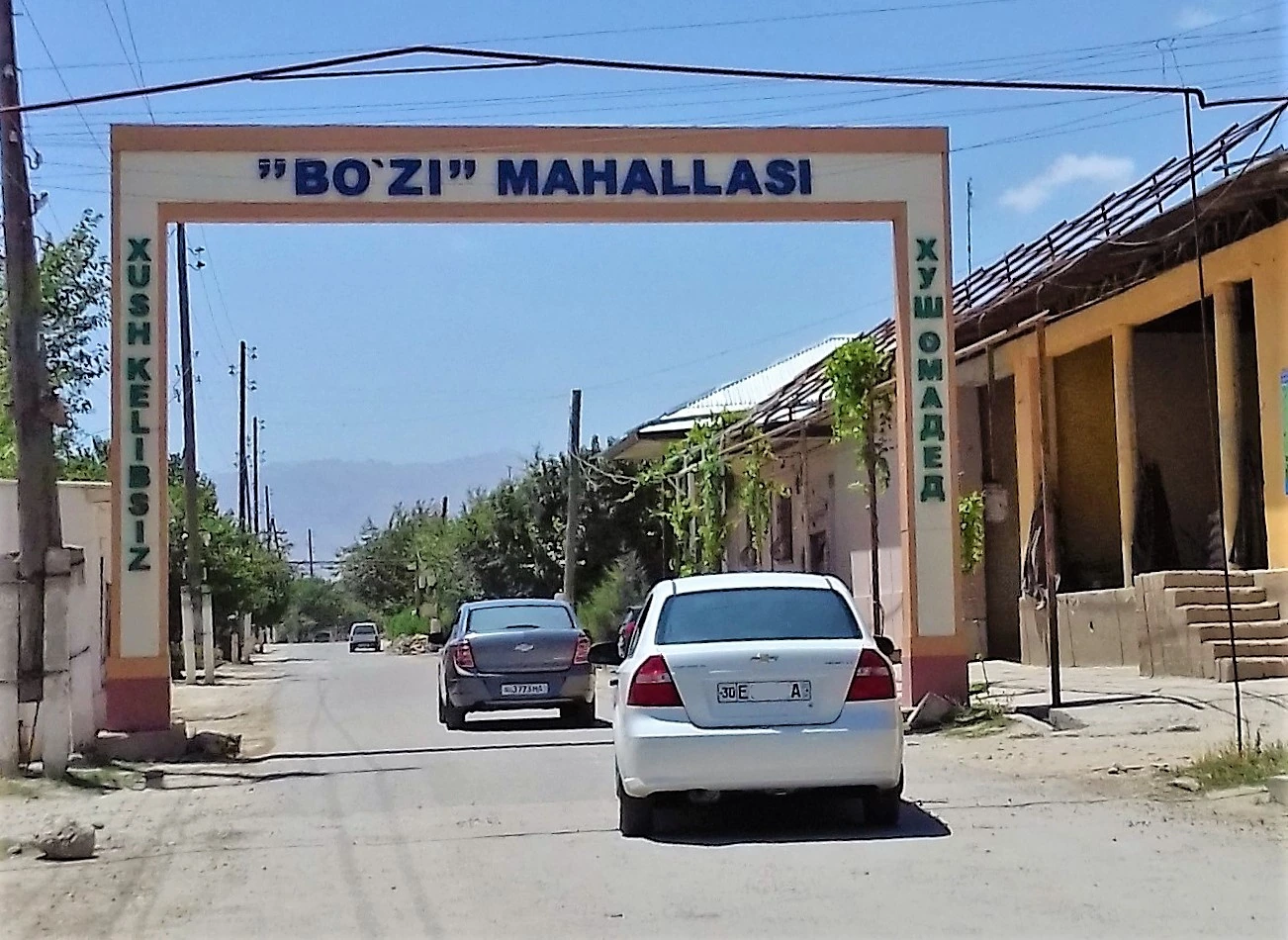
An entrance arch in the Bo'zi mahalla bearing a welcome in Tajik and Uzbek.
Saved in Babelbook · resized display copy. Select the image to open it independently of its source.
Akhemen; image adjustment by Bogomolov.PL · Source ↗CC BY-SA 4.0 ↗View the local visual field note
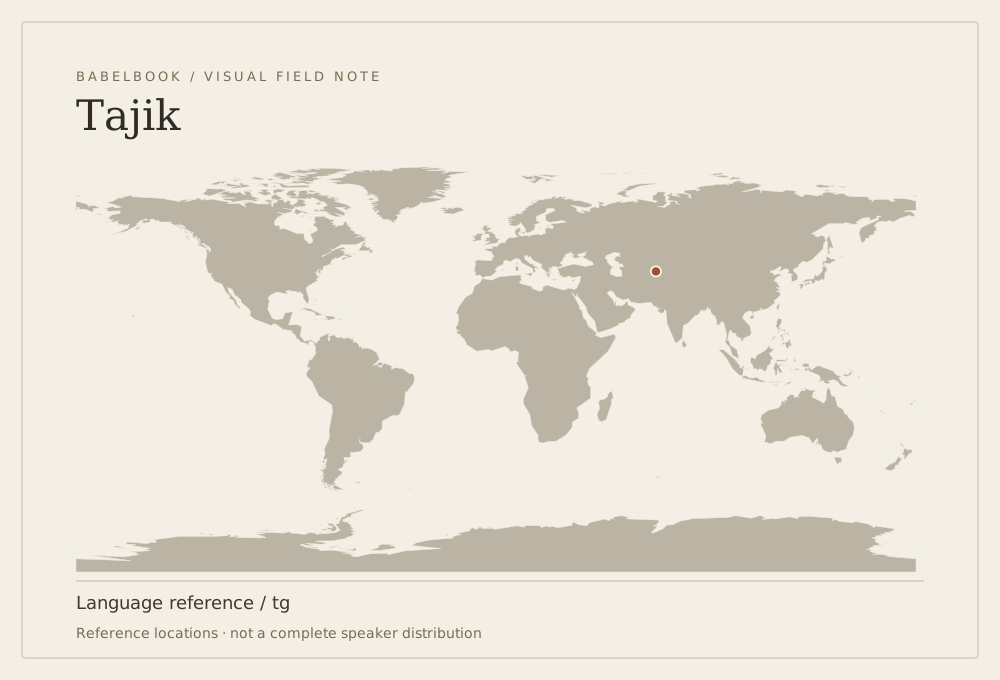
Representative reference points from Glottolog. Historical entries show reference locations, not current speakers. 1 point.
Reference & context ↗Babelbook · original editorial illustration · CC BY 4.0 · Glottolog locations; public-domain Natural Earth land
Source excerpts, selected, shortened and where noted editorially corrected from Tajik language by Wikipedia contributors. Retrieved 2026-10-05. CC BY-SA 4.0. These excerpts are not an independently verified scholarly history; missing accounts are identified above.
Read further in the source
Geographical distribution
Two major cities of Central Asia, Samarkand and Bukhara, are in present‑day Uzbekistan, but are defined by a prominent native usage of the Tajik language. Today, virtually all Tajik speakers in Bukhara are bilingual in Tajik and Uzbek. This Tajik–Uzbek bilingualism has had a strong influence on the phonology, morphology, and syntax of Bukharan Tajik. Tajiks are also found in large numbers in the Surxondaryo Region in the south and along Uzbekistan's eastern border with Tajikistan. Tajiki is still spoken by the majority of the population in Samarkand and Bukhara today, although, as Richard Foltz has noted, their spoken dialects diverge considerably from the standard literary language and most cannot read it. Official statistics in Uzbekistan state that the Tajik community comprises 5% of the nation's total population. However, these numbers do not include ethnic Tajiks who, for a variety of reasons, choose to identify themselves as Uzbeks in population census forms. During the Soviet 'Uzbekisation' supervised by Sharof Rashidov, the head of the Uzbek Communist Party, Tajiks had to choose either to stay in Uzbekistan and be registered as Uzbek in their passports or to leave the republic for the less‑developed agricultural and mountainous Tajikistan. The 'Uzbekisation' movement ended in 1924. In Tajikistan, Tajiks constitute 80% of the population, and the language dominates in most parts of the country. Some Tajiks in Gorno-Badakhshan in south‑eastern Tajikistan, where the Pamir languages are the native languages of most residents, are bilingual. Tajiks are the dominant ethnic group in northern Afghanistan as well and are also the majority group in scattered pockets elsewhere in the country, particularly in urban areas such as Kabul, Mazar-i-Sharif, Kunduz, Ghazni, and Herat. Tajiks constitute between 25% and 35% of the total population of the country. In Afghanistan, the dialects spoken by ethnic Tajiks are written using the Persian alphabet and referred to as Dari, along with the dialects of other groups in Afghanistan such as the Hazaragi and Aimaq dialects. Approximately 48%–58% of Afghan citizens are native speakers of Dari. A large Tajik‑speaking diaspora exists owing to the instability that has plagued Central Asia in recent years, with significant numbers of Tajiks found in Russia, Kazakhstan, and beyond. This Tajik diaspora is also the result of the poor state of the economy of Tajikistan; each year approximately one million men leave Tajikistan to find employment in Russia.
Dialects
Tajik dialects can be roughly divided into the following groups:
Northern dialects (Northern Tajikistan, Bukhara, Samarkand, Kyrgyzstan, and the Varzob valley region of Dushanbe). Central dialects (dialects of the upper Zarafshan Valley). Southern dialects (south and east of Dushanbe, Kulob, and the Rasht region of Tajikistan). Southeastern dialects (dialects of the Darvoz region and the Amu Darya near Rushon). The dialect used by the Bukharan Jews of Central Asia is known as the Bukhori dialect and belongs to the northern dialect grouping. It is chiefly distinguished by the inclusion of Hebrew terms, principally religious vocabulary, and the historical use of the Hebrew alphabet. Despite these differences, Bukhori is readily intelligible to other Tajik speakers, particularly speakers of northern dialects. A very important moment in the development of contemporary Tajik, especially of the spoken language, is the tendency towards a change in its dialectal orientation. The dialects of Northern Tajikistan were the foundation of the prevalent standard Tajik, while the Southern dialects did not enjoy either popularity or prestige. Now, all politicians and public officials make their speeches in the Kulob dialect, which is also used in broadcasting.
Writing system
In Tajikistan and other countries of the former Soviet Union, Tajik Persian is currently written in the Cyrillic script, although it was written in the Latin script from 1928 and in the Arabic alphabet prior to 1928. In the Tajik Soviet Socialist Republic, the use of the Latin script was later replaced in 1939 by the Cyrillic script. The Tajik alphabet added six additional letters to the Cyrillic script inventory, and these additional letters are distinguished in Tajik orthography by the use of diacritics.
History
According to many scholars, the New Persian language (which subsequently evolved into the Persian forms spoken in Iran, Afghanistan, and Tajikistan) developed in Transoxiana and Khorasan, in what are today parts of Afghanistan, Iran, Uzbekistan, and Tajikistan. While New Persian was descended primarily from Middle Persian, it also incorporated substantial elements of other Iranian languages of ancient Central Asia, such as Sogdian. Following the Islamic conquest of Iran and most of Central Asia in the 8th century AD, Arabic for a time became the court language, and Persian and other Iranian languages were relegated to the private sphere. In the 9th century AD, following the rise of the Samanids, whose state was centred around the cities of Bukhara (Buxoro), Samarqand, and Herat and covered much of Uzbekistan, Tajikistan, Afghanistan, and north-eastern Iran, New Persian emerged as the court language and swiftly displaced Arabic. New Persian became the lingua franca of Central Asia for centuries, although it eventually lost ground to the Chaghatai language in much of its former domains as a growing number of Turkic tribes moved into the region from the east. Since the 16th century AD, Tajik has come under increasing pressure from neighbouring Turkic languages. Once spoken in areas of Turkmenistan, such as Merv, Tajik is today virtually non-existent in that country. Uzbek has also largely replaced Tajik in most areas of modern Uzbekistan—the Russian Empire in particular implemented Turkification among Tajiks in Ferghana and Samarqand, replacing the dominant language in those areas with Uzbek. Nevertheless, Tajik persisted in pockets, notably in Samarqand, Bukhara, and Surxondaryo Region, as well as in much of what is today Tajikistan. The creation of the Tajik Soviet Socialist Republic within the Soviet Union in 1929 helped to safeguard the future of Tajik, as it became an official language of the republic alongside Russian. Still, substantial numbers of Tajik speakers remained outside the borders of the republic, mostly in the neighbouring Uzbek Soviet Socialist Republic, which created a source of tension between Tajiks and Uzbeks. Neither Samarqand nor Bukhara was included in the nascent Tajik SSR, despite their immense historical importance in Tajik history. After the creation of the Tajik SSR, a large number of ethnic Tajiks from the Uzbek SSR migrated there, particularly to the region of the capital, Dushanbe, exercising a substantial influence on the republic's political, cultural, and economic life. The influence of this influx of ethnic Tajik immigrants from the Uzbek SSR is most prominently manifested in the fact that literary Tajik is based on their north-western dialects of the language, rather than the central dialects that are spoken by the natives in the Dushanbe region and adjacent areas. After the fall of the Soviet Union and Tajikistan's independence in 1991, the government of Tajikistan has made substantial efforts to promote the use of Tajik in all spheres of public and private life. Tajik is gaining ground among the once-Russified upper classes and continues its role as the vernacular of the majority of the country's population. There has been a rise in the number of Tajik publications. Increasing contact with media from Iran and Afghanistan, after decades of isolation under the Soviets, as well as governmental orientation towards a Persianization of the language, have brought Tajik and the other Persian dialects closer together.