Thai
Thai, or Central Thai (historically Siamese; Thai: ภาษาไทย), is a Tai language of the Kra–Dai language family. It is spoken by the Central Thai, Mon, Lao Wiang, and Phuan people in Central Thailand and by the vast majority of Thai Chinese enclaves throughout the country. It is the sole official language of Thailand. Thai is the most spoken of over 60 languages of Thailand by both number of native and overall speakers. Over half of its vocabulary is derived from or borrowed from Pali, Sanskrit, Mon and Old Khmer. It is a tonal and analytic language. Thai has a complex orthography and system of relational markers. Spoken Thai, depending on standard sociolinguistic factors such as age, gender, class, spatial proximity, and the urban/rural divide, is partly mutually intelligible with Lao, Isan, and some fellow Thai topolects. These languages are written with slightly different scripts, but are linguistically similar and effectively form a dialect continuum. The Thai language is spoken by over 70 million people in Thailand as of 2024. Central Thai is the language of television, education, news reporting, and all forms of media. Most Thais in the northern (Lanna), the Southern (Tai) and the northeastern (Isan) parts of the country are therefore today bilingual in Central Thai and their own regional dialect. A study found that speakers of the Northern Thai language, also known as Phasa Mueang or Kham Mueang, have become few, most people in northern Thailand now speaking Standard Thai. They use mostly Central Thai words and only season their speech with the "Kham Mueang" accent.
Translate in Thai ↗Thai, or Central Thai (historically Siamese; Thai: ภาษาไทย), is a Tai language of the Kra–Dai language family. It is spoken by the Central Thai, Mon, Lao Wiang, and Phuan people in Central Thailand and by the vast majority of Thai Chinese enclaves throughout the country. It is the sole official language of Thailand. Thai is the most spoken of over 60 languages of Thailand by both number of native and overall speakers. Over half of its vocabulary is derived from or borrowed from Pali, Sanskrit, Mon and Old Khmer. It is a tonal and analytic language. Thai has a complex orthography and system of relational markers. Spoken Thai, depending on standard sociolinguistic factors such as age, gender, class, spatial proximity, and the urban/rural divide, is partly mutually intelligible with Lao, Isan, and some fellow Thai topolects. These languages are written with slightly different scripts, but are linguistically similar and effectively form a dialect continuum. The Thai language is spoken by over 70 million people in Thailand as of 2024. Central Thai is the language of television, education, news reporting, and all forms of media. Most Thais in the northern (Lanna), the Southern (Tai) and the northeastern (Isan) parts of the country are therefore today bilingual in Central Thai and their own regional dialect. A study found that speakers of the Northern Thai language, also known as Phasa Mueang or Kham Mueang, have become few, most people in northern Thailand now speaking Standard Thai. They use mostly Central Thai words and only season their speech with the "Kham Mueang" accent.
Southeast Asia
Present-day use
The captured source does not contain a separate current-use account.
Origins
From Middle Chinese or Teochew Chinese. From Old Khmer From Old Mon and Middle Mon, in Christian Bauer's transcriptions. The Portuguese were the first Western nation to arrive in what is modern-day Thailand in the 16th century during the Ayutthaya period. Their influence in trade, especially weaponry, allowed them to establish a community just outside the capital and practise their faith, as well as exposing and converting the locals to Christianity. Thus, Portuguese words involving trade and religion were introduced and used by the locals.
Development
Thai has undergone various historical sound changes. Some of the most significant changes occurred during the evolution from Old Thai to modern Thai. The Thai writing system has an eight-century history, and many of these changes, especially in consonants and tones, are evidenced in the modern orthography. The vowel system of modern Thai contains nine pure vowels and three centering diphthongs, each of which can occur as short or long. According to Li (1977), however, many Tai languages possess only one such short–long pair (/a aː/), and it is generally difficult or impossible to find minimal short–long pairs in Thai that involve vowels other than /a/ while maintaining consistent correspondences across the Tai family. More specifically, Li notes the following regarding Thai: In open syllables, only long vowels occur. (This assumes that all apparent cases of short open syllables are better described as ending in a glottal stop. This hypothesis is supported by the lack of tonal distinctions in such syllables, and the fact that a glottal stop is reconstructible across the Tai languages.) In closed syllables, the long high vowels /iː ɯː uː/ are rare. Where they do exist, they typically correspond to diphthongs in other Tai languages. In closed syllables, both short and long mid /e eː o oː/ and low /ɛ ɛː ɔ ɔː/ vowels occur.
Writing
Thai is written in the Thai script, an abugida written from left to right. The language and its script are closely related to the Lao language and script. Most literate Lao are able to read and understand Thai, as more than half of the Thai vocabulary, grammar, intonation, vowels and so forth are common with the Lao language. The Thais adopted and modified the Khmer script to create their own writing system. While in Thai the pronunciation can largely be inferred from the script, the orthography is complex, with silent letters to preserve original spellings and many letters representing the same sound. While the oldest known inscription in the Khmer language dates from 611 CE, inscriptions in Thai writing began to appear around 1292 CE. Notable features include: It is an abugida script, in which the implicit vowel is a short /a/ in a syllable without final consonant and a short /o/ in a syllable with final consonant. Tone markers, if present, are placed above the final onset consonant of the syllable. Vowels sounding after an initial consonant can be located before, after, above or below the consonant, or in a combination of these positions. There is no universally applied method for transcribing Thai into the Latin alphabet. For example, the name of the main airport is transcribed variably as Suvarnabhumi, Suwannaphum, or Suwunnapoom. Guide books, textbooks and dictionaries follow different systems. For this reason, many language courses recommend that learners master the Thai script. Official standards are the Royal Thai General System of Transcription (RTGS), published by the Royal Institute of Thailand, and the almost identical ISO 11940-2 defined by the International Organization for Standardization. The RTGS system is increasingly used in Thailand by central and local governments, especially for road signs. Its main drawback is that it does not indicate tone or vowel length.
Beyond the typeface.
Signs, manuscripts, published pages and contextual photographs, with their place, period, source and reuse terms. Captions identify historical spellings, regional examples, community references and character imagery.
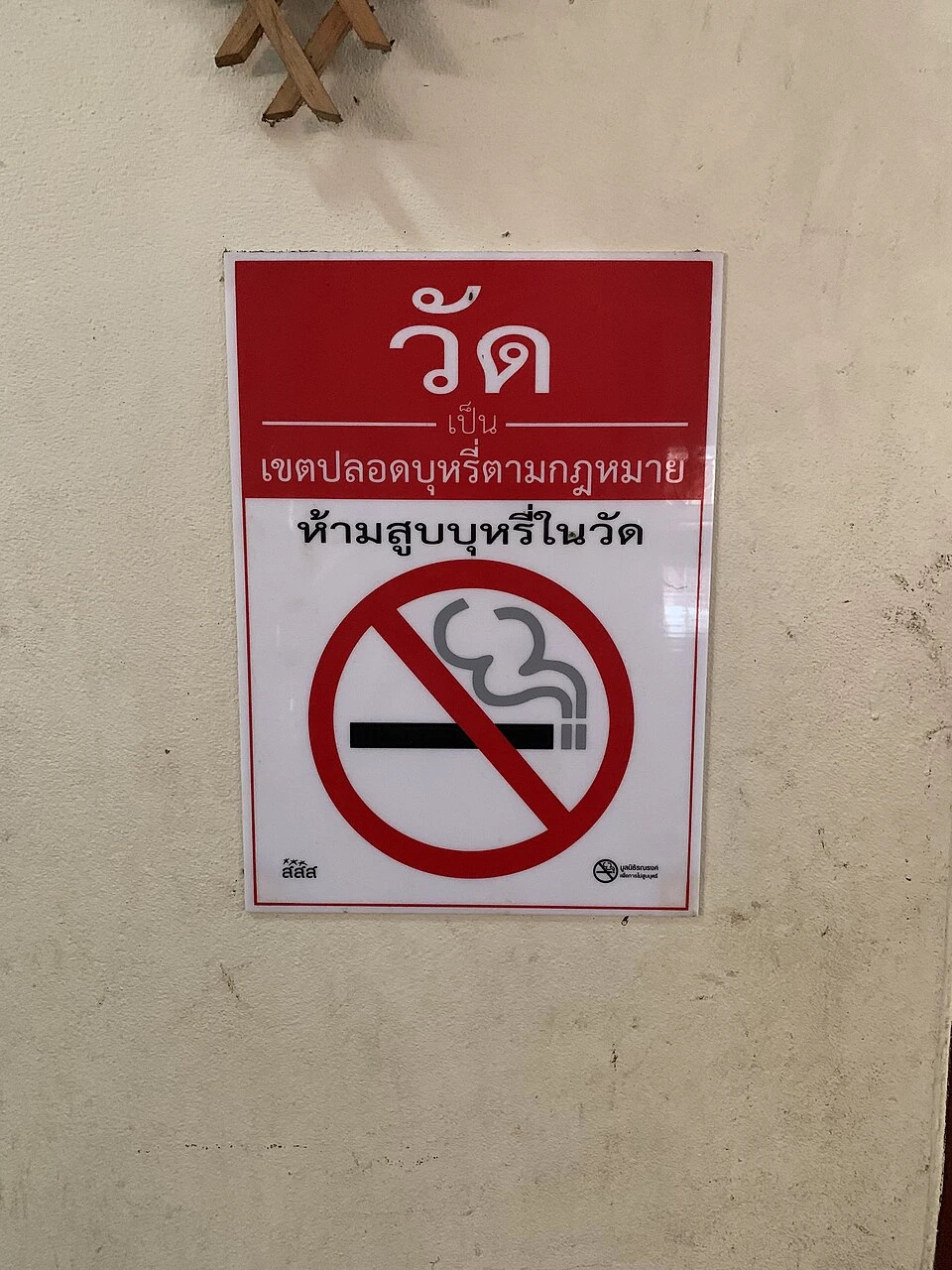
Thai no-smoking notice at Wat Prasitthiwet, Nakhon Nayok, 2019. The source identifies the message as smoking being illegal in the temple. Displayed at reduced size; no additional crop.
Saved in Babelbook · resized display copy. Select the image to open it independently of its source.
Chainwit. · Source ↗CC BY-SA 4.0 ↗View the local visual field note
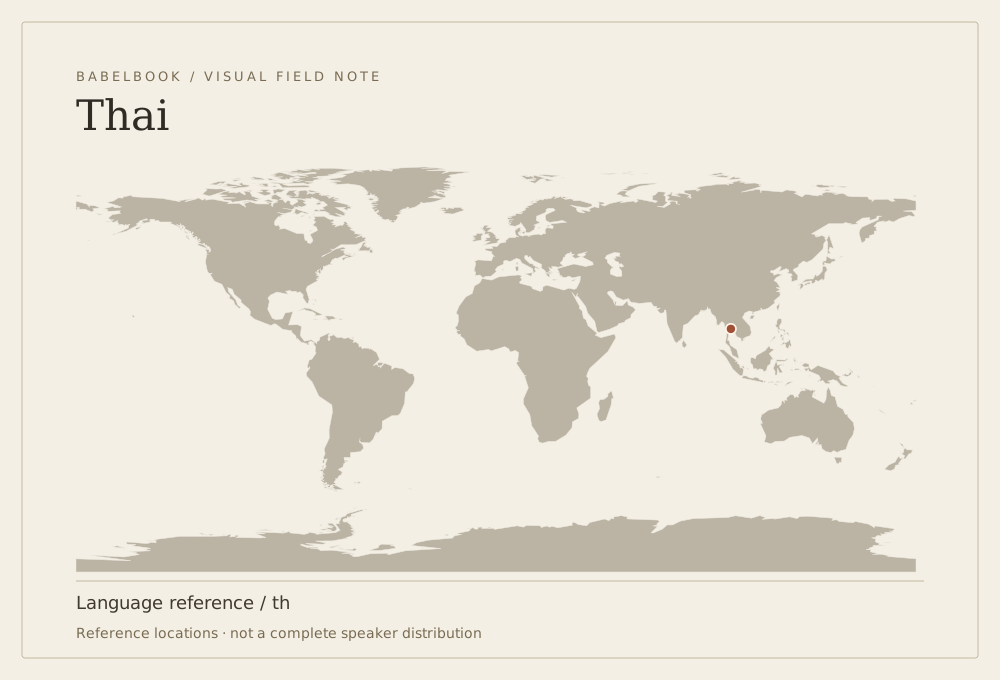
Representative reference points from Glottolog. Historical entries show reference locations, not current speakers. 1 point.
Reference & context ↗Babelbook · original editorial illustration · CC BY 4.0 · Glottolog locations; public-domain Natural Earth land
Source excerpts, selected, shortened and where noted editorially corrected from Thai language by Wikipedia contributors. Retrieved 2026-10-05. CC BY-SA 4.0. These excerpts are not an independently verified scholarly history; missing accounts are identified above.
Read further in the source
History
Thai has undergone various historical sound changes. Some of the most significant changes occurred during the evolution from Old Thai to modern Thai. The Thai writing system has an eight-century history, and many of these changes, especially in consonants and tones, are evidenced in the modern orthography.
Mon-origin
From Old Mon and Middle Mon, in Christian Bauer's transcriptions.
Portuguese-origin
The Portuguese were the first Western nation to arrive in what is modern-day Thailand in the 16th century during the Ayutthaya period. Their influence in trade, especially weaponry, allowed them to establish a community just outside the capital and practise their faith, as well as exposing and converting the locals to Christianity. Thus, Portuguese words involving trade and religion were introduced and used by the locals.
Writing system
Thai is written in the Thai script, an abugida written from left to right. The language and its script are closely related to the Lao language and script. Most literate Lao are able to read and understand Thai, as more than half of the Thai vocabulary, grammar, intonation, vowels and so forth are common with the Lao language. The Thais adopted and modified the Khmer script to create their own writing system. While in Thai the pronunciation can largely be inferred from the script, the orthography is complex, with silent letters to preserve original spellings and many letters representing the same sound. While the oldest known inscription in the Khmer language dates from 611 CE, inscriptions in Thai writing began to appear around 1292 CE. Notable features include:
It is an abugida script, in which the implicit vowel is a short /a/ in a syllable without final consonant and a short /o/ in a syllable with final consonant. Tone markers, if present, are placed above the final onset consonant of the syllable. Vowels sounding after an initial consonant can be located before, after, above or below the consonant, or in a combination of these positions.