Tigrinya
Tigrinya, sometimes romanized according to Italian spelling rules as Tigrigna, is an Ethio-Semitic language, which is a subgrouping within the Semitic branch of the Afroasiatic languages. It is primarily spoken by the Tigrinya and Tigrayan peoples, native to Eritrea and to the Tigray Region of Ethiopia, respectively. It is also spoken by the global diaspora of these regions.
Translate in Tigrinya ↗There is no general name for the people who speak Tigrinya. In Eritrea, Tigrinya speakers are officially known as the Bəher-Təgrəñña ('nation of Tigrinya speakers') or Tigrinya people. In Ethiopia, a Tigrayan, that is a native of Tigray, who also speaks the Tigrinya language, is referred to in Tigrinya as təgraway (male), təgrawäyti (female), tägaru (plural). Bəher roughly means "nation" in the ethnic sense of the word in Tigrinya, Tigre, Amharic and Ge'ez. The Jeberti in Eritrea also speak Tigrinya. Tigrinya is the most widely spoken language in Eritrea, and the fourth most spoken language in Ethiopia after Amharic, Oromo, and Somali. It is also spoken by large immigrant communities around the world, in countries including Sudan, Saudi Arabia, Israel, Denmark, Germany, Uganda, Italy, Sweden, the United Kingdom, Canada and the United States. In Australia, Tigrinya is one of the languages broadcast on public radio via the multicultural Special Broadcasting Service. Tigrinya dialects differ phonetically, lexically, and grammatically. No dialect appears to be accepted as a standard. Even though the most spread and used in, for example books, movies and news is the Asmara dialect.
Sub-Saharan Africa
Present-day use
The captured source does not contain a separate current-use account.
Origins
The captured article does not contain a separate origins section. See the historical account and linked source.
Development
Although it differs markedly from the Geʽez (Classical Ethiopic) language, for instance in having phrasal verbs, and in using a word order that places the main verb last instead of first in the sentence, there is a strong influence of Geʽez on Tigrinya literature, especially with terms relating to Christian life, Biblical names, and so on. Ge'ez, because of its status in Eritrean and Ethiopian culture, and possibly also its simple structure, acted as a literary medium until relatively recent times. Tigrinya is lexically 68% similar to Geʽez, slightly higher than the lexical similarity of Amharic to the ancient language at 62%. Despite a rich oral tradition, Tigrinya historically lacked a written literary tradition, which Carlo Conti Rossini attributed to the use of Ge'ez in church texts and within rural learned circles, along with Amharic's status as the official language of the ruling authorities. The earliest known example of Tigrinya literature is a text of local laws found in the district of Loggo Sarda (located in present-day Debub Region of Eritrea), believed to be from the 19th century. The legal code was found inserted within a Ge'ez manuscript of the Gospels dated to approximately the late 15th or early 16th century. In Eritrea, during British administration, the Ministry of Information put out a weekly newspaper in Tigrinya that cost 5 cents and sold 5,000 copies weekly. At the time, it was reported to be the first of its kind. Tigrinya (along with Arabic) was one of Eritrea's official languages during its short-lived federation with Ethiopia. In 1958, it was replaced by the Southern Ethiopic language Amharic prior to Eritrea's annexation. Upon Eritrea's independence in 1991, Tigrinya retained the status of working language in the country. Eritrea was the only state in the world to officially recognize Tigrinya until 2020, when Ethiopia made changes to recognize Tigrinya on a national level.
Writing
Tigrinya is written in the Geʽez script, originally developed for Geʽez. The Ethiopic script is an abugida: each symbol represents a consonant+vowel syllable, and the symbols are organized in groups of similar symbols on the basis of both the consonant and the vowel. In the table below the columns are assigned to the seven vowels of Tigrinya; they appear in the traditional order. The rows are assigned to the consonants, again in the traditional order. For each consonant in an abugida, there is an unmarked symbol representing that consonant followed by a canonical or inherent vowel. For the Ethiopic abugida, this canonical vowel is ä, the first column in the table. However, since the pharyngeal and glottal consonants of Tigrinya (and other Ethiopian Semitic languages) cannot be followed by this vowel, the symbols in the first column for those consonants are pronounced with the vowel a, exactly as in the fourth column. These redundant symbols are falling into disuse in Tigrinya and are shown with a dark gray background in the table. When it is necessary to represent a consonant with no following vowel, the consonant+ə form is used (the symbol in the sixth column). For example, the word ʼǝntay 'what?' is written እንታይ, literally ʼǝ-nǝ-ta-yǝ. Since some of the distinctions that were apparently made in Ge'ez have been lost in Tigrinya, there are two rows of symbols each for the consonants ‹ḥ›, ‹s›, and ‹sʼ›. In Eritrea, for ‹s› and ‹sʼ›, at least, one of these has fallen into disuse in Tigrinya and is now considered old-fashioned. These less-used series are shown with a dark gray background in the chart. The orthography does not mark gemination, so the pair of words qärräbä 'he approached', qäräbä 'he was near' are both written ቀረበ. Since such minimal pairs are very rare, this presents no problem to readers of the language.
Beyond the typeface.
Signs, manuscripts, published pages and contextual photographs, with their place, period, source and reuse terms. Captions identify historical spellings, regional examples, community references and character imagery.
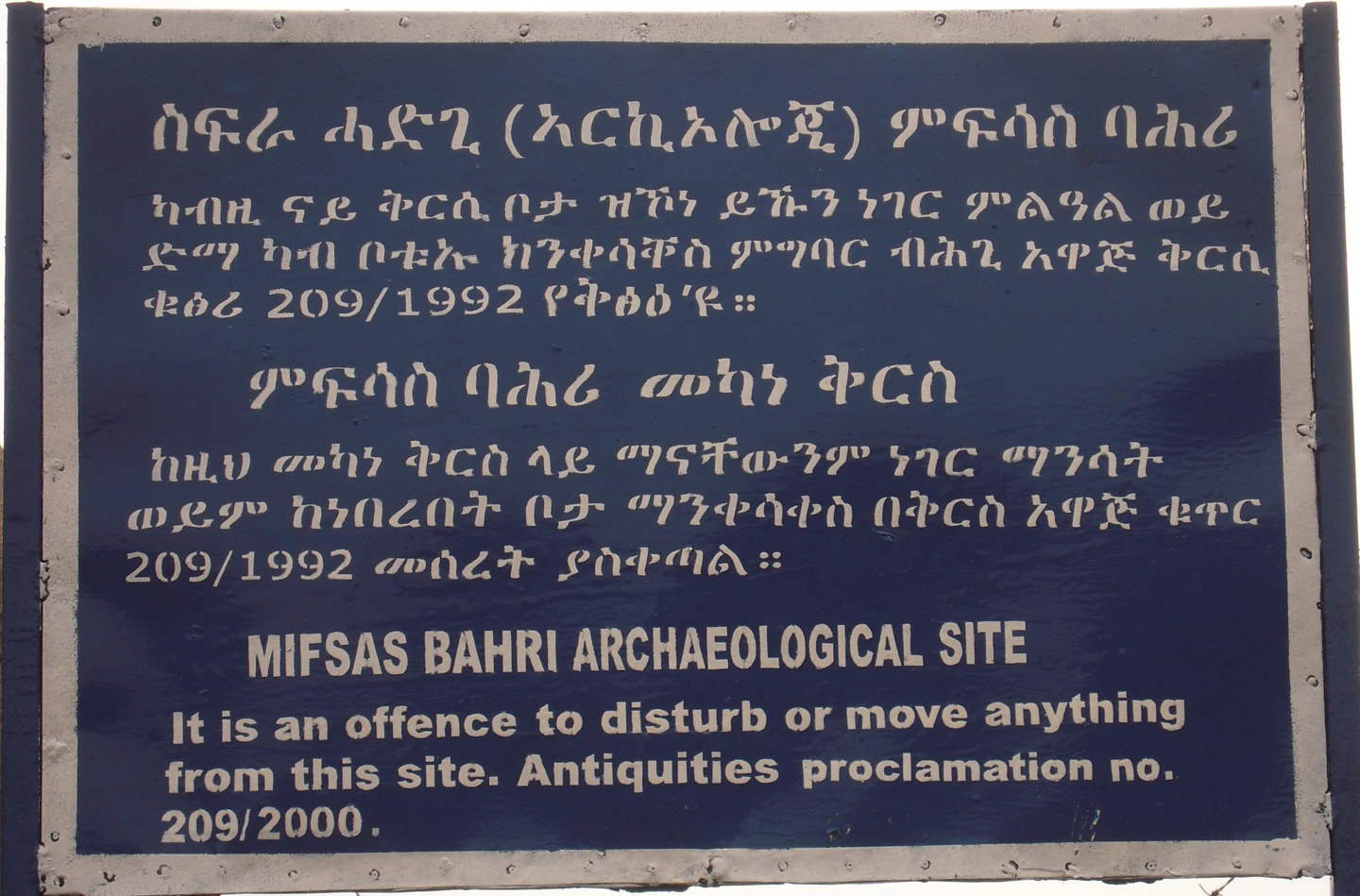
Protected-monument sign in Tigray, Ethiopia, photographed on 5 March 2014. Commons explicitly identifies Tigrinya, Amharic and English on the sign; not independently transcribed.
Saved in Babelbook · resized display copy. Select the image to open it independently of its source.
Pyule · Source ↗CC BY-SA 3.0 ↗View the local visual field note
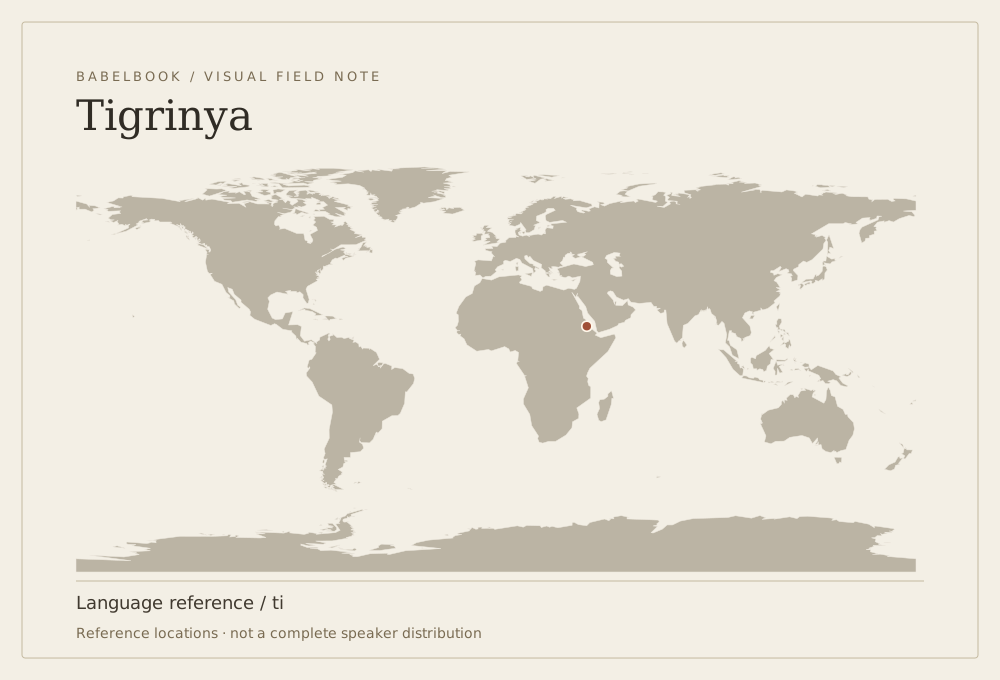
Representative reference points from Glottolog. Historical entries show reference locations, not current speakers. 1 point.
Reference & context ↗Babelbook · original editorial illustration · CC BY 4.0 · Glottolog locations; public-domain Natural Earth land
Source excerpts, selected, shortened and where noted editorially corrected from Tigrinya language by Wikipedia contributors. Retrieved 2026-10-05. CC BY-SA 4.0. These excerpts are not an independently verified scholarly history; missing accounts are identified above.
Read further in the source
History and literature
Although it differs markedly from the Geʽez (Classical Ethiopic) language, for instance in having phrasal verbs, and in using a word order that places the main verb last instead of first in the sentence, there is a strong influence of Geʽez on Tigrinya literature, especially with terms relating to Christian life, Biblical names, and so on. Ge'ez, because of its status in Eritrean and Ethiopian culture, and possibly also its simple structure, acted as a literary medium until relatively recent times. Tigrinya is lexically 68% similar to Geʽez, slightly higher than the lexical similarity of Amharic to the ancient language at 62%. Despite a rich oral tradition, Tigrinya historically lacked a written literary tradition, which Carlo Conti Rossini attributed to the use of Ge'ez in church texts and within rural learned circles, along with Amharic's status as the official language of the ruling authorities. The earliest known example of Tigrinya literature is a text of local laws found in the district of Loggo Sarda (located in present-day Debub Region of Eritrea), believed to be from the 19th century. The legal code was found inserted within a Ge'ez manuscript of the Gospels dated to approximately the late 15th or early 16th century. In Eritrea, during British administration, the Ministry of Information put out a weekly newspaper in Tigrinya that cost 5 cents and sold 5,000 copies weekly. At the time, it was reported to be the first of its kind. Tigrinya (along with Arabic) was one of Eritrea's official languages during its short-lived federation with Ethiopia. In 1958, it was replaced by the Southern Ethiopic language Amharic prior to Eritrea's annexation. Upon Eritrea's independence in 1991, Tigrinya retained the status of working language in the country. Eritrea was the only state in the world to officially recognize Tigrinya until 2020, when Ethiopia made changes to recognize Tigrinya on a national level.
Speakers
There is no general name for the people who speak Tigrinya. In Eritrea, Tigrinya speakers are officially known as the Bəher-Təgrəñña ('nation of Tigrinya speakers') or Tigrinya people. In Ethiopia, a Tigrayan, that is a native of Tigray, who also speaks the Tigrinya language, is referred to in Tigrinya as təgraway (male), təgrawäyti (female), tägaru (plural). Bəher roughly means "nation" in the ethnic sense of the word in Tigrinya, Tigre, Amharic and Ge'ez. The Jeberti in Eritrea also speak Tigrinya. Tigrinya is the most widely spoken language in Eritrea, and the fourth most spoken language in Ethiopia after Amharic, Oromo, and Somali. It is also spoken by large immigrant communities around the world, in countries including Sudan, Saudi Arabia, Israel, Denmark, Germany, Uganda, Italy, Sweden, the United Kingdom, Canada and the United States. In Australia, Tigrinya is one of the languages broadcast on public radio via the multicultural Special Broadcasting Service. Tigrinya dialects differ phonetically, lexically, and grammatically. No dialect appears to be accepted as a standard. Even though the most spread and used in, for example books, movies and news is the Asmara dialect.
Writing system
Tigrinya is written in the Geʽez script, originally developed for Geʽez. The Ethiopic script is an abugida: each symbol represents a consonant+vowel syllable, and the symbols are organized in groups of similar symbols on the basis of both the consonant and the vowel. In the table below the columns are assigned to the seven vowels of Tigrinya; they appear in the traditional order. The rows are assigned to the consonants, again in the traditional order. For each consonant in an abugida, there is an unmarked symbol representing that consonant followed by a canonical or inherent vowel. For the Ethiopic abugida, this canonical vowel is ä, the first column in the table. However, since the pharyngeal and glottal consonants of Tigrinya (and other Ethiopian Semitic languages) cannot be followed by this vowel, the symbols in the first column for those consonants are pronounced with the vowel a, exactly as in the fourth column. These redundant symbols are falling into disuse in Tigrinya and are shown with a dark gray background in the table. When it is necessary to represent a consonant with no following vowel, the consonant+ə form is used (the symbol in the sixth column). For example, the word ʼǝntay 'what?' is written እንታይ, literally ʼǝ-nǝ-ta-yǝ. Since some of the distinctions that were apparently made in Ge'ez have been lost in Tigrinya, there are two rows of symbols each for the consonants ‹ḥ›, ‹s›, and ‹sʼ›. In Eritrea, for ‹s› and ‹sʼ›, at least, one of these has fallen into disuse in Tigrinya and is now considered old-fashioned. These less-used series are shown with a dark gray background in the chart. The orthography does not mark gemination, so the pair of words qärräbä 'he approached', qäräbä 'he was near' are both written ቀረበ. Since such minimal pairs are very rare, this presents no problem to readers of the language.