Turkmen
Turkmen (türkmençe, түркменче, تۆرکمنچه, [tʏɾkˈmøntʃø] or türkmen dili, түркмен дили, تۆرکمن ديلی, [tʏɾkˈmøn dɪˈlɪ]) is a Turkic language of the Oghuz branch spoken by the Turkmens of Central Asia. It has an estimated 4.7 million native speakers in Turkmenistan (where it is the official language), plus a further 359,000 speakers in northeastern Iran and 1.2 million people in northwestern Afghanistan, where it has no official status. Turkmen is also spoken to lesser varying degrees in Turkmen communities of Uzbekistan and Tajikistan and by diaspora communities, primarily in Turkey and Russia. Turkmen is a member of the Oghuz branch of the Turkic languages. It is closely related to Azerbaijani, Gagauz, Qashqai, and Turkish, sharing varying degrees of mutual intelligibility with each of those languages. However, the closest relative of Turkmen is considered Khorasani Turkic, spoken in northeastern regions of Iran and with which it shares the eastern subbranch of Oghuz languages, as well as Khorazm, the Oghuz dialect of Uzbek spoken mainly in Khorezm along the Turkmenistan border. Elsewhere in Iran, the Turkmen language comes second after the Azerbaijani language in terms of the number of speakers of Turkic languages of Iran. The standardized form of Turkmen (spoken in Turkmenistan) is based on the Teke dialect, while Iranian Turkmen use mostly the Yomud dialect, and Afghan Turkmen use the Ersary variety.
Translate in Turkmen ↗Turkmen (türkmençe, түркменче, تۆرکمنچه, [tʏɾkˈmøntʃø] or türkmen dili, түркмен дили, تۆرکمن ديلی, [tʏɾkˈmøn dɪˈlɪ]) is a Turkic language of the Oghuz branch spoken by the Turkmens of Central Asia. It has an estimated 4.7 million native speakers in Turkmenistan (where it is the official language), plus a further 359,000 speakers in northeastern Iran and 1.2 million people in northwestern Afghanistan, where it has no official status. Turkmen is also spoken to lesser varying degrees in Turkmen communities of Uzbekistan and Tajikistan and by diaspora communities, primarily in Turkey and Russia. Turkmen is a member of the Oghuz branch of the Turkic languages. It is closely related to Azerbaijani, Gagauz, Qashqai, and Turkish, sharing varying degrees of mutual intelligibility with each of those languages. However, the closest relative of Turkmen is considered Khorasani Turkic, spoken in northeastern regions of Iran and with which it shares the eastern subbranch of Oghuz languages, as well as Khorazm, the Oghuz dialect of Uzbek spoken mainly in Khorezm along the Turkmenistan border. Elsewhere in Iran, the Turkmen language comes second after the Azerbaijani language in terms of the number of speakers of Turkic languages of Iran. The standardized form of Turkmen (spoken in Turkmenistan) is based on the Teke dialect, while Iranian Turkmen use mostly the Yomud dialect, and Afghan Turkmen use the Ersary variety. The Turkmen language, unlike other languages of the Oghuz branch, preserved most of the unique and archaic features of the language spoken by the early Oghuz Turks, including phonemic vowel length. Iraqi and Syrian Turkmen speak dialects that form a continuum between Turkish and Azerbaijani, in both cases heavily influenced by Arabic and Persian.
Central Asia
Present-day use
The captured source does not contain a separate current-use account.
Origins
The captured article does not contain a separate origins section. See the historical account and linked source.
Development
The captured article does not contain a distinct historical account. No chronology has been invented.
Writing
The Turkmen written language was formed in the 13–14th centuries, with its literary tradition dating back to the 14th century. During this period, the Arabic alphabet was used extensively for writing. By the 18th century, there had been a rich literary tradition in the Turkmen language. At the same time, the literacy of the population in their native language remained at low levels; book publishing was extremely limited, and the first primer in the Turkmen language appeared only in 1913, while the first newspaper ("Transcaspian native newspaper") was printed in 1914. The Arabic script was not adapted to the phonetic features of the Turkic languages. Thus, it did not have necessary signs to designate specific sounds of the Turkmen language, and at the same time there were many letters to designate Arabic sounds that were not in the Turkmen language. During the first years after the establishment of the Soviet power, the Arabic alphabet of Turkmen under the USSR was reformed twice, in 1922 and 1925. In the course of the reforms, letters with diacritics were introduced to denote Turkic phonemes; and letters were abolished for sounds that are absent in the Turkmen language. The Turkmens of Afghanistan and Iran continue to use Arabic script. In January 1925, on the pages of the republican newspaper Türkmenistan, the question of switching to a new, Latin alphabet was raised. After the first All-Union Turkological Congress in Baku (February–March 1926), the State Academic Council under the People's Commissariat of Education of the Turkmen SSR developed a draft of a new alphabet. On 3 January 1928, the revised new Latin alphabet was approved by the Central Executive Committee of the Turkmen SSR. At the end of the 1930s, the process of the Cyrillization of writing began throughout the USSR.
Beyond the typeface.
Signs, manuscripts, published pages and contextual photographs, with their place, period, source and reuse terms. Captions identify historical spellings, regional examples, community references and character imagery.

Writing in use at the fruit halls of Altyn Asyr Bazar; Commons identifies the signage as Turkmen.
Saved in Babelbook · resized display copy. Select the image to open it independently of its source.
Hans Birger Nilsen · Source ↗CC BY 2.0 ↗View the local visual field note
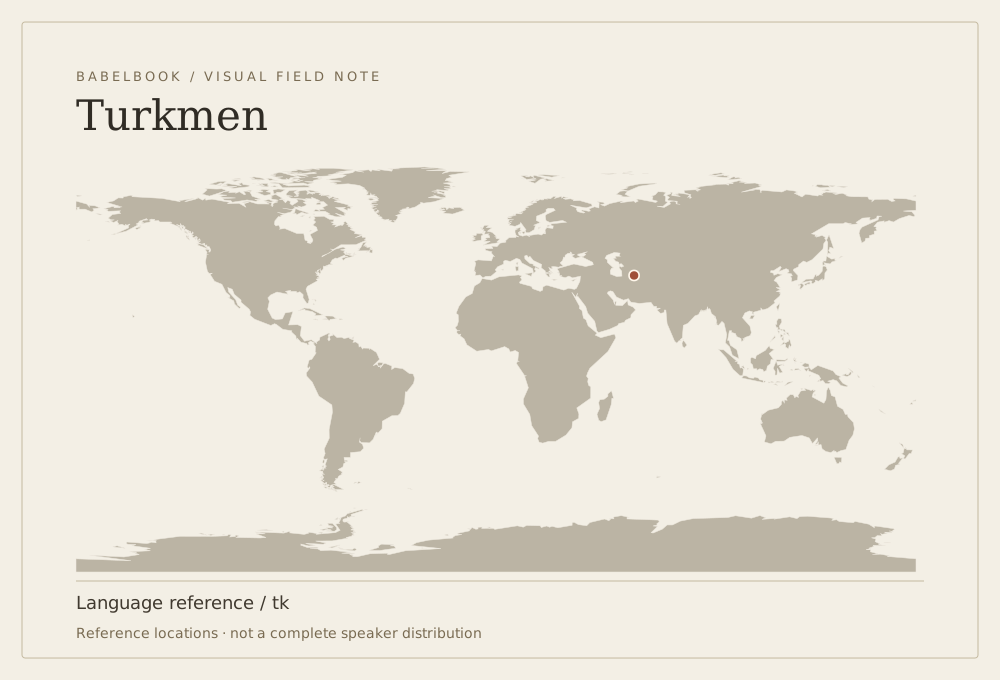
Representative reference points from Glottolog. Historical entries show reference locations, not current speakers. 1 point.
Reference & context ↗Babelbook · original editorial illustration · CC BY 4.0 · Glottolog locations; public-domain Natural Earth land
Source excerpts, selected, shortened and where noted editorially corrected from Turkmen language by Wikipedia contributors. Retrieved 2026-10-05. CC BY-SA 4.0. These excerpts are not an independently verified scholarly history; missing accounts are identified above.
Read further in the source
Writing system
The Turkmen written language was formed in the 13–14th centuries, with its literary tradition dating back to the 14th century. During this period, the Arabic alphabet was used extensively for writing. By the 18th century, there had been a rich literary tradition in the Turkmen language. At the same time, the literacy of the population in their native language remained at low levels; book publishing was extremely limited, and the first primer in the Turkmen language appeared only in 1913, while the first newspaper ("Transcaspian native newspaper") was printed in 1914. The Arabic script was not adapted to the phonetic features of the Turkic languages. Thus, it did not have necessary signs to designate specific sounds of the Turkmen language, and at the same time there were many letters to designate Arabic sounds that were not in the Turkmen language. During the first years after the establishment of the Soviet power, the Arabic alphabet of Turkmen under the USSR was reformed twice, in 1922 and 1925. In the course of the reforms, letters with diacritics were introduced to denote Turkic phonemes; and letters were abolished for sounds that are absent in the Turkmen language. The Turkmens of Afghanistan and Iran continue to use Arabic script. In January 1925, on the pages of the republican newspaper Türkmenistan, the question of switching to a new, Latin alphabet was raised. After the first All-Union Turkological Congress in Baku (February–March 1926), the State Academic Council under the People's Commissariat of Education of the Turkmen SSR developed a draft of a new alphabet. On 3 January 1928, the revised new Latin alphabet was approved by the Central Executive Committee of the Turkmen SSR. At the end of the 1930s, the process of the Cyrillization of writing began throughout the USSR. In January 1939, the newspaper Sowet Türkmenistany published a letter from teachers in Ashgabat and the Ashgabat region with an initiative to replace the Turkmen (Latin) script with Cyrillic. The Presidium of the Supreme Soviet of the Turkmen SSR instructed the Research Institute of Language and Literature to draw up a draft of a new alphabet. The teachers of the Ashgabat Pedagogical Institute and print workers also took part in the development of the new writing system. In April 1940, the draft alphabet was published. In May 1940, the Council of People's Commissars of the Turkmen SSR adopted a resolution on the transition to a new alphabet of all state and public institutions from 1 July 1940, and on the beginning of teaching the new alphabet in schools from 1 September of the same year. After the dissolution of the Soviet Union, in January 1993, a meeting was held at the Academy of Sciences of Turkmenistan on the issue of replacing the Cyrillic with the Latin alphabet, at which a commission was formed to develop the alphabet. In February, a new version of the alphabet was published in the press. On 12 April 1993, the Mejlis of Turkmenistan approved a presidential decree on the new alphabet.