Tagalog
Tagalog ( tə-GAH-log; native pronunciation: [tɐˈɡaːloɡ] ; Baybayin: ᜆᜄᜎᜓᜄ᜔) is an Austronesian language spoken as a first language by the ethnic Tagalog people, who make up a quarter of the population of the Philippines, and as a second language by the majority. Its standardized and codified form, Filipino, is the national language of the Philippines, and is one language of the nation's two official languages, alongside English. Tagalog, like other Austronesian languages, commonly uses verb-subject-object order, but can also use subject-verb-object order. Tagalog follows the trigger system of morphosyntactic alignment that is common among Philippine languages. It has head-initial directionality. It is an agglutinative language but can also display inflection. It is not a tonal language and can be considered a pitch-accent language and a syllable-timed language. It has nine basic parts of speech. Tagalog is closely related to other Philippine languages, such as the Bikol languages, the Bisayan languages, Ilocano, Kapampangan, and Pangasinan, and more distantly to other Austronesian languages, such as the Formosan languages of Taiwan, Indonesian, Malay, Hawaiian, Māori, Malagasy, and many more.
Translate in Tagalog ↗Tagalog was declared the official language by the first revolutionary constitution in the Philippines, the Constitution of Biak-na-Bato in 1897. In 1935, the Philippine constitution designated English and Spanish as official languages, but mandated the development and adoption of a common national language based on one of the existing native languages. After study and deliberation, the National Language Institute, a committee composed of seven members who represented various regions in the Philippines, chose Tagalog as the basis for the evolution and adoption of the national language of the Philippines. President Manuel L. Quezon then, on December 30, 1937, proclaimed the selection of the Tagalog language to be used as the basis for the evolution and adoption of the national language of the Philippines. In 1939, President Quezon designated the proposed Tagalog-based national language as the Wikang Pambansâ (national language). Quezon himself was born and raised in Baler, Aurora, which is a native Tagalog-speaking area. Upon the country gaining independence on July 4, 1946, Commonwealth Act No. 570, which was approved in June 7, 1940, officially declared it an official language under the name, Filipino. Under the Japanese puppet government during World War II, Tagalog as a national language was strongly promoted; the 1943 Constitution specifying: "The government shall take steps toward the development and propagation of Tagalog as the national language." In 1959, Wikang Pambansang Pilipino was institutionally further renamed as Pilipino. Along with English, the national language has had official status under the 1973 constitution (as "Pilipino") and the 1987 constitution (as "Filipino").
Southeast Asia
Present-day use
Tagalog was declared the official language by the first revolutionary constitution in the Philippines, the Constitution of Biak-na-Bato in 1897. In 1935, the Philippine constitution designated English and Spanish as official languages, but mandated the development and adoption of a common national language based on one of the existing native languages. After study and deliberation, the National Language Institute, a committee composed of seven members who represented various regions in the Philippines, chose Tagalog as the basis for the evolution and adoption of the national language of the Philippines. President Manuel L. Quezon then, on December 30, 1937, proclaimed the selection of the Tagalog language to be used as the basis for the evolution and adoption of the national language of the Philippines. In 1939, President Quezon designated the proposed Tagalog-based national language as the Wikang Pambansâ (national language). Quezon himself was born and raised in Baler, Aurora, which is a native Tagalog-speaking area. Upon the country gaining independence on July 4, 1946, Commonwealth Act No. 570, which was approved in June 7, 1940, officially declared it an official language under the name, Filipino. Under the Japanese puppet government during World War II, Tagalog as a national language was strongly promoted; the 1943 Constitution specifying: "The government shall take steps toward the development and propagation of Tagalog as the national language." In 1959, Wikang Pambansang Pilipino was institutionally further renamed as Pilipino. Along with English, the national language has had official status under the 1973 constitution (as "Pilipino") and the 1987 constitution (as "Filipino").
Origins
The captured article does not contain a separate origins section. See the historical account and linked source.
Development
The word Tagalog is possibly derived from the endonym taga-ilog ("river dweller"), composed of tagá- ("native of" or "from") and ilog ("river"), or alternatively, taga-alog deriving from alog ("pool of water in the lowlands"; "rice or vegetable plantation"). Linguists such as David Zorc and Robert Blust speculate that the Tagalogs and other Central Philippine ethno-linguistic groups originated in Northeastern Mindanao or the Eastern Visayas. Possible words of Old Tagalog origin are attested in the Laguna Copperplate Inscription from the tenth century, which is largely written in Old Malay. The first known complete book to be written in Tagalog is the Doctrina Christiana (Christian Doctrine), printed in 1593. The Doctrina was written in Spanish and two transcriptions of Tagalog; one in the ancient, then-current Baybayin script and the other in an early Spanish attempt at a Latin orthography for the language. Throughout the 333 years of Spanish rule, various grammars and dictionaries were written by Spanish clergymen. In 1610, the Dominican priest Francisco Blancas de San José published the Arte y reglas de la lengua tagala (which was subsequently revised with two editions in 1752 and 1832) in Bataan. In 1613, the Franciscan priest Pedro de San Buenaventura published the first Tagalog dictionary, his Vocabulario de la lengua tagala in Pila, Laguna. The first substantial dictionary of the Tagalog language was written by the Czech Jesuit missionary Pablo Clain in the beginning of the 18th century. Clain spoke Tagalog and used it actively in several of his books. He prepared the dictionary, which he later passed over to Francisco Jansens and José Hernandez. Further compilation of his substantial work was prepared by P. Juan de Noceda and P.
Writing
Tagalog, like other Philippines languages, is written using the Latin alphabet. Prior to the arrival of the Spanish in 1521 and the beginning of their colonization in 1565, Tagalog was written in an abugida—or alphasyllabary—called Baybayin. This system of writing gradually gave way to the use and propagation of the Latin alphabet as introduced by the Spanish. As the Spanish began to record and create grammars and dictionaries for the various languages of the Philippine archipelago, they adopted systems of writing closely following the orthographic customs of the Spanish language and were refined over the years. Until the first half of the 20th century, most Philippine languages were widely written in a variety of ways based on Spanish orthography. In the late 19th century, a number of educated Filipinos began proposing for revising the spelling system used for Tagalog at the time. In 1884, Filipino doctor and student of languages Trinidad Pardo de Tavera published his study on the ancient Tagalog script Contribucion para el Estudio de los Antiguos Alfabetos Filipinos and in 1887, published his essay El Sanscrito en la lengua Tagalog which made use of a new writing system developed by him. Meanwhile, Jose Rizal, inspired by Pardo de Tavera's 1884 work, also began developing a new system of orthography (unaware at first of Pardo de Tavera's own orthography). A major noticeable change in these proposed orthographies was the use of the letter ⟨k⟩ rather than ⟨c⟩ and ⟨q⟩ to represent the phoneme /k/. In 1889, the new bilingual Spanish-Tagalog La España Oriental newspaper, of which Isabelo de los Reyes was an editor, began publishing using the new orthography stating in a footnote that it would "use the orthography recently introduced by ... learned Orientalis". This new orthography, while having its supporters, was also not initially accepted by several writers. Soon after the first issue of La España, Pascual H.
Beyond the typeface.
Signs, manuscripts, published pages and contextual photographs, with their place, period, source and reuse terms. Captions identify historical spellings, regional examples, community references and character imagery.
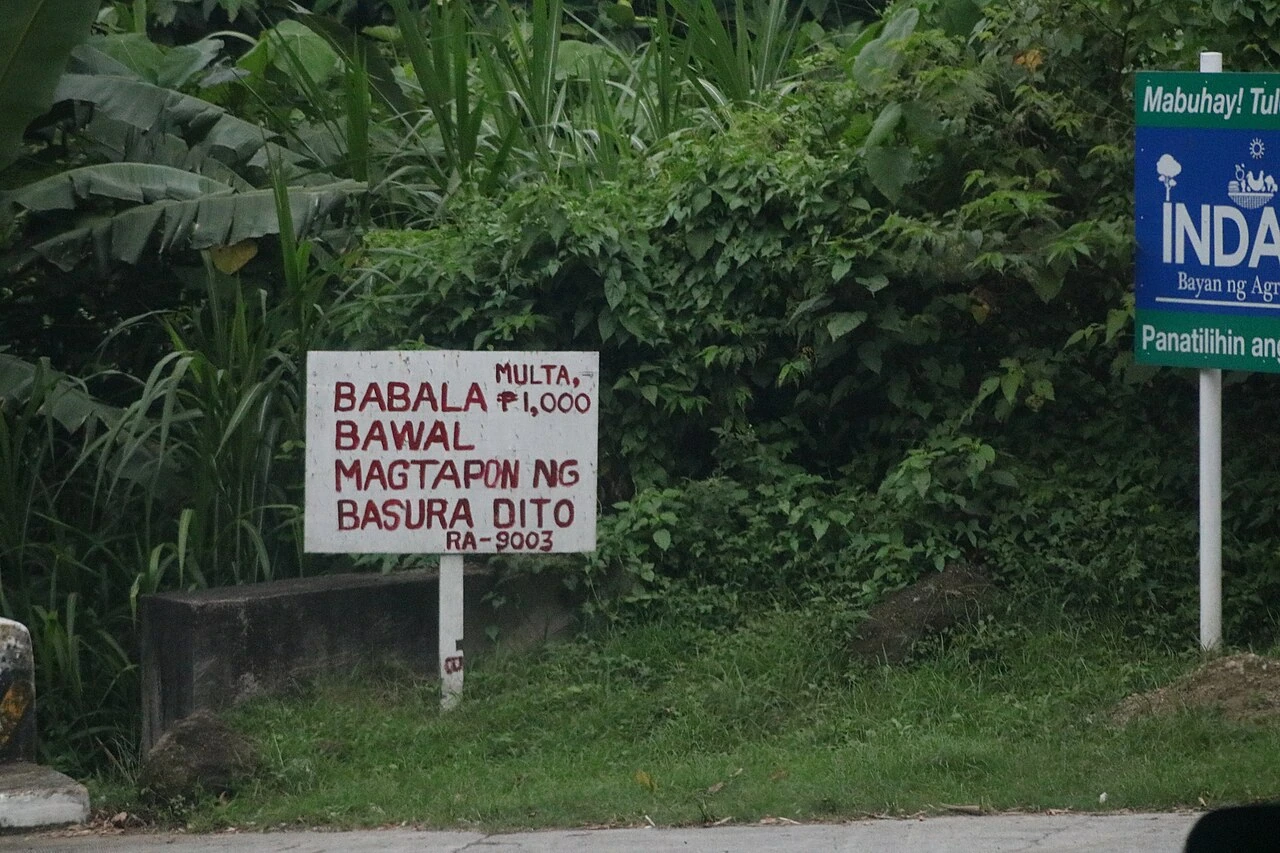
Tagalog no-dumping sign in Indang, Cavite, Philippines. Language identification follows the source description; not independently transcribed.
Saved in Babelbook · resized display copy. Select the image to open it independently of its source.
TagaSanPedroAko · Source ↗CC0 1.0 ↗View the local visual field note
Representative reference points from Glottolog. Historical entries show reference locations, not current speakers. 1 point.
Reference & context ↗Babelbook · original editorial illustration · CC BY 4.0 · Glottolog locations; public-domain Natural Earth land
Source excerpts, selected, shortened and where noted editorially corrected from Tagalog language by Wikipedia contributors. Retrieved 2026-10-05. CC BY-SA 4.0. These excerpts are not an independently verified scholarly history; missing accounts are identified above.
Read further in the source
History
The word Tagalog is possibly derived from the endonym taga-ilog ("river dweller"), composed of tagá- ("native of" or "from") and ilog ("river"), or alternatively, taga-alog deriving from alog ("pool of water in the lowlands"; "rice or vegetable plantation"). Linguists such as David Zorc and Robert Blust speculate that the Tagalogs and other Central Philippine ethno-linguistic groups originated in Northeastern Mindanao or the Eastern Visayas. Possible words of Old Tagalog origin are attested in the Laguna Copperplate Inscription from the tenth century, which is largely written in Old Malay. The first known complete book to be written in Tagalog is the Doctrina Christiana (Christian Doctrine), printed in 1593. The Doctrina was written in Spanish and two transcriptions of Tagalog; one in the ancient, then-current Baybayin script and the other in an early Spanish attempt at a Latin orthography for the language.
Throughout the 333 years of Spanish rule, various grammars and dictionaries were written by Spanish clergymen. In 1610, the Dominican priest Francisco Blancas de San José published the Arte y reglas de la lengua tagala (which was subsequently revised with two editions in 1752 and 1832) in Bataan. In 1613, the Franciscan priest Pedro de San Buenaventura published the first Tagalog dictionary, his Vocabulario de la lengua tagala in Pila, Laguna. The first substantial dictionary of the Tagalog language was written by the Czech Jesuit missionary Pablo Clain in the beginning of the 18th century. Clain spoke Tagalog and used it actively in several of his books. He prepared the dictionary, which he later passed over to Francisco Jansens and José Hernandez. Further compilation of his substantial work was prepared by P. Juan de Noceda and P. Pedro de Sanlucar and published as Vocabulario de la lengua tagala in Manila in 1754 and then repeatedly reedited, with the last edition being in 2013 in Manila. Among others, Arte de la lengua tagala y manual tagalog para la administración de los Santos Sacramentos (1850) in addition to early studies of the language. The indigenous poet Francisco Balagtas (1788–1862) is known as the foremost Tagalog writer, his most notable work being the 19th-century epic Florante at Laura.
Official status
Tagalog was declared the official language by the first revolutionary constitution in the Philippines, the Constitution of Biak-na-Bato in 1897. In 1935, the Philippine constitution designated English and Spanish as official languages, but mandated the development and adoption of a common national language based on one of the existing native languages. After study and deliberation, the National Language Institute, a committee composed of seven members who represented various regions in the Philippines, chose Tagalog as the basis for the evolution and adoption of the national language of the Philippines. President Manuel L. Quezon then, on December 30, 1937, proclaimed the selection of the Tagalog language to be used as the basis for the evolution and adoption of the national language of the Philippines. In 1939, President Quezon designated the proposed Tagalog-based national language as the Wikang Pambansâ (national language). Quezon himself was born and raised in Baler, Aurora, which is a native Tagalog-speaking area. Upon the country gaining independence on July 4, 1946, Commonwealth Act No. 570, which was approved in June 7, 1940, officially declared it an official language under the name, Filipino. Under the Japanese puppet government during World War II, Tagalog as a national language was strongly promoted; the 1943 Constitution specifying: "The government shall take steps toward the development and propagation of Tagalog as the national language." In 1959, Wikang Pambansang Pilipino was institutionally further renamed as Pilipino. Along with English, the national language has had official status under the 1973 constitution (as "Pilipino") and the 1987 constitution (as "Filipino").
Dialects
As of 2024, no comprehensive dialectology has been done in the Tagalog-speaking regions, though there have been descriptions in the form of dictionaries and grammars of various Tagalog dialects. Ethnologue lists Manila, Lubang, Marinduque, Bataan (Western Central Luzon), Batangas, Bulacan (Eastern Central Luzon), Tanay-Paete (Rizal-Laguna), and Tayabas (Quezon) as dialects of Tagalog; however, there appear to be four main dialects, of which the aforementioned are a part: Northern (exemplified by the Bulacan dialect), Central (including Manila), Southern (exemplified by Batangas), and Marinduque. Some example of dialectal differences are:
Many Tagalog dialects, particularly those in the south, preserve the glottal stop found after consonants and before vowels. This has been lost in Standard Tagalog, probably influenced by Spanish, where the glottal stop doesn't exist. For example, standard Tagalog ngayón (now, today), sinigáng (broth stew), gabí (night), matamís (sweet), are pronounced and written ngay-on, sinig-ang, gab-i, and matam-is in other dialects. In Teresian-Morong Tagalog, [ɾ] alternates with [d]. For example, bundók (mountain), dagat (sea), dingdíng (wall), isdâ (fish), and litid (joints) become bunrók, ragat, ringríng, isrâ, and litir, e.g. "sandók sa dingdíng" ("ladle on a wall" or "ladle on the wall", depending on the sentence) becoming "sanrók sa ringríng". However, exceptions are newer loanwords, and if the next consonant after a [d] is an [ɾ] (durog) or an [l] (dilà). In many southern dialects, the progressive aspect infix of -um- verbs is na-. For example, standard Tagalog kumakain (eating) is nákáin in Aurora, Quezon, and Batangas Tagalog. This is the butt of some jokes by other Tagalog speakers, for should a Southern Tagalog ask nákáin ka ba ng patíng? ("Do you eat shark?"), he would be understood as saying "Has a shark eaten you?" by speakers of the Manila Dialect. Some dialects have interjections which are considered a regional trademark. For example, the interjection ala e! usually identifies someone from Batangas as does hane?! in Rizal and Quezon provinces and akkaw in Aurora. Perhaps the most divergent Tagalog dialects are those spoken in Marinduque. Linguist Rosa Soberano identifies two dialects, western and eastern, with the former being closer to the Tagalog dialects spoken in the provinces of Batangas and Quezon. One example is the verb conjugation paradigms. While some of the affixes are different, Marinduque also preserves the imperative affixes, also found in Visayan and Bikol languages, that have mostly disappeared from most Tagalog early 20th century; they have since merged with the infinitive.
Outside of Luzon, a variety of Tagalog called Soccsksargen Tagalog (Sox-Tagalog, also called Kabacan Tagalog) is spoken in Soccsksargen, a southwestern region in Mindanao, as well as Cotabato City. This "hybrid" Tagalog dialect is a blend of Tagalog (including its dialects) with other languages where they are widely spoken and varyingly heard such as Hiligaynon (a regional lingua franca), Ilocano, Cebuano as well as Maguindanaon and other indigenous languages native to region, as a result of migration from Panay, Negros, Cebu, Bohol, Siquijor, Ilocandia, Cagayan Valley, Cordillera Administrative Region, Central Luzon, Calabarzon, Mindoro and Marinduque since the turn of 20th century, therefore making the region a melting pot of cultures and languages.
Writing system
Tagalog, like other Philippines languages, is written using the Latin alphabet. Prior to the arrival of the Spanish in 1521 and the beginning of their colonization in 1565, Tagalog was written in an abugida—or alphasyllabary—called Baybayin. This system of writing gradually gave way to the use and propagation of the Latin alphabet as introduced by the Spanish. As the Spanish began to record and create grammars and dictionaries for the various languages of the Philippine archipelago, they adopted systems of writing closely following the orthographic customs of the Spanish language and were refined over the years. Until the first half of the 20th century, most Philippine languages were widely written in a variety of ways based on Spanish orthography. In the late 19th century, a number of educated Filipinos began proposing for revising the spelling system used for Tagalog at the time. In 1884, Filipino doctor and student of languages Trinidad Pardo de Tavera published his study on the ancient Tagalog script Contribucion para el Estudio de los Antiguos Alfabetos Filipinos and in 1887, published his essay El Sanscrito en la lengua Tagalog which made use of a new writing system developed by him. Meanwhile, Jose Rizal, inspired by Pardo de Tavera's 1884 work, also began developing a new system of orthography (unaware at first of Pardo de Tavera's own orthography). A major noticeable change in these proposed orthographies was the use of the letter ⟨k⟩ rather than ⟨c⟩ and ⟨q⟩ to represent the phoneme /k/. In 1889, the new bilingual Spanish-Tagalog La España Oriental newspaper, of which Isabelo de los Reyes was an editor, began publishing using the new orthography stating in a footnote that it would "use the orthography recently introduced by ... learned Orientalis". This new orthography, while having its supporters, was also not initially accepted by several writers. Soon after the first issue of La España, Pascual H. Poblete's Revista Católica de Filipina began a series of articles attacking the new orthography and its proponents. A fellow writer, Pablo Tecson was also critical. Among the attacks was the use of the letters "k" and "w" as they were deemed to be of German origin and thus its proponents were deemed as "unpatriotic". The publishers of these two papers would eventually merge as La Lectura Popular in January 1890 and would eventually make use of both spelling systems in its articles. Pedro Laktaw, a schoolteacher, published the first Spanish-Tagalog dictionary using the new orthography in 1890. In April 1890, Jose Rizal authored an article Sobre la Nueva Ortografia de la Lengua Tagalog in the Madrid-based periodical La Solidaridad. In it, he addressed the criticisms of the new writing system by writers like Pobrete and Tecson and the simplicity, in his opinion, of the new orthography. Rizal described the orthography promoted by Pardo de Tavera as "more perfect" than what he himself had developed. The new orthography was, however, not broadly adopted initially and was used inconsistently in the bilingual periodicals of Manila until the early 20th century. The revolutionary society Kataás-taasan, Kagalang-galang Katipunan ng̃ mg̃á Anak ng̃ Bayan or Katipunan made use of the k-orthography and the letter k featured prominently on many of its flags and insignias. In 1937, Tagalog was selected to serve as basis for the country's national language. In 1940, the Balarilâ ng Wikang Pambansâ (English: Grammar of the National Language) of grammarian Lope K. Santos introduced the Abakada alphabet. This alphabet consists of 20 letters and became the standard alphabet of the national language. The orthography as used by Tagalog would eventually influence and spread to the systems of writing used by other Philippine languages (which had been using variants of the Spanish-based system of writing). In 1987, the Abakada was dropped and replaced by the expanded 28-letter Filipino alphabet.