Tswana
Tswana, also known by its native name Setswana, is a Bantu language indigenous to Southern Africa and spoken by about 8.2 million people. It is closely related to the Sepedi and Sesotho languages, as well as the Sekgaladi and likely the Silozi language. Tswana is an official language of South Africa and Zimbabwe. It is a lingua franca in Botswana and parts of South Africa, particularly North West Province. Setswana speaking ethnic groups are found in several provinces of South Africa, primarily in the North West, where about four million people speak the language. An urbanised variety is known as Sepitori, and is the principal unique language of the city of Pretoria. The three South African provinces with the most speakers are Gauteng (circa 11%), Northern Cape, and North West (over 70%). Until 1994, South African Batswana were notionally citizens of Bophuthatswana, one of the bantustans of the apartheid regime. The Setswana language in the Northwest Province has variations in which it is spoken according to the ethnic groups found in the Tswana culture (Bakgatla, Barolong, Bakwena, Batlhaping, Bahurutshe, Bafokeng, Batlokwa, Bataung, and Batswapong, among others); the written language remains the same. A small number of speakers are also found in Zimbabwe (unknown number) and Namibia (about 10,000 people).
Translate in Tswana ↗Tswana, also known by its native name Setswana, is a Bantu language indigenous to Southern Africa and spoken by about 8.2 million people. It is closely related to the Sepedi and Sesotho languages, as well as the Sekgaladi and likely the Silozi language. Tswana is an official language of South Africa and Zimbabwe. It is a lingua franca in Botswana and parts of South Africa, particularly North West Province. Setswana speaking ethnic groups are found in several provinces of South Africa, primarily in the North West, where about four million people speak the language. An urbanised variety is known as Sepitori, and is the principal unique language of the city of Pretoria. The three South African provinces with the most speakers are Gauteng (circa 11%), Northern Cape, and North West (over 70%). Until 1994, South African Batswana were notionally citizens of Bophuthatswana, one of the bantustans of the apartheid regime. The Setswana language in the Northwest Province has variations in which it is spoken according to the ethnic groups found in the Tswana culture (Bakgatla, Barolong, Bakwena, Batlhaping, Bahurutshe, Bafokeng, Batlokwa, Bataung, and Batswapong, among others); the written language remains the same. A small number of speakers are also found in Zimbabwe (unknown number) and Namibia (about 10,000 people).
Sub-Saharan Africa
Present-day use
The captured source does not contain a separate current-use account.
Origins
The captured article does not contain a separate origins section. See the historical account and linked source.
Development
The first European to describe the language was the German traveller Hinrich Lichtenstein, who lived among a Batswana tribe known as Batlhaping in 1806 although his work was not published until 1930. He mistakenly regarded Setswana as a dialect of the isiXhosa, and the name that he used for the language "Beetjuana" may also have covered Sepedi and Sesotho. The first major work on Tswana was carried out by the British missionary Robert Moffat, who had also lived among the Batlhaping, and published Bechuana Spelling Book and A Bechuana Catechism in 1826. In the following years, he published several books of the Bible, and in 1857, he was able to publish a complete translation of the Bible. The first grammar of Setswana was published in 1833 by the missionary James Archbell although it was modelled on isiXhosa grammar. The first grammar of Setswana which regarded it as a separate language from isiXhosa (but still not as a separate language from the Sepedi and Sesotho) was published by the French missionary, E. Casalis in 1841. He changed his mind later, and in a publication from 1882, he noted that Sepedi and Sesotho were distinct from Setswana. Solomon Plaatje, a South African intellectual and linguist, was one of the first writers to extensively write in and about the Tswana language.
Writing
Setswana orthography is based on the Latin alphabet. The letter š was introduced in 1937, but the corresponding sound is still sometimes written as ⟨sh⟩. The letters ⟨ê⟩ and ⟨ô⟩ are used in textbooks and language reference books, but not so much in daily standard writing.
Beyond the typeface.
Signs, manuscripts, published pages and contextual photographs, with their place, period, source and reuse terms. Captions identify historical spellings, regional examples, community references and character imagery.
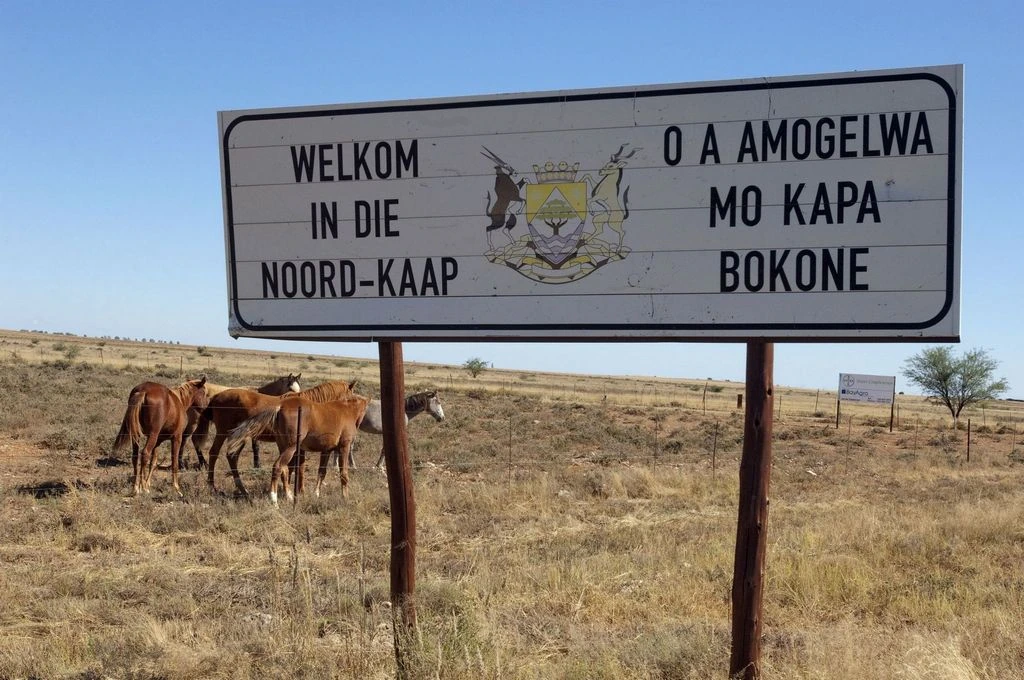
A Northern Cape roadside welcome sign, catalogued by Commons as bilingual Afrikaans–Tswana.
Saved in Babelbook · resized display copy. Select the image to open it independently of its source.
South African Tourism · Source ↗CC BY 2.0 ↗View the local visual field note
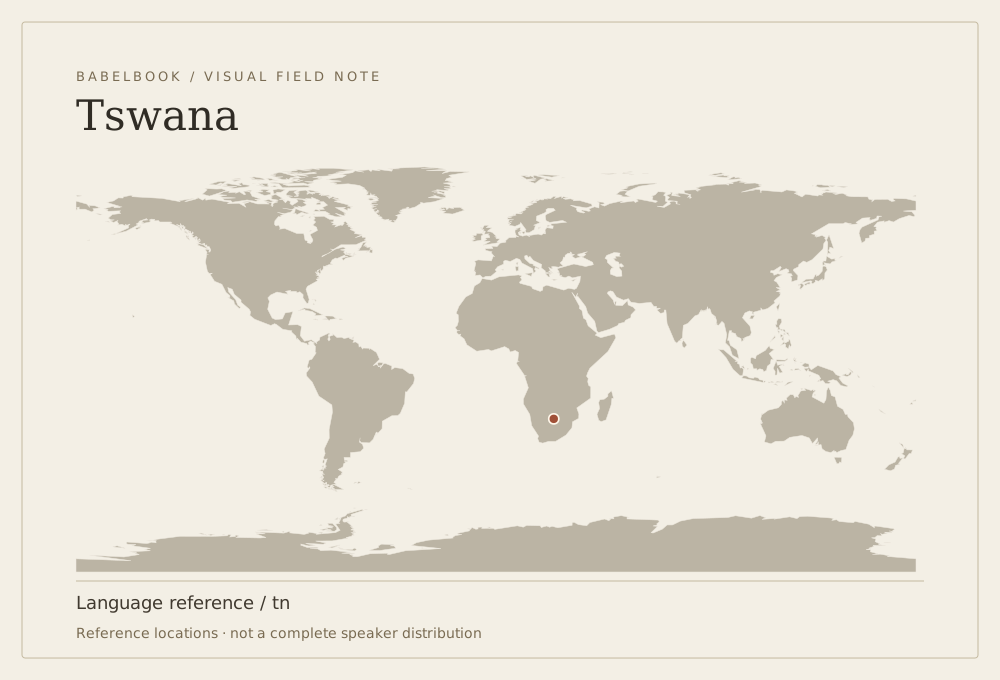
Representative reference points from Glottolog. Historical entries show reference locations, not current speakers. 1 point.
Reference & context ↗Babelbook · original editorial illustration · CC BY 4.0 · Glottolog locations; public-domain Natural Earth land
Source excerpts, selected, shortened and where noted editorially corrected from Tswana language by Wikipedia contributors. Retrieved 2026-10-05. CC BY-SA 4.0. These excerpts are not an independently verified scholarly history; missing accounts are identified above.
Read further in the source
History
The first European to describe the language was the German traveller Hinrich Lichtenstein, who lived among a Batswana tribe known as Batlhaping in 1806 although his work was not published until 1930. He mistakenly regarded Setswana as a dialect of the isiXhosa, and the name that he used for the language "Beetjuana" may also have covered Sepedi and Sesotho. The first major work on Tswana was carried out by the British missionary Robert Moffat, who had also lived among the Batlhaping, and published Bechuana Spelling Book and A Bechuana Catechism in 1826. In the following years, he published several books of the Bible, and in 1857, he was able to publish a complete translation of the Bible. The first grammar of Setswana was published in 1833 by the missionary James Archbell although it was modelled on isiXhosa grammar. The first grammar of Setswana which regarded it as a separate language from isiXhosa (but still not as a separate language from the Sepedi and Sesotho) was published by the French missionary, E. Casalis in 1841. He changed his mind later, and in a publication from 1882, he noted that Sepedi and Sesotho were distinct from Setswana. Solomon Plaatje, a South African intellectual and linguist, was one of the first writers to extensively write in and about the Tswana language.
Orthography
Setswana orthography is based on the Latin alphabet.
The letter š was introduced in 1937, but the corresponding sound is still sometimes written as ⟨sh⟩. The letters ⟨ê⟩ and ⟨ô⟩ are used in textbooks and language reference books, but not so much in daily standard writing.