Tongan
Tongan (English pronunciation: TONG-(g)ən; lea fakatonga) is an Austronesian language of the Polynesian branch native to the island nation of Tonga. It has around 187,000 speakers. It uses the word order verb–subject–object and, although primarily spoken, the written form uses Latin script.
Translate in Tongan ↗Tongan (English pronunciation: TONG-(g)ən; lea fakatonga) is an Austronesian language of the Polynesian branch native to the island nation of Tonga. It has around 187,000 speakers. It uses the word order verb–subject–object and, although primarily spoken, the written form uses Latin script.
Oceania
Present-day use
The captured source does not contain a separate current-use account.
Origins
The captured article does not contain a separate origins section. See the historical account and linked source.
Development
The earliest attempts to transcribe the Tongan language were made by Willem Schouten and Jacob Le Maire of the Dutch East India Company when they first arrived in 1616. They transcribed a limited number of nouns and verbs using phonetic Dutch spelling and added them to a growing list of Polynesian vocabulary. Abel Tasman, also of the Dutch East India Company, attempted to converse with indigenous Tongans using vocabulary from this list when he arrived on Tongatapu on 20 January 1643, although he was poorly understood, likely using words added from different Polynesian languages.
Writing
Latin or customary script (catalog classification; see the source for context).
Beyond the typeface.
Signs, manuscripts, published pages and contextual photographs, with their place, period, source and reuse terms. Captions identify historical spellings, regional examples, community references and character imagery.
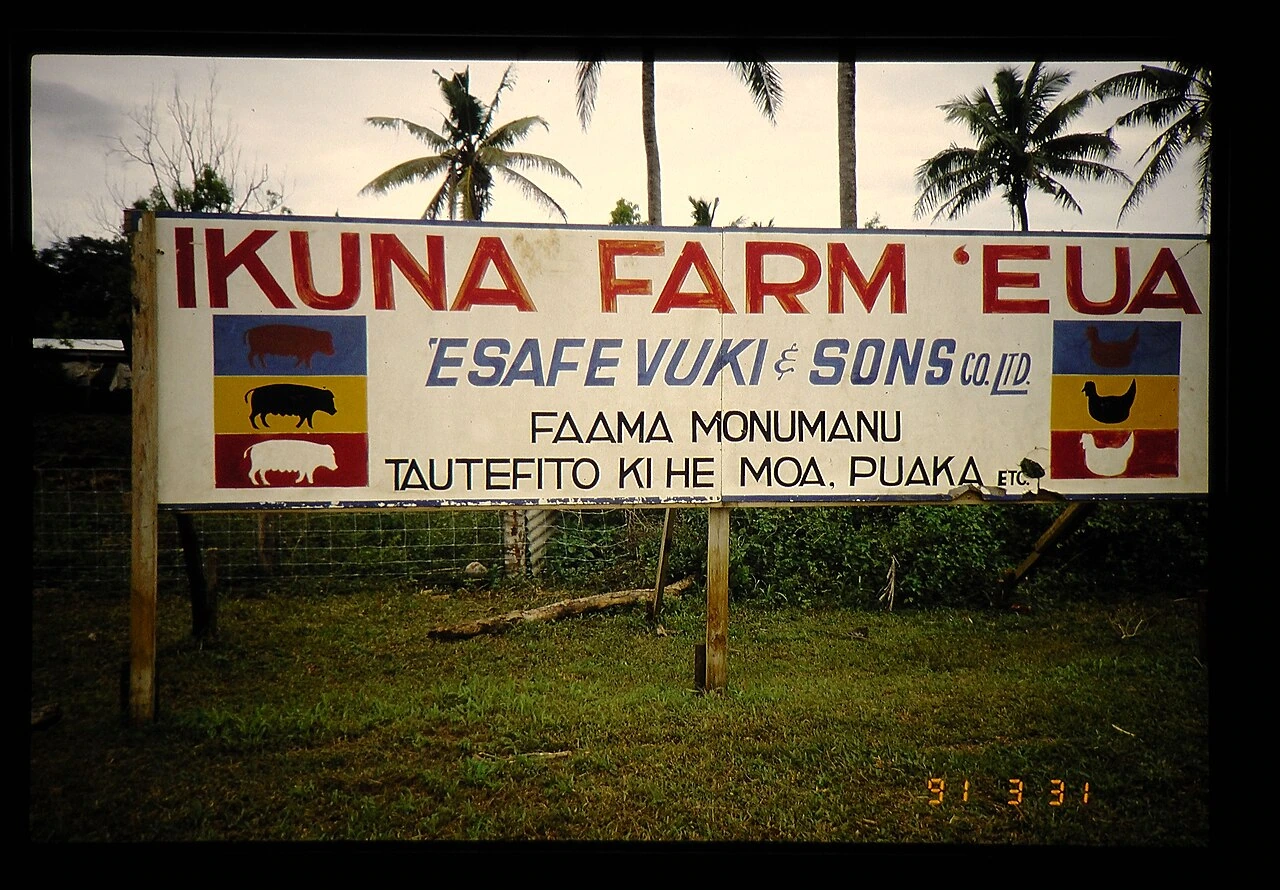
English and Tongan farm entrance sign on ‘Eua island. Language identification follows Commons metadata; not independently transcribed.
Saved in Babelbook · resized display copy. Select the image to open it independently of its source.
Miyasige Tosikazu / JIRCAS · Source ↗CC BY 2.0 ↗View the local visual field note
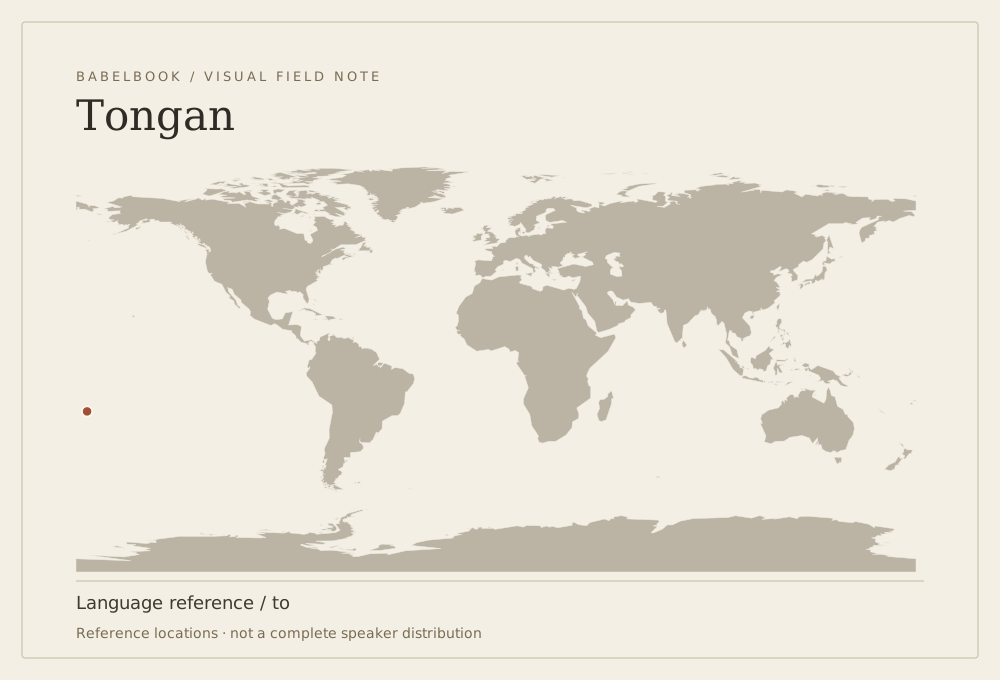
Representative reference points from Glottolog. Historical entries show reference locations, not current speakers. 1 point.
Reference & context ↗Babelbook · original editorial illustration · CC BY 4.0 · Glottolog locations; public-domain Natural Earth land
Source excerpts, selected, shortened and where noted editorially corrected from Tongan language by Wikipedia contributors. Retrieved 2026-10-05. CC BY-SA 4.0. These excerpts are not an independently verified scholarly history; missing accounts are identified above.
Read further in the source
History
The earliest attempts to transcribe the Tongan language were made by Willem Schouten and Jacob Le Maire of the Dutch East India Company when they first arrived in 1616. They transcribed a limited number of nouns and verbs using phonetic Dutch spelling and added them to a growing list of Polynesian vocabulary. Abel Tasman, also of the Dutch East India Company, attempted to converse with indigenous Tongans using vocabulary from this list when he arrived on Tongatapu on 20 January 1643, although he was poorly understood, likely using words added from different Polynesian languages.