Turkish
Turkish (Türkçe [ˈtyɾctʃɛ], Türk dili [ˈtyɾc dilɪ], also known as Türkiye Türkçesi 'Turkish of Turkey') is the most widely spoken of the Turkic languages, with around 90 million speakers. It is the national language of Turkey and one of two official languages of Cyprus. Significant smaller groups of Turkish speakers also exist in Germany, Austria, Bulgaria, North Macedonia, Greece, other parts of Europe, the South Caucasus, and some parts of Central Asia, Iraq, and Syria. Turkish is the 21st-most spoken language in the world. To the west, the influence of Ottoman Turkish—the variety of the Turkish language that was used as the administrative and literary language of the Ottoman Empire—spread as the Ottoman Empire expanded. In 1928, as one of Atatürk's reforms in the early years of the Republic of Turkey, the Perso-Arabic script-based Ottoman Turkish alphabet was replaced with the Latin script-based Turkish alphabet. Turkish grammar is characterized by extensive agglutination and is generally very regular. The basic word order is subject–object–verb. Turkish has no noun classes or grammatical gender. Other notable grammatical features include evidentiality, converbs, and a variety of tenses, aspects, and moods. Turkish phonology is marked by vowel harmony; native words typically contain only front vowels (⟨e, i, ö, ü⟩) or only back vowels (⟨a, ı, o, u⟩), a phenomenon known as palatal harmony. In addition, certain suffixes exhibit a fourfold harmony that also includes rounding harmony among high vowels. While most suffixes agree with vowel harmony, there are some exceptions.
Translate in Turkish ↗Turkish is natively spoken by the Turkish people in Turkey and by the Turkish diaspora in some 30 other countries. The Turkish language is mutually intelligible with Azerbaijani. In particular, Turkish-speaking minorities exist in countries that formerly (in whole or part) belonged to the Ottoman Empire, such as Iraq, Bulgaria, Cyprus, Greece (primarily in Western Thrace), the Republic of North Macedonia, Romania, and Serbia. More than two million Turkish speakers live in Germany; and there are significant Turkish-speaking communities in the United States, France, the Netherlands, Austria, Belgium, Switzerland, and the United Kingdom. Due to the cultural assimilation of Turkish immigrants in host countries, not all ethnic members of the diaspora speak the language with native fluency. In 2005, 93% of the population of Turkey were native speakers of Turkish, about 67 million at the time, with Kurdish languages making up most of the remainder. Azerbaijani is the official language of Azerbaijan and is mutually intelligible with Turkish. Speakers of the two languages can usually understand each other, particularly in everyday conversations. Turkey and Azerbaijan have very good relations, and many Turkish companies and government agencies invest in Azerbaijan. Consequently, Turkey exerts significant influence over Azerbaijan. However, the growing presence of Turkish in Azerbaijan, coupled with the tendency of many children to use Turkish words instead of Azerbaijani ones due to satellite TV, has raised concerns that the unique characteristics of Azerbaijani may be eroded. Many bookstores sell Turkish books alongside Azerbaijani ones. Agalar Mahmadov, a leading intellectual, has expressed concern that Turkish has "already started to take over the national and natural dialects of Azerbaijan." Nevertheless, Turkish is not as prevalent as Russian as a foreign language. Turkish is the official language of Turkey and is one of the official languages of Cyprus.
Global / other
Present-day use
After the foundation of the modern state of Turkey and the script reform, the Turkish Language Association (TDK) was established in 1932 under the patronage of Mustafa Kemal Atatürk, with the aim of conducting research on Turkish. One of the tasks of the newly established association was to initiate a language reform to replace loanwords of Arabic and Persian origins with Turkish equivalents. By banning the usage of imported words in the press, the association succeeded in removing several hundred foreign words from the language. While most of the words introduced to the language by the TDK were newly derived from Turkic roots, it also opted for reviving Old Turkish words which had not been used for centuries. In 1935, the TDK published a bilingual Ottoman-Turkish/Pure Turkish dictionary that documents the results of the language reform. Owing to this sudden change in the language, older and younger people in Turkey started to differ in their vocabularies. While the generations born before the 1940s tend to use the older terms of Arabic and Persian origins, the younger generations favor new expressions. It is considered particularly ironic that Atatürk himself, in his lengthy speech to the new Parliament in 1927, used the formal style of Ottoman Turkish that had been common at the time amongst statesmen and the educated strata of society in the setting of formal speeches and documents. After the language reform, the Turkish education system discontinued the teaching of literary Ottoman Turkish, and over time the speaking and writing ability of society atrophied to the point that later generations of Turkish speakers would perceive the speech as sounding so alien that it had to be "translated" three times into modern Turkish: first in 1963, again in 1986, and most recently in 1995. The past few decades have seen the continuing work of the TDK to coin new Turkish words to express new concepts and technologies as they enter the language, mostly from English.
Origins
Around 86% of the Turkish vocabulary is of Turkic origin. The majority of the core vocabulary and the most commonly used words in Turkish, including those first acquired by children as they learn to speak, derive from Turkic. Nevertheless, Turkish vocabulary contains a significant number of loanwords from other languages, in which around 14% of Turkish words are of foreign origin. According to the Turkish Language Association, 6,463 of these foreign words come from Arabic, 4,974 from French, 1,374 from Persian, 632 from Italian, 538 from English, 399 from Greek, and 147 from Latin. In Turkish, there are many pairs of synonyms where one word is of foreign origin and the other of Turkic origin. These pairs are the result of the enrichment of the Turkish vocabulary with loanwords from Arabic, Persian and French, and of the Turkish language reform initiated in the early 20th century that aimed to restore foreign-origin words with Turkic equivalents.
Development
The earliest known Old Turkic inscriptions are the three monumental Orkhon inscriptions found in modern Mongolia. Erected in honour of the prince Kul Tigin and his brother Emperor Bilge Khagan, these date back to the Second Turkic Khaganate (dated 682–744 CE). After the discovery and excavation of these monuments and associated stone slabs by Russian archaeologists in the wider area surrounding the Orkhon Valley between 1889 and 1893, it became established that the language on the inscriptions was the Old Turkic language written using the Old Turkic alphabet, which has also been referred to as "Turkic runes" or "runiform" due to a superficial similarity to the Germanic runic alphabets. With the Turkic expansion during Early Middle Ages (c. 6th–11th centuries), peoples speaking Turkic languages spread across Central Asia, covering a vast geographical region stretching from Siberia all the way to Europe and the Mediterranean. The Seljuqs of the Oghuz Turks, in particular, brought their language, Oghuz—the direct ancestor of today's Turkish language—into Anatolia during the 11th century. Also during the 11th century, an early linguist of the Turkic languages, Mahmud al-Kashgari from the Kara-Khanid Khanate, published the first comprehensive Turkic language dictionary and map of the geographical distribution of Turkic speakers in the Dīwān Lughāt al-Turk (ديوان لغات الترك).
Writing
Turkish is written using a version of Latin script introduced in 1928 by Atatürk to replace the Ottoman Turkish alphabet, a version of Perso-Arabic script. The Ottoman alphabet marked only three different vowels—long ā, ū and ī—and included several redundant consonants, such as variants of z (which were distinguished in Arabic but not in Turkish). The omission of short vowels in the Arabic script was claimed to make it particularly unsuitable for Turkish, which has eight vowels. The reform of the script was an important step in the cultural reforms of the period. The task of preparing the new alphabet and selecting the necessary modifications for sounds specific to Turkish was entrusted to a Language Commission composed of prominent linguists, academics, and writers. The introduction of the new Turkish alphabet was supported by public education centers opened throughout the country, cooperation with publishing companies, and encouragement by Atatürk himself, who toured the country teaching the new letters to the public. As a result, there was a dramatic increase in literacy from its original, pre-modern levels. The Latin alphabet was applied to the Turkish language for educational purposes even before the 20th-century reform. Instances include a 1635 Latin-Albanian dictionary by Frang Bardhi, who also incorporated several sayings in the Turkish language, as an appendix to his work (e.g. alma agatsdan irak duschamas—"An apple does not fall far from its tree"). Turkish now has an alphabet suited to the sounds of the language: the spelling is largely phonemic, with one letter corresponding to each phoneme. Most of the letters are used approximately as in English, the main exceptions being ⟨c⟩, which denotes [dʒ] (⟨j⟩ being used for the [ʒ] found in Persian and European loans); and the undotted ⟨ı⟩, representing [ɯ]. As in German, ⟨ö⟩ and ⟨ü⟩ represent [ø] and [y].
Beyond the typeface.
Signs, manuscripts, published pages and contextual photographs, with their place, period, source and reuse terms. Captions identify historical spellings, regional examples, community references and character imagery.
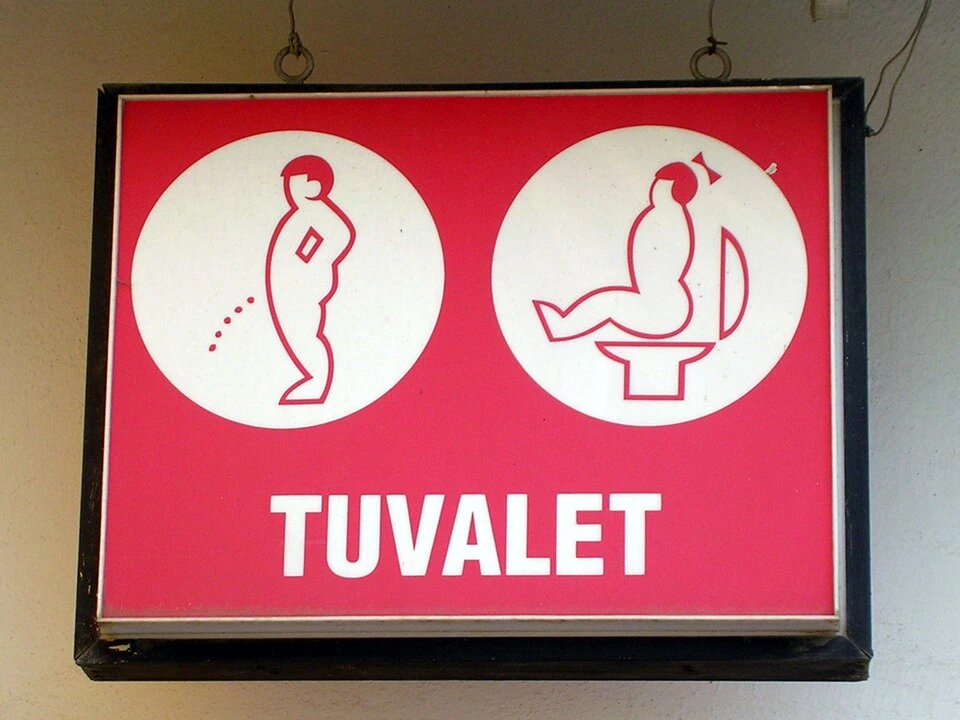
Turkish toilet sign near Pamukkale, photographed in 2005. Source-identified language; displayed without additional cropping.
Saved in Babelbook · resized display copy. Select the image to open it independently of its source.
Jake Bouma (jakebouma) · Source ↗CC BY 2.0 ↗View the local visual field note
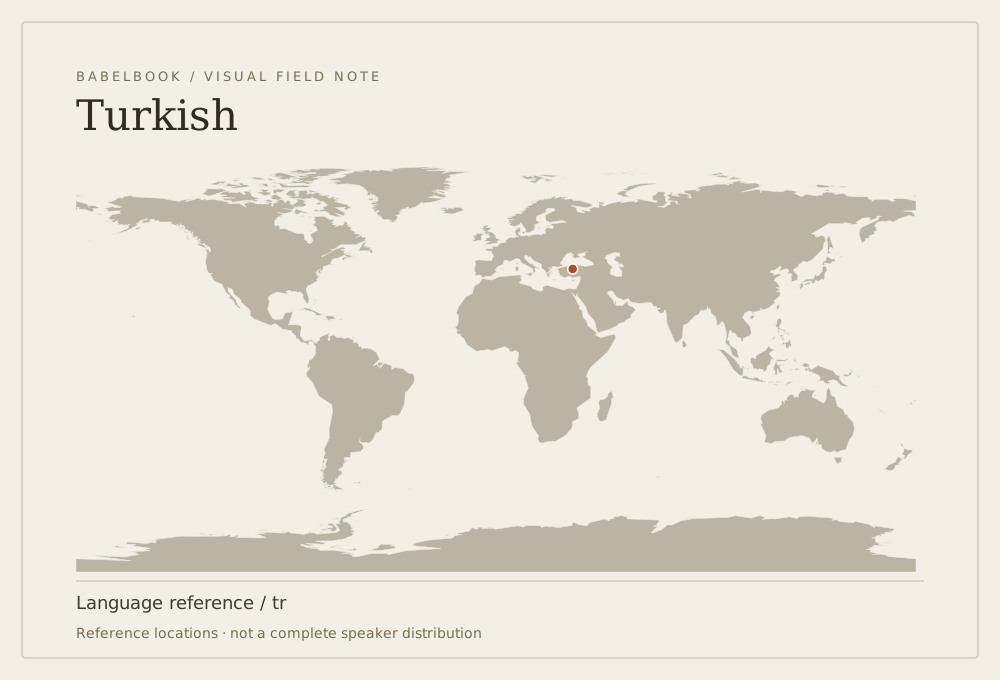
Representative reference points from Glottolog. Historical entries show reference locations, not current speakers. 1 point.
Reference & context ↗Babelbook · original editorial illustration · CC BY 4.0 · Glottolog locations; public-domain Natural Earth land
Source excerpts, selected, shortened and where noted editorially corrected from Turkish language by Wikipedia contributors. Retrieved 2026-10-05. CC BY-SA 4.0. These excerpts are not an independently verified scholarly history; missing accounts are identified above.
Read further in the source
History
The earliest known Old Turkic inscriptions are the three monumental Orkhon inscriptions found in modern Mongolia. Erected in honour of the prince Kul Tigin and his brother Emperor Bilge Khagan, these date back to the Second Turkic Khaganate (dated 682–744 CE). After the discovery and excavation of these monuments and associated stone slabs by Russian archaeologists in the wider area surrounding the Orkhon Valley between 1889 and 1893, it became established that the language on the inscriptions was the Old Turkic language written using the Old Turkic alphabet, which has also been referred to as "Turkic runes" or "runiform" due to a superficial similarity to the Germanic runic alphabets. With the Turkic expansion during Early Middle Ages (c. 6th–11th centuries), peoples speaking Turkic languages spread across Central Asia, covering a vast geographical region stretching from Siberia all the way to Europe and the Mediterranean. The Seljuqs of the Oghuz Turks, in particular, brought their language, Oghuz—the direct ancestor of today's Turkish language—into Anatolia during the 11th century. Also during the 11th century, an early linguist of the Turkic languages, Mahmud al-Kashgari from the Kara-Khanid Khanate, published the first comprehensive Turkic language dictionary and map of the geographical distribution of Turkic speakers in the Dīwān Lughāt al-Turk (ديوان لغات الترك).
Geographic distribution
Turkish is natively spoken by the Turkish people in Turkey and by the Turkish diaspora in some 30 other countries. The Turkish language is mutually intelligible with Azerbaijani. In particular, Turkish-speaking minorities exist in countries that formerly (in whole or part) belonged to the Ottoman Empire, such as Iraq, Bulgaria, Cyprus, Greece (primarily in Western Thrace), the Republic of North Macedonia, Romania, and Serbia. More than two million Turkish speakers live in Germany; and there are significant Turkish-speaking communities in the United States, France, the Netherlands, Austria, Belgium, Switzerland, and the United Kingdom. Due to the cultural assimilation of Turkish immigrants in host countries, not all ethnic members of the diaspora speak the language with native fluency.
In 2005, 93% of the population of Turkey were native speakers of Turkish, about 67 million at the time, with Kurdish languages making up most of the remainder. Azerbaijani is the official language of Azerbaijan and is mutually intelligible with Turkish. Speakers of the two languages can usually understand each other, particularly in everyday conversations. Turkey and Azerbaijan have very good relations, and many Turkish companies and government agencies invest in Azerbaijan. Consequently, Turkey exerts significant influence over Azerbaijan. However, the growing presence of Turkish in Azerbaijan, coupled with the tendency of many children to use Turkish words instead of Azerbaijani ones due to satellite TV, has raised concerns that the unique characteristics of Azerbaijani may be eroded. Many bookstores sell Turkish books alongside Azerbaijani ones. Agalar Mahmadov, a leading intellectual, has expressed concern that Turkish has "already started to take over the national and natural dialects of Azerbaijan." Nevertheless, Turkish is not as prevalent as Russian as a foreign language.
Official status
Turkish is the official language of Turkey and is one of the official languages of Cyprus. Turkish has official status in 38 municipalities in Kosovo, including Mamusha,, two in the Republic of North Macedonia and two in Iraq. Cyprus has requested the European Union to add Turkish as an official language, as it is one of the two official languages of the country. In Turkey, the regulatory body for Turkish is the Turkish Language Association (Türk Dil Kurumu or TDK), which was founded in 1932 under the name Türk Dili Tetkik Cemiyeti ("Society for Research on the Turkish Language"). The Turkish Language Association was influenced by the ideology of linguistic purism: indeed one of its primary tasks was the replacement of loanwords and of foreign grammatical constructions with equivalents of Turkish origin. These changes, together with the adoption of the new Turkish alphabet in 1928, shaped the modern Turkish language spoken today. The TDK became an independent body in 1951, with the lifting of the requirement that it should be presided over by the Minister of Education. This status continued until August 1983, when it was again made into a governmental body in the constitution of 1982, following the military coup d'état of 1980.
Dialects
Standard Turkish is based on the dialect of Istanbul. This Istanbul Turkish (İstanbul Türkçesi) constitutes the model of written and spoken Turkish, as recommended by Ziya Gökalp, Ömer Seyfettin and others. Dialectal variation persists, in spite of the levelling influence of the standard used in mass media and in the Turkish education system since the 1930s. Academic researchers from Turkey often refer to Turkish dialects as ağız or şive, leading to an ambiguity with the linguistic concept of accent, which is also covered with these words. Several universities, as well as a dedicated work-group of the Turkish Language Association, carry out projects investigating Turkish dialects. As of 2002 work continued on the compilation and publication of their research as a comprehensive dialect-atlas of the Turkish language. Although the Ottoman alphabet, being more phonetically ambiguous than the Latin script, encoded for many of the dialectal variations between Turkish dialects, the modern Latin script fails to do this. Examples of this are the presence of the nasal velar sound [ŋ] in certain eastern dialects of Turkish which was represented by the Ottoman letter ⟨ڭ⟩ but that was merged into ⟨n⟩ in the Latin script. Additionally are letters such as ⟨خ ,ق ,غ⟩ which make the sounds [ɣ], [q], and [x], respectively in certain eastern dialects but that are merged into [g], [k], and [h] in western dialects and are therefore defectively represented in the Latin alphabet for speakers of eastern dialects.
Some immigrants to Turkey from Rumelia speak Rumelian Turkish, which includes the distinct dialects of Ludogorie, Dinler, and Adakale, which show the influence of the theorized Balkan sprachbund. Kıbrıs Türkçesi is the name for Cypriot Turkish and is spoken by the Turkish Cypriots. Edirne is the dialect of Edirne. Ege is spoken in the Aegean region, with its usage extending to Antalya. The nomadic Yörüks of the Mediterranean Region of Turkey also have their own dialect of Turkish. This group is not to be confused with the Yuruk nomads of Macedonia, Greece, and European Turkey, who speak Balkan Gagauz Turkish. The Meskhetian Turks who live in Kazakhstan, Azerbaijan and Russia as well as in several Central Asian countries, also speak an Eastern Anatolian dialect of Turkish, originating in the areas of Kars, Ardahan, Artvin, Diyarbakır and Erzurum and sharing similarities with Azerbaijani, the language of Azerbaijan. The Central Anatolia Region speaks Orta Anadolu. Karadeniz, spoken in the Eastern Black Sea Region and represented primarily by the Trabzon dialect, exhibits substratum influence from Greek in phonology and syntax; it is also known as Laz dialect (not to be confused with the Laz language). Kastamonu is spoken in Kastamonu and its surrounding areas. Karamanli Turkish (Greek: Kαραμανλήδικα) is an extinct dialect that was spoken in what is now Karaman. It was the literary standard for the Karamanlides.
Word origins
Around 86% of the Turkish vocabulary is of Turkic origin. The majority of the core vocabulary and the most commonly used words in Turkish, including those first acquired by children as they learn to speak, derive from Turkic. Nevertheless, Turkish vocabulary contains a significant number of loanwords from other languages, in which around 14% of Turkish words are of foreign origin. According to the Turkish Language Association, 6,463 of these foreign words come from Arabic, 4,974 from French, 1,374 from Persian, 632 from Italian, 538 from English, 399 from Greek, and 147 from Latin. In Turkish, there are many pairs of synonyms where one word is of foreign origin and the other of Turkic origin. These pairs are the result of the enrichment of the Turkish vocabulary with loanwords from Arabic, Persian and French, and of the Turkish language reform initiated in the early 20th century that aimed to restore foreign-origin words with Turkic equivalents.
Writing system
Turkish is written using a version of Latin script introduced in 1928 by Atatürk to replace the Ottoman Turkish alphabet, a version of Perso-Arabic script. The Ottoman alphabet marked only three different vowels—long ā, ū and ī—and included several redundant consonants, such as variants of z (which were distinguished in Arabic but not in Turkish). The omission of short vowels in the Arabic script was claimed to make it particularly unsuitable for Turkish, which has eight vowels. The reform of the script was an important step in the cultural reforms of the period. The task of preparing the new alphabet and selecting the necessary modifications for sounds specific to Turkish was entrusted to a Language Commission composed of prominent linguists, academics, and writers. The introduction of the new Turkish alphabet was supported by public education centers opened throughout the country, cooperation with publishing companies, and encouragement by Atatürk himself, who toured the country teaching the new letters to the public. As a result, there was a dramatic increase in literacy from its original, pre-modern levels. The Latin alphabet was applied to the Turkish language for educational purposes even before the 20th-century reform. Instances include a 1635 Latin-Albanian dictionary by Frang Bardhi, who also incorporated several sayings in the Turkish language, as an appendix to his work (e.g. alma agatsdan irak duschamas—"An apple does not fall far from its tree"). Turkish now has an alphabet suited to the sounds of the language: the spelling is largely phonemic, with one letter corresponding to each phoneme. Most of the letters are used approximately as in English, the main exceptions being ⟨c⟩, which denotes [dʒ] (⟨j⟩ being used for the [ʒ] found in Persian and European loans); and the undotted ⟨ı⟩, representing [ɯ]. As in German, ⟨ö⟩ and ⟨ü⟩ represent [ø] and [y]. The letter ⟨ğ⟩, in principle, denotes [ɣ] but has the property of lengthening the preceding vowel and assimilating any subsequent vowel. The letters ⟨ş⟩ and ⟨ç⟩ represent [ʃ] and [tʃ], respectively. A circumflex is written over back vowels following ⟨k⟩ and ⟨g⟩ when these consonants represent [c] and [ɟ]—almost exclusively in Arabic and Persian loans. The Turkish alphabet consists of 29 letters (q, w, x omitted and ç, ş, ğ, ı, ö, ü added); the complete list is:
a, b, c, ç, d, e, f, g, ğ, h, ı, i, j, k, l, m, n, o, ö, p, r, s, ş, t, u, ü, v, y, and z (Capital of i is İ and lowercase I is ı.) The specifically Turkish letters and spellings described above are illustrated in this table: