Tsonga
Tsonga ( (T)SONG-gə), or Xitsonga ( shee-TSONG-gə) as an endonym (also known as Changana in Mozambique), is a Bantu language spoken by the Tsonga people of South Africa and Mozambique. It is mutually intelligible with Tswa and Ronga and the name "Tsonga" is often used as a cover term for all three, also sometimes referred to as Tswa-Ronga. The Xitsonga language has been standardised as a written language. Tsonga is an official language of the Republic of South Africa, and under the name Shangani it is recognised as an official language in the Constitution of Zimbabwe. All Tswa-Ronga languages are recognised in Mozambique. It is not official in Eswatini (formerly known as Swaziland).
Translate in Tsonga ↗Tsonga ( (T)SONG-gə), or Xitsonga ( shee-TSONG-gə) as an endonym (also known as Changana in Mozambique), is a Bantu language spoken by the Tsonga people of South Africa and Mozambique. It is mutually intelligible with Tswa and Ronga and the name "Tsonga" is often used as a cover term for all three, also sometimes referred to as Tswa-Ronga. The Xitsonga language has been standardised as a written language. Tsonga is an official language of the Republic of South Africa, and under the name Shangani it is recognised as an official language in the Constitution of Zimbabwe. All Tswa-Ronga languages are recognised in Mozambique. It is not official in Eswatini (formerly known as Swaziland).
Sub-Saharan Africa
Present-day use
The captured source does not contain a separate current-use account.
Origins
The name "Tsonga" is the root of Xitsonga (culture, language or ways of the Tsonga) Mutsonga (a Tsonga person), Vatsonga (Tsonga people), etc. In the language of the Vatsonga themselves, the root never appears by itself. It is Tsonga for the ease and accessibility of the wider international community. As for the origins of the name, there are three theories. The first states that Tsonga is another pronunciation for Dzonga, which means "South" and also the name of one of the dialects of Xitsonga. The second theory is that it is an alternative spelling of the old ancestral name of the Chopi and Tembe groups, Tonga/Thonga. The other Zulu explanation for the alternative spelling of "Thonga" is that the Tembe and Rhonga people, who were the first to arrive at the Delagoa Bay and around the Natal Bay, transitioned the Rhonga "Rh" into the Zulu form of "Th". An example is rhuma (Tsonga word for "send") becoming thuma (Zulu word for the same action). The third and most accepted is that it is another pronunciation for "Rhonga", the root for the word "vurhonga" for east or the direction where the sun rises. Vurhonga also means dawn in Xitsonga. Rhonga (commonly and wrongly spelt as Ronga) is one of the Tsonga languages. The physical evidence of most Tsonga people residing along the eastern coast of Africa in the south, extending inland in a westward direction, makes this explanation especially inviting. However Junod had initially used the Ronga appellation but had also realized that the northern clans did not frequently use the name 'Ronga' as their identity name, but most certainly Tsonga is a derivation of Ronga. Much of the written history about the Tsonga regards the aftermath of the mfecane where the Nguni people overran many of the pre-existing African tribes of South Africa, Eswatini, Mozambique, and Zimbabwe.
Development
The first records of studies of Xitsonga by Europeans go back the Swiss missionary, Henri-Alexandre Junod, who between the years 1890 and 1920 hypothesised that the Xitsonga language (which he called the Thonga language) consolidated itself in Mozambique before the 1400s. In his own words, Junod states the following: My conclusion is then that the Thonga language was already-spoken by the primitive occupants of the country more than 500 years ago and that, together with a certain number of customs, it formed the great bond which bound the Thonga clans together in past centuries. Further studies were carried out by Junod and other Swiss missionaries such as Henri Berthoud and Ernest Creux, who began work on a standard written language, which they called Shigwamba. The term was however unfamiliar to many of the speakers, and was later replaced with Thonga/Tsonga. Other Swiss missionaries working alongside Tsonga people translated the Christian Bible from English and Sesotho into Tsonga. In 1996, the language was officially recognized as Xitsonga within the Constitution of South Africa (Act 108 of 1996), which declared it an official language of the nation. The standardization of the Xitsonga language has since strengthened the position of language as a medium for communication.
Writing
Latin or customary script (catalog classification; see the source for context).
Beyond the typeface.
Signs, manuscripts, published pages and contextual photographs, with their place, period, source and reuse terms. Captions identify historical spellings, regional examples, community references and character imagery.
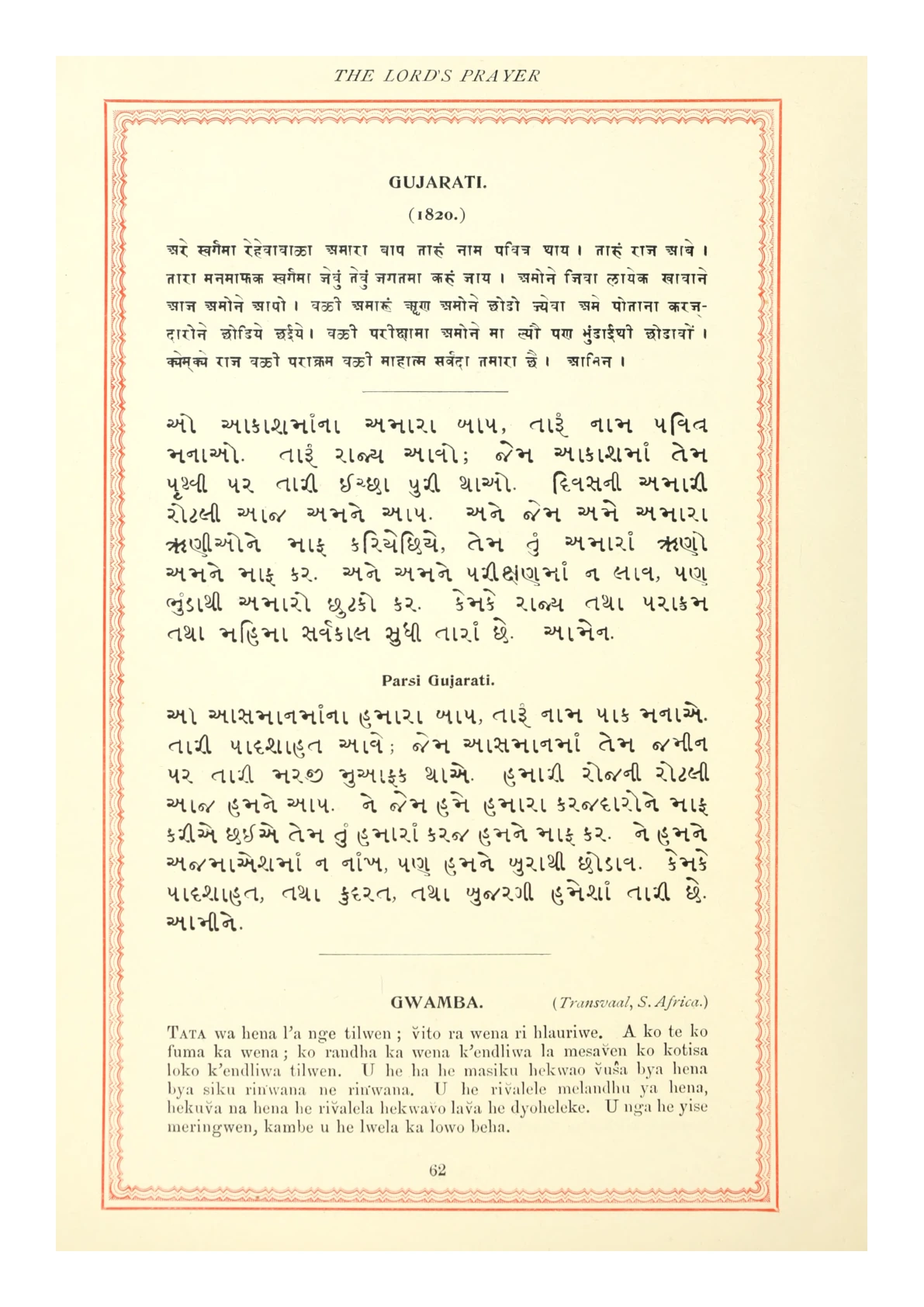
Historical printed prayer headed “GWAMBA” in The Lord’s Prayer in Five Hundred Languages, printed page 62. This older label is cross-referenced to Tsonga by the linked language authority. The Commons record dates the compilation to 1905; this copy also contains a publisher note dated June 1908. Orthography and translation reflect the historical source, not a modern usage standard. Other languages appear on the same page. The source includes period terminology and editorial annotations; these are historical evidence, not Babelbook’s current terminology or claims.
Saved in Babelbook · resized display copy. Select the image to open it independently of its source.
Reinhold Rost (compiler); Gilbert & Rivington / Wm. Clowes & Sons (publishers); Internet Archive scan · Source ↗Public domain ↗View the local visual field note
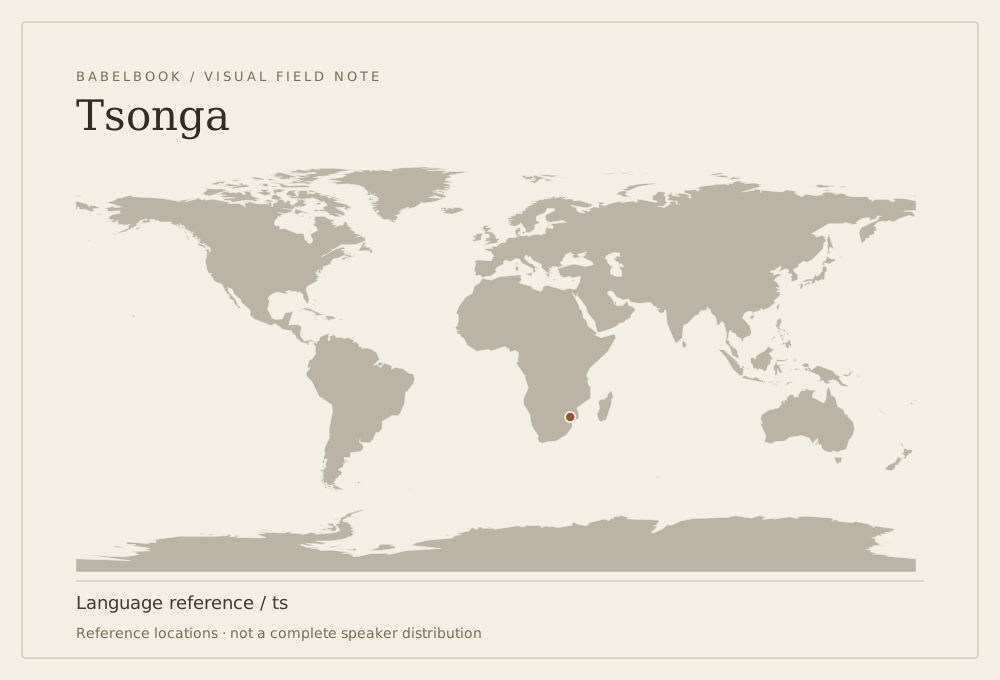
Representative reference points from Glottolog. Historical entries show reference locations, not current speakers. 1 point.
Reference & context ↗Babelbook · original editorial illustration · CC BY 4.0 · Glottolog locations; public-domain Natural Earth land
Source excerpts, selected, shortened and where noted editorially corrected from Tsonga language by Wikipedia contributors. Retrieved 2026-10-05. CC BY-SA 4.0. These excerpts are not an independently verified scholarly history; missing accounts are identified above.
Read further in the source
History
The first records of studies of Xitsonga by Europeans go back the Swiss missionary, Henri-Alexandre Junod, who between the years 1890 and 1920 hypothesised that the Xitsonga language (which he called the Thonga language) consolidated itself in Mozambique before the 1400s. In his own words, Junod states the following:
My conclusion is then that the Thonga language was already-spoken by the primitive occupants of the country more than 500 years ago and that, together with a certain number of customs, it formed the great bond which bound the Thonga clans together in past centuries. Further studies were carried out by Junod and other Swiss missionaries such as Henri Berthoud and Ernest Creux, who began work on a standard written language, which they called Shigwamba. The term was however unfamiliar to many of the speakers, and was later replaced with Thonga/Tsonga. Other Swiss missionaries working alongside Tsonga people translated the Christian Bible from English and Sesotho into Tsonga. In 1996, the language was officially recognized as Xitsonga within the Constitution of South Africa (Act 108 of 1996), which declared it an official language of the nation. The standardization of the Xitsonga language has since strengthened the position of language as a medium for communication.
Languages and dialects
Tsonga is a Bantu language (Guthrie code S.53), closely related to other members to the Tswa-Ronga group (S.50):
Ronga (Rhonga) dialects are Kalanga (Xinyisa, Xindindindi (Xizingili), Putru, and Xinyondroma. Chopi dialects are Bila (Vila), Djonga (Dzonga, Jonga), Hlanganu (Langanu, Nhlanganu), Hlave (Mbayi, Nkuna, Pai), Kande, Khosa, Luleke, N'walungu (Ngwalungu), Nkuma, Songa, Valoyi, Xika, and Xonga. Tswa (Tshwa) dialects are Dzibi (Dzivi), Dzibi-Dzonga (Dzivi-Dzonga), Tshwa, Hlengwe (Lengwe, Lhenge), Khambani, Makwakwe-Khambani, Mandla, Ndxhonge, and Nhayi (Nyai, Nyayi). Some dialects are subdialects but have been mentioned here for completeness. For example, Valoyi and Luleke comprise the N'walungu dialect. Tswa-Ronga dialects not considered part of the family include Pulana (Xipulana, Sepulane). What is commonly referred to as "Shangana/Changana" is not a recognised language in South Africa and is not a dialect that falls within the Xitsonga language group, as its distinctiveness stems mainly from the use of the Nguni language and grammar. Only six Thonga/Tsonga dialects exist and these were identified by the dawn of the 1900s. These are namely xiRonga, xiHlanganu, xiBila, xiDjonga, xiN'walungu, and xiHlengwe. All other variations within South Africa are sub-dialects of the aforementioned. The dialects most spoken in the rural communities of Limpopo are the N'walungu, Bila, Hlengwe, and the Hlanganu dialects. The Xitsonga vocabulary and phonetic permutations are also largely based on these dialects (cf. Junod 1912, p. 470–473) For "language of", the various languages and dialects employ one or more of the following prefixes: Bi-, Chi-, Ci-, Gi-, Ici-, Ki-, Ma-, Shee-, Shi-, Txi-, Va-, Wa-, and Xi-. For "people of", they use either "Ba-" or "Va-".