Tatar
Tatar ( TAH-tər; Tatar: татар теле, romanized: tatar tele or татарча, romanized: tatarça) is a Turkic language spoken by the Tatars mainly located in modern Republic of Tatarstan, wider Volga-Ural region, as well as many other regions of Russia. Tatar belongs to the Kipchak branch of Turkic languages, the same branch as Bashkir, Kazakh, Nogai and Kyrgyz. The two main dialects of Tatar are the Central Dialect (urta / qazan; most common), and the Western Dialect (könbatış / mişər). The literary Tatar language is based on the Central Dialect and on a local variant of Türki. Tatar should not be confused with Crimean Tatar or Siberian Tatar, which are different languages, although also part of the Kipchak language group. Like other Turkic languages, Tatar was traditionally written in the Arabic script for most of its history. Since 1939, the alphabet has been Cyrillic, though a number of Latin-based versions have also been used over the years.
Translate in Tatar ↗The Tatar language is spoken by about 5 million people. Most speakers live in Russia, but there are also communities in Azerbaijan, China, Finland, Georgia, Israel, Kazakhstan, Latvia, Lithuania, Romania, Turkey, Ukraine, the United States, Uzbekistan. Mordva's Qaratay group also speak a variant of Kazan Tatar. In the 2010 census, 69% of Russian Tatars claimed at least some knowledge of the Tatar language. In Tatarstan, 93% of Tatars and 3.6% of Russians claimed to have at least some knowledge of the Tatar language. In neighbouring Bashkortostan, 67% of Tatars, 27% of Bashkirs, and 1.3% of Russians claimed to understand basic Tatar language. Tatar, along with Russian, is the official language of the Republic of Tatarstan. The official script of the Tatar language is based on the Cyrillic script with some additional letters. The Republic of Tatarstan passed a law in 1999, which came into force in 2001, establishing an official Tatar Latin alphabet. A Russian federal law overrode it in 2002, making Cyrillic the sole official script in Tatarstan since. Unofficially, other scripts are used as well, mostly Latin and Arabic. All official sources in Tatarstan must use Cyrillic on their websites and in publishing. In other cases, where Tatar has no official status, the use of a specific alphabet depends on the preference of the author. The Tatar language was made a de facto official language in Russia in 1917, but only within the Tatar Autonomous Soviet Socialist Republic. Tatar is also considered to have been the official language in the short-lived Idel-Ural State, briefly formed during the Russian Civil War. The usage of Tatar declined during the 20th century. By the 1980s, the study and teaching of Tatar in the public education system was limited to rural schools.
Central Asia
Present-day use
Tatar, along with Russian, is the official language of the Republic of Tatarstan. The official script of the Tatar language is based on the Cyrillic script with some additional letters. The Republic of Tatarstan passed a law in 1999, which came into force in 2001, establishing an official Tatar Latin alphabet. A Russian federal law overrode it in 2002, making Cyrillic the sole official script in Tatarstan since. Unofficially, other scripts are used as well, mostly Latin and Arabic. All official sources in Tatarstan must use Cyrillic on their websites and in publishing. In other cases, where Tatar has no official status, the use of a specific alphabet depends on the preference of the author. The Tatar language was made a de facto official language in Russia in 1917, but only within the Tatar Autonomous Soviet Socialist Republic. Tatar is also considered to have been the official language in the short-lived Idel-Ural State, briefly formed during the Russian Civil War. The usage of Tatar declined during the 20th century. By the 1980s, the study and teaching of Tatar in the public education system was limited to rural schools. However, Tatar-speaking pupils had little chance of entering university because higher education was available in Russian almost exclusively. As of 2001, Tatar was considered a "potentially endangered language" while Siberian Tatar received "endangered" status. Higher education in Tatar can only be found in Tatarstan, and is restricted to the humanities. In other regions Tatar is primarily a spoken language and the number of speakers as well as their proficiency tends to decrease. Tatar is popular as a written language only in Tatar-speaking areas where schools with Tatar language lessons are situated. On the other hand, Tatar is the only language in use in rural districts of Tatarstan. Since 2017, Tatar language classes are no longer mandatory in the schools of Tatarstan.
Origins
The captured article does not contain a separate origins section. See the historical account and linked source.
Development
The ancestors of Tatar are the extinct Turkic Bulgar and Kipchak languages. The literary Tatar language is based on the Central Tatar (Kazan) dialect and on Volga Türki, also known as Old Tatar Language. Both are members of the Volga-Ural subgroup of the Kipchak group of Turkic languages, although they also partly derive from the ancient Volga Bulgar language. Kazan Tatars used to also write in Chaghatai language. Crimean Tatar, although similar by name, belongs to another subgroup of the Kipchak languages. Unlike Kazan Tatar, Crimean Tatar is heavily influenced by Turkish (mostly its Ottoman variety with Arabic and Persian influences) and Nogai languages.
Writing
During its history, Tatar has been written in Arabic, Latin and Cyrillic scripts. Before 1928, Tatar was mostly written in Arabic script (Иске имля/İske imlâ, "Old orthography", to 1920; Яңа имла/Yaña imlâ, "New orthography", 1920–1928). During the 19th century, Russian Christian missionary Nikolay Ilminsky devised the first Cyrillic alphabet for Tatar. This alphabet is still used by Christian Tatars (Kryashens). In the Soviet Union after 1928, Tatar was written with a Latin alphabet called Jaꞑalif. In 1939, in Tatarstan and all other parts of the Soviet Union, a Cyrillic script was adopted and is still used to write Tatar. It is also used in Kazakhstan. The Republic of Tatarstan passed a law in 1999 that came into force in 2001 establishing an official Tatar Latin alphabet. A Russian federal law overrode it in 2002, making Cyrillic the sole official script in Tatarstan since. In 2004, an attempt to introduce a Latin-based alphabet for Tatar was further abandoned when the Constitutional Court ruled that the federal law of 15 November 2002 mandating the use of Cyrillic for the state languages of the republics of the Russian Federation does not contradict the Russian constitution.
Beyond the typeface.
Signs, manuscripts, published pages and contextual photographs, with their place, period, source and reuse terms. Captions identify historical spellings, regional examples, community references and character imagery.
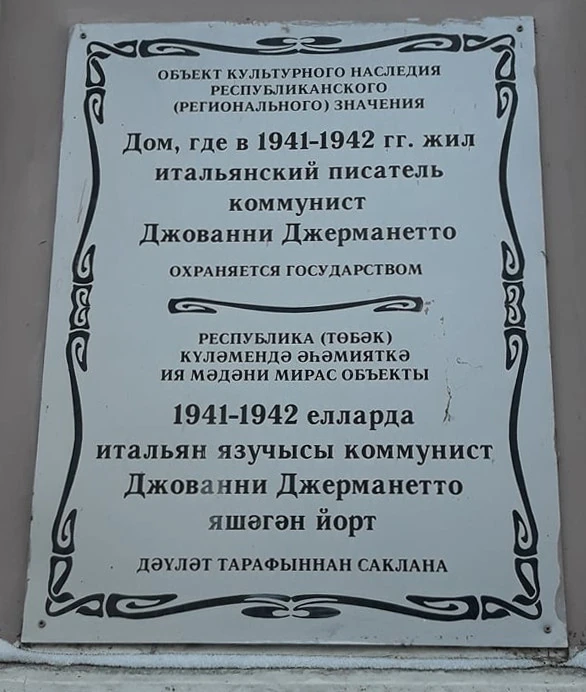
Russian and Tatar commemorative text on a plaque in Kazan.
Saved in Babelbook · resized display copy. Select the image to open it independently of its source.
OsteGuido · Source ↗CC BY-SA 4.0 ↗View the local visual field note
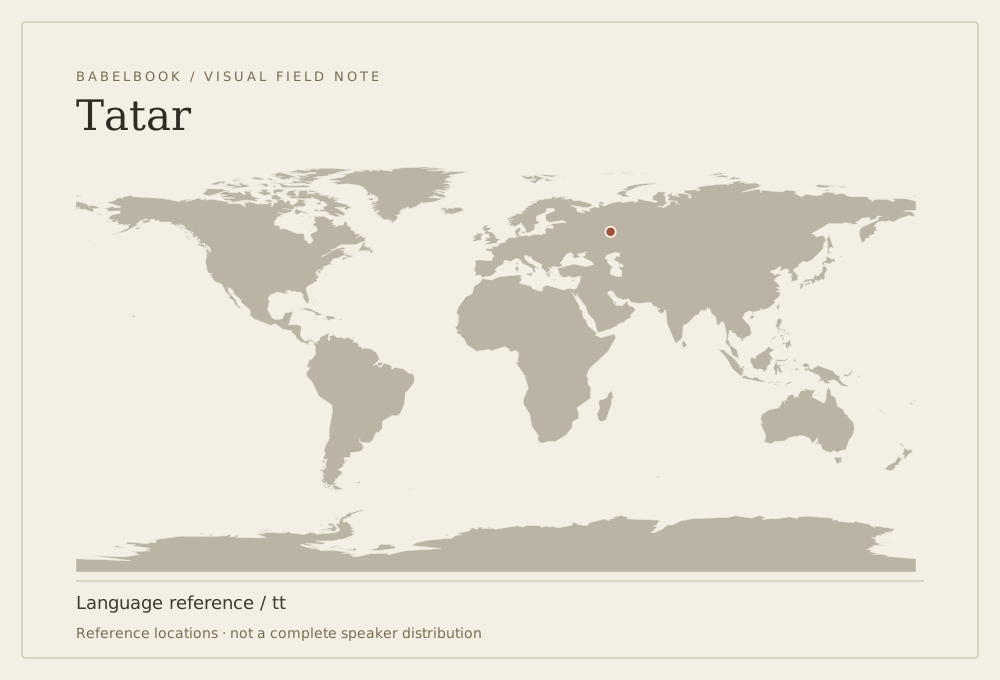
Representative reference points from Glottolog. Historical entries show reference locations, not current speakers. 1 point.
Reference & context ↗Babelbook · original editorial illustration · CC BY 4.0 · Glottolog locations; public-domain Natural Earth land
Source excerpts, selected, shortened and where noted editorially corrected from Tatar language by Wikipedia contributors. Retrieved 2026-10-05. CC BY-SA 4.0. These excerpts are not an independently verified scholarly history; missing accounts are identified above.
Read further in the source
Geographic distribution
The Tatar language is spoken by about 5 million people. Most speakers live in Russia, but there are also communities in Azerbaijan, China, Finland, Georgia, Israel, Kazakhstan, Latvia, Lithuania, Romania, Turkey, Ukraine, the United States, Uzbekistan. Mordva's Qaratay group also speak a variant of Kazan Tatar. In the 2010 census, 69% of Russian Tatars claimed at least some knowledge of the Tatar language. In Tatarstan, 93% of Tatars and 3.6% of Russians claimed to have at least some knowledge of the Tatar language. In neighbouring Bashkortostan, 67% of Tatars, 27% of Bashkirs, and 1.3% of Russians claimed to understand basic Tatar language.
Official status
Tatar, along with Russian, is the official language of the Republic of Tatarstan. The official script of the Tatar language is based on the Cyrillic script with some additional letters. The Republic of Tatarstan passed a law in 1999, which came into force in 2001, establishing an official Tatar Latin alphabet. A Russian federal law overrode it in 2002, making Cyrillic the sole official script in Tatarstan since. Unofficially, other scripts are used as well, mostly Latin and Arabic. All official sources in Tatarstan must use Cyrillic on their websites and in publishing. In other cases, where Tatar has no official status, the use of a specific alphabet depends on the preference of the author. The Tatar language was made a de facto official language in Russia in 1917, but only within the Tatar Autonomous Soviet Socialist Republic. Tatar is also considered to have been the official language in the short-lived Idel-Ural State, briefly formed during the Russian Civil War. The usage of Tatar declined during the 20th century. By the 1980s, the study and teaching of Tatar in the public education system was limited to rural schools. However, Tatar-speaking pupils had little chance of entering university because higher education was available in Russian almost exclusively. As of 2001, Tatar was considered a "potentially endangered language" while Siberian Tatar received "endangered" status. Higher education in Tatar can only be found in Tatarstan, and is restricted to the humanities. In other regions Tatar is primarily a spoken language and the number of speakers as well as their proficiency tends to decrease. Tatar is popular as a written language only in Tatar-speaking areas where schools with Tatar language lessons are situated. On the other hand, Tatar is the only language in use in rural districts of Tatarstan. Since 2017, Tatar language classes are no longer mandatory in the schools of Tatarstan. According to the opponents of this change, it will further endanger the Tatar language and is a violation of the Tatarstan Constitution which stipulates the equality of Russian and Tatar languages in the republic.
History
The ancestors of Tatar are the extinct Turkic Bulgar and Kipchak languages. The literary Tatar language is based on the Central Tatar (Kazan) dialect and on Volga Türki, also known as Old Tatar Language. Both are members of the Volga-Ural subgroup of the Kipchak group of Turkic languages, although they also partly derive from the ancient Volga Bulgar language. Kazan Tatars used to also write in Chaghatai language. Crimean Tatar, although similar by name, belongs to another subgroup of the Kipchak languages. Unlike Kazan Tatar, Crimean Tatar is heavily influenced by Turkish (mostly its Ottoman variety with Arabic and Persian influences) and Nogai languages.
Dialects
There are two main dialects of Tatar:
Central or Middle (Urta / Qazan) Western (Könbatış / Mişär) These dialects also have subdivisions. Significant contributions to the study of the Tatar language and its dialects, were made by a scientist Gabdulkhay Akhatov, who is considered to be the founder of the modern Tatar dialectological school. Spoken idioms of Siberian Tatars, which differ significantly from the above two, are often considered as the third dialect group of Tatar by some, but as an independent language on its own by others.
Writing system
During its history, Tatar has been written in Arabic, Latin and Cyrillic scripts. Before 1928, Tatar was mostly written in Arabic script (Иске имля/İske imlâ, "Old orthography", to 1920; Яңа имла/Yaña imlâ, "New orthography", 1920–1928). During the 19th century, Russian Christian missionary Nikolay Ilminsky devised the first Cyrillic alphabet for Tatar. This alphabet is still used by Christian Tatars (Kryashens). In the Soviet Union after 1928, Tatar was written with a Latin alphabet called Jaꞑalif. In 1939, in Tatarstan and all other parts of the Soviet Union, a Cyrillic script was adopted and is still used to write Tatar. It is also used in Kazakhstan. The Republic of Tatarstan passed a law in 1999 that came into force in 2001 establishing an official Tatar Latin alphabet. A Russian federal law overrode it in 2002, making Cyrillic the sole official script in Tatarstan since. In 2004, an attempt to introduce a Latin-based alphabet for Tatar was further abandoned when the Constitutional Court ruled that the federal law of 15 November 2002 mandating the use of Cyrillic for the state languages of the republics of the Russian Federation does not contradict the Russian constitution. In accordance with this Constitutional Court ruling, on 28 December 2004, the Tatar Supreme Court overturned the Tatarstani law that made the Latin alphabet official. In 2012 the Tatarstan government adopted a new Latin alphabet but with limited usage (mostly for Romanization). In 2024, the modified Common Turkic Alphabet replaced letter ä with ə, which was already in use in Azerbaijani, as well as among Tatar activists using the Latin alphabet.
Tatar Perso-Arabic alphabet (before 1928):
Tatar Old Latin (Jaꞑalif) alphabet (1928 to 1940):
Tatar Old Cyrillic alphabet (by Nikolay Ilminsky, 1861; the letters in parentheses are not used in modern publications):
Tatar Cyrillic alphabet (1939; the letter order adopted in 1997):
1999 Tatar Latin alphabet, made official by a law adopted by Tatarstani authorities but annulled by the Tatar Supreme Court in 2004:
2012 Tatar Latin alphabet