Tahitian
Tahitian (autonym: reo Tahiti, pronounced [ˈreo tahiti], part of reo Māʼohi, [ˈreo ˈmaːʔohi], languages of French Polynesia) is a Polynesian language, spoken mainly on the Society Islands in French Polynesia. It belongs to the Eastern Polynesian group. As Tahitian had no written tradition before the arrival of the Western colonists, the spoken language was first transcribed by missionaries of the London Missionary Society in the early 19th century.
Translate in Tahitian ↗Tahitian (autonym: reo Tahiti, pronounced [ˈreo tahiti], part of reo Māʼohi, [ˈreo ˈmaːʔohi], languages of French Polynesia) is a Polynesian language, spoken mainly on the Society Islands in French Polynesia. It belongs to the Eastern Polynesian group. As Tahitian had no written tradition before the arrival of the Western colonists, the spoken language was first transcribed by missionaries of the London Missionary Society in the early 19th century.
Oceania
Present-day use
The captured source does not contain a separate current-use account.
Origins
The captured article does not contain a separate origins section. See the historical account and linked source.
Development
When Europeans first arrived in Tahiti at the end of the 18th century, there was no writing system and Tahitian was only a spoken language. Reports by some early European explorers including Quirós include attempts to transcribe notable Tahitian words heard during initial interactions with the indigenous people of Marquesa. Aboard the Endeavour, Lt. James Cook and the ship's master, Robert Molyneux, transcribed the names of 72 and 55 islands respectively as recited by the Tahitian arioi, Tupaia. Many of these were "non-geographic" or "ghost islands" of Polynesian mythology and all were transcribed using phonetic English spelling. In 1797, Protestant missionaries arrived in Tahiti on a British ship called Duff, captained by James Wilson. Among the missionaries was Henry Nott (1774–1844) who learned the Tahitian language and worked with Pōmare II, a Tahitian king, and the Welsh missionary, John Davies (1772–1855), to translate the Bible into Tahitian. A system of five vowels and nine consonants was adopted for the Tahitian Bible, which would become the key text by which many Polynesians would learn to read and write. John Davies's spelling book (1810) was the first book to be printed in the Tahitian language. He also published a grammar and a dictionary of that language.
Writing
Latin or customary script (catalog classification; see the source for context).
Beyond the typeface.
Signs, manuscripts, published pages and contextual photographs, with their place, period, source and reuse terms. Captions identify historical spellings, regional examples, community references and character imagery.

A welcoming scene with signage catalogued as trilingual Tahitian, French and English.
Saved in Babelbook · resized display copy. Select the image to open it independently of its source.
Matthew Dillon · Source ↗CC BY 2.0 ↗View the local visual field note
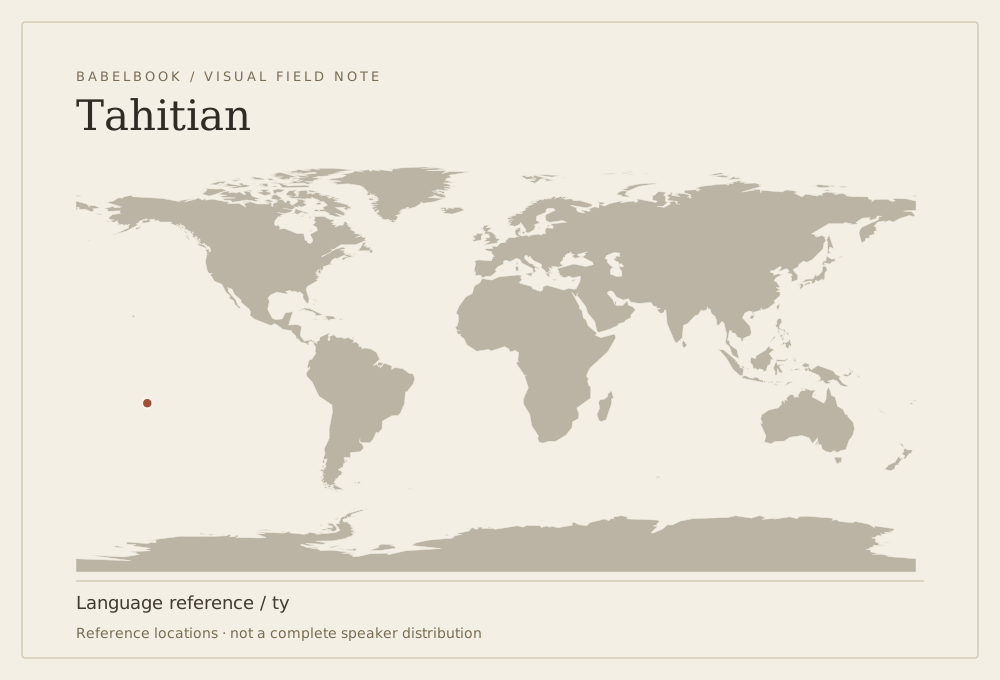
Representative reference points from Glottolog. Historical entries show reference locations, not current speakers. 1 point.
Reference & context ↗Babelbook · original editorial illustration · CC BY 4.0 · Glottolog locations; public-domain Natural Earth land
Source excerpts, selected, shortened and where noted editorially corrected from Tahitian language by Wikipedia contributors. Retrieved 2026-10-05. CC BY-SA 4.0. These excerpts are not an independently verified scholarly history; missing accounts are identified above.
Read further in the source
History
When Europeans first arrived in Tahiti at the end of the 18th century, there was no writing system and Tahitian was only a spoken language. Reports by some early European explorers including Quirós include attempts to transcribe notable Tahitian words heard during initial interactions with the indigenous people of Marquesa. Aboard the Endeavour, Lt. James Cook and the ship's master, Robert Molyneux, transcribed the names of 72 and 55 islands respectively as recited by the Tahitian arioi, Tupaia. Many of these were "non-geographic" or "ghost islands" of Polynesian mythology and all were transcribed using phonetic English spelling. In 1797, Protestant missionaries arrived in Tahiti on a British ship called Duff, captained by James Wilson. Among the missionaries was Henry Nott (1774–1844) who learned the Tahitian language and worked with Pōmare II, a Tahitian king, and the Welsh missionary, John Davies (1772–1855), to translate the Bible into Tahitian. A system of five vowels and nine consonants was adopted for the Tahitian Bible, which would become the key text by which many Polynesians would learn to read and write. John Davies's spelling book (1810) was the first book to be printed in the Tahitian language. He also published a grammar and a dictionary of that language.