Ukrainian
Ukrainian (українська мова, ukrainska mova, IPA: [ʊkrɐˈjinʲsʲkɐ ˈmɔwɐ]) is an East Slavic language, spoken primarily in Ukraine. It is the first (native) language of a large majority of Ukrainians. Written Ukrainian uses the Ukrainian alphabet, a variant of the Cyrillic script. The standard language is studied by the National Academy of Sciences of Ukraine and Potebnia Institute of Linguistics. Comparisons are often made between Ukrainian and Russian, another East Slavic language, yet there is more mutual intelligibility with Belarusian, and a closer lexical distance to West Slavic Polish and South Slavic Bulgarian. Ukrainian is a descendant of Old East Slavic, a language spoken in the medieval state of Kievan Rusʹ. In the Grand Duchy of Lithuania, the language developed into Ruthenian, where it became an official language, before a process of Polonization began in the Polish–Lithuanian Commonwealth. By the 18th century, Ruthenian diverged into regional variants, and the modern Ukrainian language developed in the territory of present-day Ukraine. Russification saw the Ukrainian language banned as a subject from schools and as a language of instruction in the Russian Empire, and continued in various ways in the Soviet Union. Even so, the language continued to see use throughout the country, and remained particularly strong in Western Ukraine.
Translate in Ukrainian ↗In the Russian Empire Census of 1897 the following picture emerged, with Ukrainian being the second most spoken language of the Russian Empire. According to the Imperial census's terminology, the Russian language (Русскій) was subdivided into Ukrainian (Малорусскій, 'Little Russian'), what is known as Russian today (Великорусскій, 'Great Russian'), and Belarusian (Бѣлорусскій, 'White Russian'). The following table shows the distribution of settlement by native language ("по родному языку") in 1897 in Russian Empire governorates (guberniyas) that had more than 100,000 Ukrainian speakers. Although in the rural regions of the Ukrainian provinces, 80% of the inhabitants said that Ukrainian was their native language in the Census of 1897 (for which the results are given above), in the urban regions only 32.5% of the population claimed Ukrainian as their native language. For example, in Odesa (then part of the Russian Empire), at the time the largest city in the territory of current Ukraine, only 5.6% of the population said Ukrainian was their native language. Until the 1920s the urban population in Ukraine grew faster than the number of Ukrainian speakers. This implies that there was a (relative) decline in the use of Ukrainian language. For example, in Kyiv, the number of people stating that Ukrainian was their native language declined from 30.3% in 1874 to 16.6% in 1917.
Europe
Present-day use
Since 1991, Ukrainian has been the official state language in Ukraine, and the state administration implemented government policies to broaden the use of Ukrainian. The educational system in Ukraine has been transformed over the first decade of independence from a system that is partly Ukrainian to one that is overwhelmingly so. The government has also mandated a progressively increased role for Ukrainian in the media and commerce. In the 2001 census, 67.5% of the country's population named Ukrainian as their native language (a 2.8% increase from 1989), while 29.6% named Russian (a 3.2% decrease). For many Ukrainians (of various ethnic origins), the term native language may not necessarily associate with the language they use more frequently. The overwhelming majority of ethnic Ukrainians consider the Ukrainian language native, including those who often speak Russian. According to the official 2001 census data, 92.3% of Kyiv region population responded "Ukrainian" to the native language (ridna mova) census question, compared with 88.4% in 1989, and 7.2% responded "Russian". In 2019, the law of Ukraine "On protecting the functioning of the Ukrainian language as the state language" was approved by the parliament, formalizing rules governing the usage of the language and introducing penalties for violations. The use of the Ukrainian language is increasing after a long period of decline. Although there are almost fifty million ethnic Ukrainians worldwide, including 37.5 million in Ukraine in 2001 (77.8% of the total population at the time), the Ukrainian language is prevalent mainly in western and central Ukraine. In Kyiv, both Ukrainian and Russian are spoken, a notable shift from the recent past when the city was primarily Russian-speaking. The shift is believed to be caused mainly by an influx of migrants from western regions of Ukraine but also by some Kyivans opting to use the language they speak at home more widely in public settings.
Origins
As a result of close Slavic contacts with the remnants of the Scythian and Sarmatian population north of the Black Sea, lasting into the early Middle Ages, the appearance of the voiced fricative γ/г (romanized "h"), in modern Ukrainian and some southern Russian dialects is explained by the assumption that it initially emerged in Scythian and related eastern Iranian dialects, from earlier common Proto-Indo-European *g and *gʰ. During the 13th century, when German settlers were invited to Ukraine by the princes of the Kingdom of Ruthenia, German words began to appear in the language spoken in Ukraine. Their influence would continue under Poland not only through German colonists but also through the Yiddish-speaking Jews. Often such words involve trade or handicrafts. Examples of words of German or Yiddish origin spoken in Ukraine include dakh ("roof"), rura ("pipe"), rynok ("market"), kushnir ("furrier"), and majster ("master" or "craftsman").
Development
As a result of close Slavic contacts with the remnants of the Scythian and Sarmatian population north of the Black Sea, lasting into the early Middle Ages, the appearance of the voiced fricative γ/г (romanized "h"), in modern Ukrainian and some southern Russian dialects is explained by the assumption that it initially emerged in Scythian and related eastern Iranian dialects, from earlier common Proto-Indo-European *g and *gʰ. During the 13th century, when German settlers were invited to Ukraine by the princes of the Kingdom of Ruthenia, German words began to appear in the language spoken in Ukraine. Their influence would continue under Poland not only through German colonists but also through the Yiddish-speaking Jews. Often such words involve trade or handicrafts. Examples of words of German or Yiddish origin spoken in Ukraine include dakh ("roof"), rura ("pipe"), rynok ("market"), kushnir ("furrier"), and majster ("master" or "craftsman"). In the 13th century, eastern parts of Rus (including Moscow) came under Tatar rule until their unification under the Tsardom of Muscovy, whereas the south-western areas (including Kyiv) were incorporated into the Grand Duchy of Lithuania. For the following four centuries, the languages of the two regions evolved in relative isolation from each other. Direct written evidence of the existence of the Ukrainian language dates to the late 16th century. By the 16th century, a peculiar official language formed: a mixture of the liturgical standardised language of Old Church Slavonic, Ruthenian and Polish. The influence of the latter gradually increased relative to the former two, as the nobility and rural large-landowning class, known as the szlachta, was largely Polish-speaking. Documents soon took on many Polish characteristics superimposed on Ruthenian phonetics. Polish–Lithuanian rule and education also involved significant exposure to Latin.
Writing
Spelling search, which began in the late 18th century with the emergence of modern literary language, led to the emergence of several spelling options. In particular, there was the spelling system of Oleksii Pavlovskyi, the spelling version of "Mermaid of the Dniester" (1837), Kulishivka (P. Kulish's spelling system), Drahomanivka (produced in Kyiv in the 1870s by a group of cultural figures led by linguist P. Zhytetskyi, which included and M. Drahomanov), Zhelekhivka (system of Yevhen Zhelekhovskyi (1886), enshrined in the Ruthenian Grammar by Smal-Stotskyi and Theodore Gartner 1893). Borys Hrinchenko used some corrections in the fundamental four-volume Dictionary of the Ukrainian Language (1907–1909). Most of the spelling rules (practically based on phonetics – "write as you hear") used in Hrinchenko's dictionary are still valid. Hrinchenko's work became an informal spelling and model for Ukrainian writers and publications from 1907 until the creation of the first official Ukrainian spelling in 1918. On 17 January 1918, the Central Rada of Ukraine issued the "Main Rules of Ukrainian orthography", which, however, did not cover the entire scope of the language. On 17 May 1919, the Ukrainian Academy of Sciences approved the "Main Rules of Ukrainian Orthography", which became the basis for all subsequent revisions and amendments. On 23 July 1925, the Council of People's Commissars of the USSR decided to organize a State Commission for the Organization of Ukrainian Spelling (State Spelling Commission). It included more than 20 academics from the USSR, who also expressed a desire to invite representatives of Western Ukraine: Smal-Stotskyi, Volodymyr Hnatiuk and Vasyl Simovych. After almost a year of work in April 1926, the "Project of Ukrainian Spelling" was published to acquaint the general public with the new system.
Beyond the typeface.
Signs, manuscripts, published pages and contextual photographs, with their place, period, source and reuse terms. Captions identify historical spellings, regional examples, community references and character imagery.
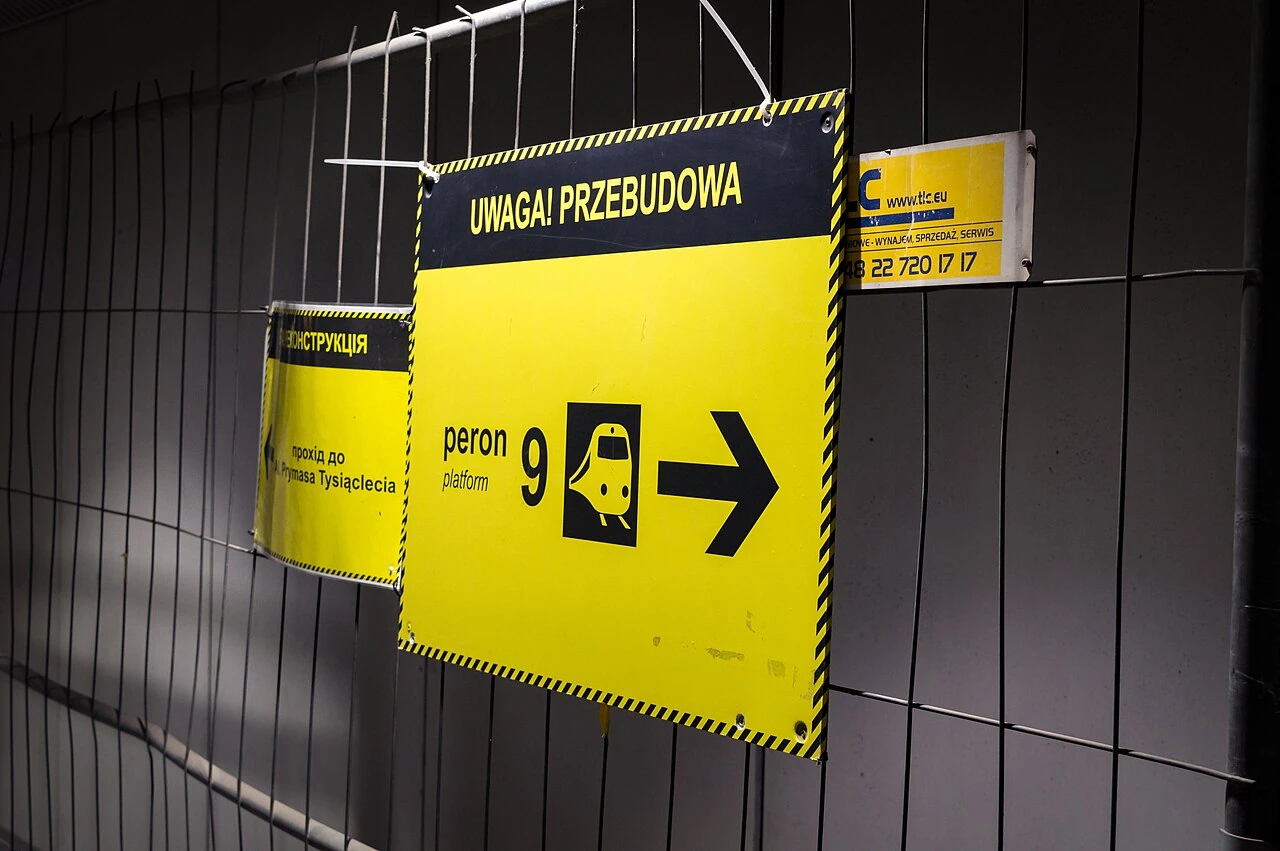
Ukrainian directions on multilingual reconstruction signage at Warszawa Zachodnia station, 2025, alongside Polish and English. Source-identified language; displayed without additional cropping.
Saved in Babelbook · resized display copy. Select the image to open it independently of its source.
RAIL P (RAIL.PHOTOGRAPHY) / CC0 / Wikimedia Commons · Source ↗CC0 1.0 ↗View the local visual field note
Representative reference points from Glottolog. Historical entries show reference locations, not current speakers. 1 point.
Reference & context ↗Babelbook · original editorial illustration · CC BY 4.0 · Glottolog locations; public-domain Natural Earth land
Source excerpts, selected, shortened and where noted editorially corrected from Ukrainian language by Wikipedia contributors. Retrieved 2026-10-05. CC BY-SA 4.0. These excerpts are not an independently verified scholarly history; missing accounts are identified above.
Read further in the source
Origins and developments during medieval times
As a result of close Slavic contacts with the remnants of the Scythian and Sarmatian population north of the Black Sea, lasting into the early Middle Ages, the appearance of the voiced fricative γ/г (romanized "h"), in modern Ukrainian and some southern Russian dialects is explained by the assumption that it initially emerged in Scythian and related eastern Iranian dialects, from earlier common Proto-Indo-European *g and *gʰ. During the 13th century, when German settlers were invited to Ukraine by the princes of the Kingdom of Ruthenia, German words began to appear in the language spoken in Ukraine. Their influence would continue under Poland not only through German colonists but also through the Yiddish-speaking Jews. Often such words involve trade or handicrafts. Examples of words of German or Yiddish origin spoken in Ukraine include dakh ("roof"), rura ("pipe"), rynok ("market"), kushnir ("furrier"), and majster ("master" or "craftsman").
Speakers in the Russian Empire
In the Russian Empire Census of 1897 the following picture emerged, with Ukrainian being the second most spoken language of the Russian Empire. According to the Imperial census's terminology, the Russian language (Русскій) was subdivided into Ukrainian (Малорусскій, 'Little Russian'), what is known as Russian today (Великорусскій, 'Great Russian'), and Belarusian (Бѣлорусскій, 'White Russian'). The following table shows the distribution of settlement by native language ("по родному языку") in 1897 in Russian Empire governorates (guberniyas) that had more than 100,000 Ukrainian speakers.
Although in the rural regions of the Ukrainian provinces, 80% of the inhabitants said that Ukrainian was their native language in the Census of 1897 (for which the results are given above), in the urban regions only 32.5% of the population claimed Ukrainian as their native language. For example, in Odesa (then part of the Russian Empire), at the time the largest city in the territory of current Ukraine, only 5.6% of the population said Ukrainian was their native language. Until the 1920s the urban population in Ukraine grew faster than the number of Ukrainian speakers. This implies that there was a (relative) decline in the use of Ukrainian language. For example, in Kyiv, the number of people stating that Ukrainian was their native language declined from 30.3% in 1874 to 16.6% in 1917.
Dialects
Several modern dialects of Ukrainian exist.
Northern (Polissian) dialects: (3) Eastern Polissian is spoken in Chernihiv (excluding the southeastern districts), in the northern part of Sumy, and in the southeastern portion of the Kyiv Oblast as well as in the adjacent areas of Russia, which include the southwestern part of the Bryansk Oblast (the area around Starodub), as well as in some places in the Kursk, Voronezh and Belgorod Oblasts. No linguistic border can be defined. The vocabulary approaches Russian as the language approaches the Russian Federation. Both Ukrainian and Russian grammar sets can be applied to this dialect. (2) Central Polissian is spoken in the northwestern part of the Kyiv Oblast, in the northern part of Zhytomyr and the northeastern part of the Rivne Oblast. (1) West Polissian is spoken in the northern part of the Volyn Oblast, the northwestern part of the Rivne Oblast, and in the adjacent districts of the Brest Region in Belarus. The dialect spoken in Belarus uses Belarusian grammar and thus is considered by some to be a dialect of Belarusian. Southeastern dialects: (4) Middle Dnieprian is the basis of the Standard Literary Ukrainian. It is spoken in the central part of Ukraine, primarily in the southern and eastern part of the Kyiv Oblast. In addition, the dialects spoken in Cherkasy, Poltava, and Kyiv regions are considered to be close to "standard" Ukrainian. (5) Slobodan is spoken in Kharkiv, Sumy, Luhansk, and the northern part of Donetsk, as well as in the Voronezh and Belgorod regions of Russia. This dialect is formed from a gradual mixture of Russian and Ukrainian, with progressively more Russian in the northern and eastern parts of the region. Thus, there is no linguistic border between Russian and Ukrainian, and, thus, both grammar sets can be applied. A (6) Steppe dialect is spoken in southern and southeastern Ukraine. This dialect was originally the main language of the Zaporozhian Cossacks. A Kuban dialect related to or based on the Steppe dialect is often referred to as Balachka and is spoken by the Kuban Cossacks in the Kuban region in Russia by the descendants of the Zaporozhian Cossacks, who settled in that area in the late 18th century. It was formed from a gradual mixture of Russian into Ukrainian. This dialect features the use of some Russian vocabulary along with some Russian grammar. There are three main variants, which have been grouped together according to location. Southwestern dialects: (13) Boyko is spoken by the Boyko people on the northern side of the Carpathian Mountains in the Lviv and Ivano-Frankivsk Oblasts. It can also be heard across the border in the Subcarpathian Voivodeship of Poland. (12) Hutsul is spoken by the Hutsul people on the northern slopes of the Carpathian Mountains, in the extreme southern parts of the Ivano-Frankivsk Oblast, and in parts of the Chernivtsi and Transcarpathian Oblasts. Lemko is spoken by the Lemko people, whose homeland rests outside the borders of Ukraine in the Prešov Region of Slovakia along the southern side of the Carpathian Mountains, and in the southeast of modern Poland, along the northern sides of the Carpathians. (8) Podillian is spoken in the southern parts of the Vinnytsia and Khmelnytskyi Oblasts, in the northern part of the Odesa Oblast, and in the adjacent districts of the Cherkasy Oblast, the Kirovohrad Oblast, and the Mykolaiv Oblast. (7) Volynian is spoken in Rivne and Volyn, as well as in parts of Zhytomyr and Ternopil. It is also used in Chełm, Poland. (11) Pokuttia (Bukovinian) is spoken in the Chernivtsi Oblast of Ukraine. This dialect has some distinct vocabulary borrowed from Romanian. (9) Upper Dniestrian (Kresy) is considered to be the main Galician dialect, spoken in the Lviv, Ternopil, and Ivano-Frankivsk Oblasts. Its distinguishing characteristics are the influence of Polish and the German vocabulary, which is reminiscent of the Austro-Hungarian rule. Some of the distinct words used in this dialect can be found here. (10) Upper Sannian is spoken in the border area between Ukraine and Poland in the San river valley. The Rusyn language is considered by Ukrainian linguists to be a dialect of Ukrainian as well: Dolinian Rusyn or Subcarpathian Rusyn is spoken in the Transcarpathian Oblast. Pannonian or Bačka Rusyn is spoken in northwestern Serbia and eastern Croatia. Rusin language of the Bačka dialect is one of the official languages of the Serbian Autonomous Province of Vojvodina. Pryashiv Rusyn is the Rusyn spoken in the Prešov (in Ukrainian: Pryashiv) region of Slovakia, as well as by some émigré communities, primarily in the United States of America.
Orthography
Spelling search, which began in the late 18th century with the emergence of modern literary language, led to the emergence of several spelling options. In particular, there was the spelling system of Oleksii Pavlovskyi, the spelling version of "Mermaid of the Dniester" (1837), Kulishivka (P. Kulish's spelling system), Drahomanivka (produced in Kyiv in the 1870s by a group of cultural figures led by linguist P. Zhytetskyi, which included and M. Drahomanov), Zhelekhivka (system of Yevhen Zhelekhovskyi (1886), enshrined in the Ruthenian Grammar by Smal-Stotskyi and Theodore Gartner 1893). Borys Hrinchenko used some corrections in the fundamental four-volume Dictionary of the Ukrainian Language (1907–1909). Most of the spelling rules (practically based on phonetics – "write as you hear") used in Hrinchenko's dictionary are still valid. Hrinchenko's work became an informal spelling and model for Ukrainian writers and publications from 1907 until the creation of the first official Ukrainian spelling in 1918. On 17 January 1918, the Central Rada of Ukraine issued the "Main Rules of Ukrainian orthography", which, however, did not cover the entire scope of the language. On 17 May 1919, the Ukrainian Academy of Sciences approved the "Main Rules of Ukrainian Orthography", which became the basis for all subsequent revisions and amendments. On 23 July 1925, the Council of People's Commissars of the USSR decided to organize a State Commission for the Organization of Ukrainian Spelling (State Spelling Commission). It included more than 20 academics from the USSR, who also expressed a desire to invite representatives of Western Ukraine: Smal-Stotskyi, Volodymyr Hnatiuk and Vasyl Simovych. After almost a year of work in April 1926, the "Project of Ukrainian Spelling" was published to acquaint the general public with the new system. After several months of discussion and consideration of the project at the All-Ukrainian Spelling Conference (26 May – 6 June 1927), the Ukrainian orthography of 1928 was adopted in accordance with the RNC resolution of 6 September 1928. It went down in history as "Kharkiv" or "Skrypnik orthography" – from the place of creation, or from the surname of Skrypnyk. In 1929, Hryhorii Holoskevych published the Ukrainian Spelling Dictionary (about 40,000 words), agreed with the full spelling produced by the State Spelling Commission and approved by the People's Commissar for Education (6 September 1928). In 1933, a spelling commission headed by Andrii Khvylia branded the Ukrainian orthography of 1928 as "nationalist", immediately stopped publishing any dictionaries, and without any discussion, in a very short time (five months), created a new spelling that unified as never before the Ukrainian and Russian languages. The letter ґ was removed from the alphabet, and Ukrainian scientific terminology was revised and harmonized with Russian-Ukrainian dictionaries (the Institute of Ukrainian Scientific Language was abolished in 1930). This version of the spelling was approved by the resolution of the People's Commissar of Education of the USSR of 5 September 1933. Some minor changes were made in the spelling of 1946 and 1959 (published the following year). It was connected with the document "The rules of Russian spelling and punctuation", published in 1956. From 1960 until 1990, the 1960 edition was the official standard. After the beginning of "perestroika", the issue of improving Ukrainian spelling became relevant again: the editing of the spelling code was started by the Orthographic Commission at the LMM of the USSR Academy of Sciences. The project was also discussed in the newly established Ukrainian Language Society. T. Shevchenko (headed by Dmytro Pavlychko). The new version was approved on 14 November 1989, and published in 1990. The main achievements were the restoration of the letter ґ and the accusative case (in Soviet times it was optional and was called the accusative form). Today, despite the existence of the official spelling of the Ukrainian language, it is not the only spelling standard in use. Even in Ukraine itself, many publishers and publications use other versions of the spelling, which either tend to "skrypnykivka", or else differ from the official rules of transmission of words of foreign origin. On 22 May 2019, the Cabinet of Ministers of Ukraine approved a new version of the orthography prepared by the Ukrainian National Commission on Spelling. The new edition brought to life some features of orthography in 1928, which were part of the Ukrainian orthographic tradition. At the same time, the commission was guided by the understanding that the language practice of Ukrainians in the second half of the 20th to the beginning of the 21st century has already become part of the Ukrainian orthographic tradition.