Urdu
Urdu (اُرْدُو, urdū, [ˈʊɾduː] ) is an Indo-Aryan language spoken primarily in South Asia. It is the national language and lingua franca of Pakistan. It is also an official Eighth Schedule language in India, the status and cultural heritage of which are recognised by the Constitution of India — alongside having official status in several Indian states (Uttar Pradesh, Bihar, Jharkhand, West Bengal, and both Telugu states). Urdu and Hindi are closely related. They share a common, predominantly Sanskrit- and Prakrit-derived, vocabulary base, phonology, syntax, and grammar, making them mutually intelligible during colloquial communication. The common base of the two languages is sometimes referred to as the Hindi–Urdu or Hindustani language, and Urdu has been described as a Persianised standard register of the Hindustani language. While formal Urdu draws literary, political, and technical vocabulary from Persian and Arabic, formal Hindi draws these aspects from Sanskrit; consequently, the two languages' mutual intelligibility effectively decreases as the level of formality increases. Urdu originated geographically in the upper Ganga-Yamuna doab, in and around the Delhi region of India, where Khari Boli was spoken. Urdu shared a grammatical foundation with Khari Boli, but was written in a revised Perso-Arabic script and included vocabulary borrowed from Persian and Arabic, which retained its original grammatical structure in those languages.
Translate in Urdu ↗There are over 100 million native speakers of Urdu in India and Pakistan together: there were 50.8 million Urdu speakers in India (4.34% of the total population) as per the 2011 census; and approximately 22.3 million in Pakistan (9.25% of the total population) in 2023. There are several hundred thousand in the United Kingdom, Saudi Arabia, United States, and Bangladesh. However, Hindustani, of which Urdu is one variety, is spoken much more widely, forming the third most commonly spoken language in the world, after Mandarin and English. The syntax (grammar), morphology, and the core vocabulary of Urdu and Hindi are essentially identical – thus linguists usually count them as one single language, while some contend that they are considered as two different languages for socio-political reasons. Owing to interaction with other languages, Urdu has become localised wherever it is spoken, including in Pakistan. Though Urdu is spoken by many Muhajirs in its standard form. In some areas, it has borrowed words from regional languages, giving the language a peculiar regional flavor. Similarly, the Urdu spoken in India can also be distinguished into many dialects such as the Standard Urdu of Lucknow and Delhi, as well as the Dakhni (Deccan) of South India. Because of Urdu's similarity to Hindi, speakers of the two languages can easily understand one another if both sides refrain from using literary vocabulary. The following table shows the number of Urdu speakers in some countries.
South Asia
Present-day use
Standard Urdu is often compared with Standard Hindi. Both Urdu and Hindi, which are considered standard registers of the same language, Hindustani (or Hindi–Urdu), share a core vocabulary and grammar. Apart from religious associations, the differences are largely restricted to the standard forms: Standard Urdu is conventionally written in the Nastaliq style of the Persian alphabet and relies heavily on Persian and Arabic as a source for technical and literary vocabulary, whereas Standard Hindi is conventionally written in Devanāgarī and draws on Sanskrit. However, both share a core vocabulary of native Sanskrit and Prakrit derived words and a significant number of Arabic and Persian loanwords, with a consensus of linguists considering them to be two standardised forms of the same language and consider the differences to be sociolinguistic; a few classify them separately. The two languages are often considered to be a single language (Hindustani or Hindi–Urdu) on a dialect continuum ranging from Persianised to Sanskritised vocabulary, but now they are more and more different in words due to politics. Old Urdu dictionaries also contain most of the Sanskrit words now present in Hindi. Mutual intelligibility decreases in literary and specialised contexts that rely on academic or technical vocabulary. In a longer conversation, differences in formal vocabulary and pronunciation of some Urdu phonemes are noticeable, though many native Hindi speakers also pronounce these phonemes. At a phonological level, speakers of both languages are frequently aware of the Perso-Arabic or Sanskrit origins of their word choice, which affects the pronunciation of those words. Urdu speakers will often insert vowels to break up consonant clusters found in words of Sanskritic origin, but will pronounce them correctly in Arabic and Persian loanwords.
Origins
The name Urdu was first used by the Indian poet Ghulam Hamadani Mushafi around 1780 for the language, even though he himself also used Hindavi term in his poetry to define the language. Ordu means army in the Turkic languages. In late 18th century, it was known as Zaban-e-Urdu-e-Mualla زبانِ اُرْدُوئے مُعَلّٰی means language of the exalted camp. It was previously known by several terms such as Hindvi, Hindi, Hindustani and Rekhta. Urdu is a part of the Hindi–Urdu linguistic continuum, which is commonly referred to as Hindustani in contemporary usage. Some linguists have suggested that the earliest forms of Urdu evolved from the medieval (6th to 13th century) Apabhraṃśa register of the preceding Shauraseni language, a Middle Indo-Aryan language that is also the ancestor of other modern Indo-Aryan languages. In the Delhi region of India, the native language was Khariboli, whose earliest form is known as Old Hindi (or Hindavi). It belongs to the Western Hindi group of the Central Indo-Aryan languages. The contact of Hindu and Muslim cultures during the period of Muslim conquests in the Indian subcontinent (12th to 16th centuries) led to the development of Hindustani as a product of a composite Ganga-Jamuni tehzeeb. In cities such as Delhi, the ancient language Old Hindi began to acquire many Persian loanwords and continued to be called "Hindi" and later, also "Hindustani". An early literary tradition of Hindavi was founded by Amir Khusrau in the late 13th century, who has been called "the father of Urdu literature". After the conquest of the Deccan, and a subsequent immigration of noble Muslim families into the south, a form of the language flourished in medieval India as a vehicle of poetry, (especially under the Bahmanids), and is known as Dakhini, which contains loanwords from Telugu and Marathi. From the 13th century until the end of the 18th century, the language now known as Urdu was called Hindi, Hindavi, Hindustani, Dehlavi, Dihlawi, Lahori, and Lashkari.
Development
The captured article does not contain a distinct historical account. No chronology has been invented.
Writing
Urdu is written right-to left in an extension of the Persian alphabet, which is itself an extension of the Arabic alphabet. Urdu is associated with the Nastaʿlīq style of Persian calligraphy, whereas Arabic is generally written in the Naskh or Ruq'ah styles. Because of its thousands of ligatures, Nasta’liq is notoriously difficult to typeset, so Urdu newspapers were hand-written by masters of calligraphy, known as kātib or khush-nawīs, until the late 1980s. One handwritten Urdu newspaper, The Musalman, is still published daily in Chennai. InPage, a widely used desktop publishing tool for Urdu, has over 20,000 ligatures in its Nastaʿliq computer fonts. A highly Persianised and technical form of Urdu was the lingua franca of the law courts of the British administration in Bengal and the North-West Provinces & Oudh. Until the late 19th century, all proceedings and court transactions in this register of Urdu were written officially in the Persian script. In 1880, Sir Ashley Eden, the Lieutenant-Governor of Bengal in colonial India abolished the use of the Persian alphabet in the law courts of Bengal and ordered the exclusive use of Kaithi, a popular script used for both Urdu and Hindi; in the Bihar Province, the court language was Urdu written in the Kaithi script. Kaithi's association with Urdu and Hindi was ultimately eliminated by the political contest between these languages and their scripts, in which the Persian script was definitively linked to Urdu. More recently in India, Urdu speakers have adopted Devanagari for publishing Urdu periodicals and have innovated new strategies to mark Urdu in Devanagari as distinct from Hindi in Devanagari. Such publishers have introduced new orthographic features into Devanagari for the purpose of representing the Perso-Arabic etymology of Urdu words. One example is the use of अ (Devanagari a) with vowel signs to mimic contexts of ع (‘ain), in violation of Hindi orthographic rules.
Beyond the typeface.
Signs, manuscripts, published pages and contextual photographs, with their place, period, source and reuse terms. Captions identify historical spellings, regional examples, community references and character imagery.
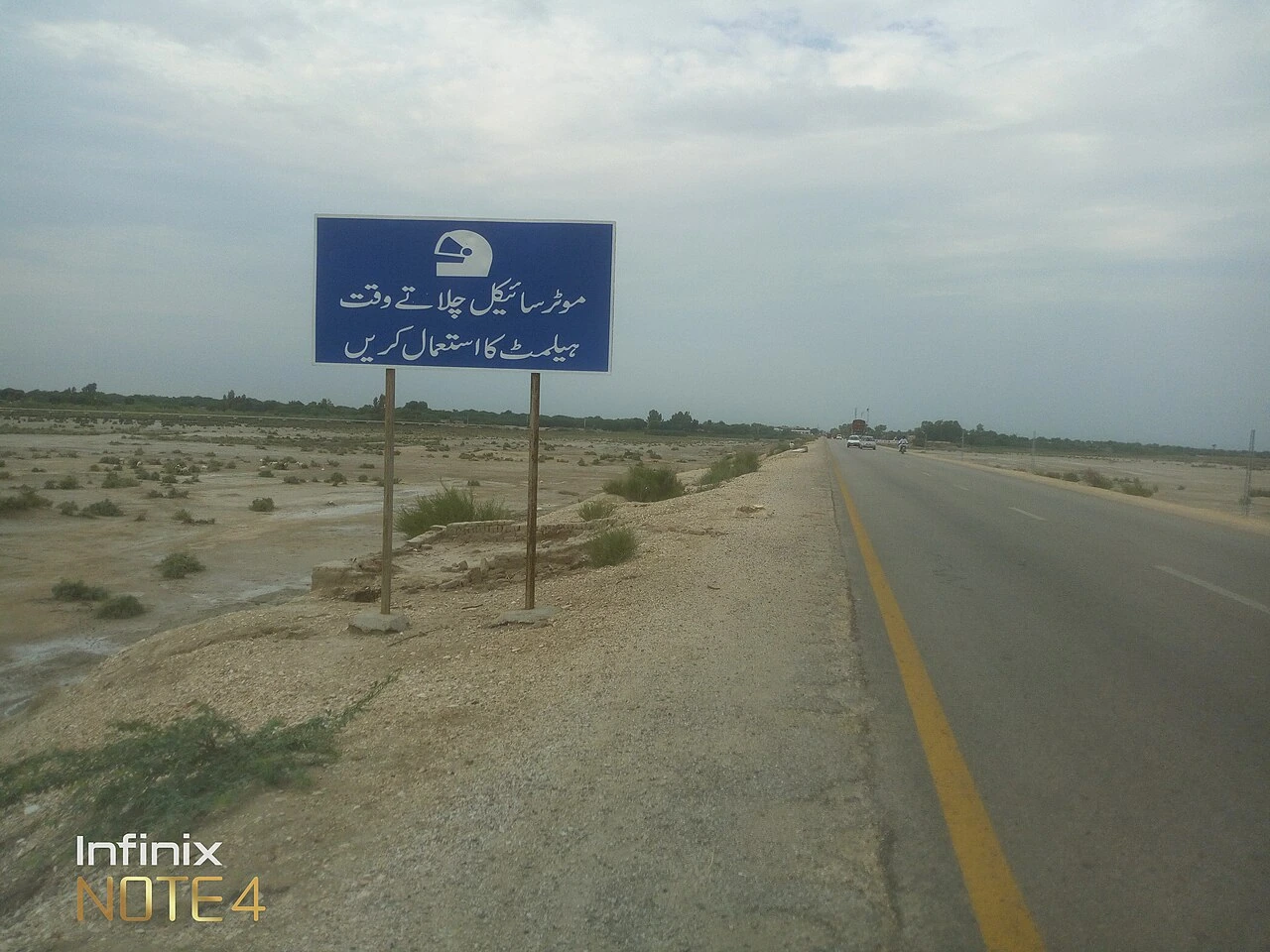
Urdu helmet-use instructions for motorcyclists on a Mehran Highway road sign in Pakistan. Source-identified language; displayed without additional cropping.
Saved in Babelbook · resized display copy. Select the image to open it independently of its source.
JogiAsad · Source ↗CC BY-SA 4.0 ↗View the local visual field note
Representative reference points from Glottolog. Historical entries show reference locations, not current speakers. 1 point.
Reference & context ↗Babelbook · original editorial illustration · CC BY 4.0 · Glottolog locations; public-domain Natural Earth land
Source excerpts, selected, shortened and where noted editorially corrected from Urdu by Wikipedia contributors. Retrieved 2026-10-05. CC BY-SA 4.0. These excerpts are not an independently verified scholarly history; missing accounts are identified above.
Read further in the source
Origins
Urdu is a part of the Hindi–Urdu linguistic continuum, which is commonly referred to as Hindustani in contemporary usage. Some linguists have suggested that the earliest forms of Urdu evolved from the medieval (6th to 13th century) Apabhraṃśa register of the preceding Shauraseni language, a Middle Indo-Aryan language that is also the ancestor of other modern Indo-Aryan languages. In the Delhi region of India, the native language was Khariboli, whose earliest form is known as Old Hindi (or Hindavi). It belongs to the Western Hindi group of the Central Indo-Aryan languages. The contact of Hindu and Muslim cultures during the period of Muslim conquests in the Indian subcontinent (12th to 16th centuries) led to the development of Hindustani as a product of a composite Ganga-Jamuni tehzeeb. In cities such as Delhi, the ancient language Old Hindi began to acquire many Persian loanwords and continued to be called "Hindi" and later, also "Hindustani". An early literary tradition of Hindavi was founded by Amir Khusrau in the late 13th century, who has been called "the father of Urdu literature". After the conquest of the Deccan, and a subsequent immigration of noble Muslim families into the south, a form of the language flourished in medieval India as a vehicle of poetry, (especially under the Bahmanids), and is known as Dakhini, which contains loanwords from Telugu and Marathi. From the 13th century until the end of the 18th century, the language now known as Urdu was called Hindi, Hindavi, Hindustani, Dehlavi, Dihlawi, Lahori, and Lashkari. The Delhi Sultanate established Persian as its official language in India, a policy continued by the Mughal Empire, which extended over most of northern South Asia from the 16th century to the 18th, and cemented Persian influence on Hindustani.
According to the Navadirul Alfaz by Khan-i Arzu, the "Zaban-e Urdu-e Shahi" [language of the Imperial Camp] had attained special importance in the time of Alamgir". By the end of the reign of Aurangzeb in the early 1700s, the common language around Delhi began to be referred to as Zaban-e-Urdu, a name derived from the Turkic word ordu (army) or orda and is said to have arisen as the "language of the camp", or "Zaban-i-Ordu" means "Language of High camps" or natively "Lashkari Zaban" means "Language of Army" even though the term Urdu held different meanings at that time. It is recorded that Aurangzeb spoke in Hindvi, which was most likely Persianised, as there are substantial evidence that Hindvi was written in the Persian script in this period. During this time period, Urdu was referred to as "Moors", which simply meant Muslim, by European writers. John Ovington wrote in 1689:
The language of the Moors is different from that of the ancient original inhabitants of India but is obliged to these Gentiles for its characters. For though the Moors dialect is peculiar to themselves, yet it is destitute of Letters to express it; and therefore, in all their Writings in their Mother Tongue, they borrow their letters from the Heathens, or from the Persians, or other Nations. In 1715, a complete literary Diwan in Rekhta was written by Nawab Sadruddin Khan. An Urdu-Persian dictionary was written by Khan-i Arzu in 1751 in the reign of Ahmad Shah Bahadur. The name Urdu was first introduced by the poet Ghulam Hamadani Mushafi around 1780. As a literary language, Urdu took shape in courtly, elite settings. While Urdu retained the grammar and core Indo-Aryan vocabulary of the local Indian dialect Khariboli, it adopted the Perso-Arab writing system, written in the Nastaleeq style. – which was developed as a style of Persian calligraphy. Urdu was patronised by the Nawab of Awadh and in Lucknow, the language was refined, being not only spoken in the court, but by the common people in the city—both Hindus and Muslims; the city of Lucknow gave birth to Urdu prose literature, with a notable novel being Umrao Jaan Ada.
Demographics and geographic distribution
There are over 100 million native speakers of Urdu in India and Pakistan together: there were 50.8 million Urdu speakers in India (4.34% of the total population) as per the 2011 census; and approximately 22.3 million in Pakistan (9.25% of the total population) in 2023. There are several hundred thousand in the United Kingdom, Saudi Arabia, United States, and Bangladesh. However, Hindustani, of which Urdu is one variety, is spoken much more widely, forming the third most commonly spoken language in the world, after Mandarin and English. The syntax (grammar), morphology, and the core vocabulary of Urdu and Hindi are essentially identical – thus linguists usually count them as one single language, while some contend that they are considered as two different languages for socio-political reasons. Owing to interaction with other languages, Urdu has become localised wherever it is spoken, including in Pakistan. Though Urdu is spoken by many Muhajirs in its standard form. In some areas, it has borrowed words from regional languages, giving the language a peculiar regional flavor. Similarly, the Urdu spoken in India can also be distinguished into many dialects such as the Standard Urdu of Lucknow and Delhi, as well as the Dakhni (Deccan) of South India. Because of Urdu's similarity to Hindi, speakers of the two languages can easily understand one another if both sides refrain from using literary vocabulary.
Dialects
Urdu became a literary language in the 18th century and two similar standard forms came into existence in Delhi and Lucknow. Since the partition of India in 1947, a third standard has arisen in the Pakistani city of Karachi. Deccani, an older form used in southern India, became a court language of the Deccan sultanates by the 16th century. Urdu has a few recognised dialects, including Dakhni, Dhakaiya, Rekhta, and Modern Vernacular Urdu (based on the Khariboli dialect of the Delhi region). Dakhni (also known as Dakani, Deccani, Desia, Mirgan) is spoken in Deccan region of southern India. It is distinct by its mixture of vocabulary from Marathi and Konkani, as well as some vocabulary from Arabic, Persian and Chagatai that are not found in the standard dialect of Urdu. Dakhini is widely spoken in all parts of Maharashtra, Telangana, Andhra Pradesh and Karnataka. Urdu is read and written as in other parts of India. A number of daily newspapers and several monthly magazines in Urdu are published in these states. Dhakaiya Urdu is a dialect native to the city of Old Dhaka in Bangladesh, dating back to the Mughal era. However, its popularity, even among native speakers, has been gradually declining since the Bengali language movement in the 20th century. It is not officially recognised by the Government of Bangladesh. The Urdu spoken by Stranded Pakistanis in Bangladesh is different from this dialect.
Comparison with Modern Standard Hindi
Standard Urdu is often compared with Standard Hindi. Both Urdu and Hindi, which are considered standard registers of the same language, Hindustani (or Hindi–Urdu), share a core vocabulary and grammar. Apart from religious associations, the differences are largely restricted to the standard forms: Standard Urdu is conventionally written in the Nastaliq style of the Persian alphabet and relies heavily on Persian and Arabic as a source for technical and literary vocabulary, whereas Standard Hindi is conventionally written in Devanāgarī and draws on Sanskrit. However, both share a core vocabulary of native Sanskrit and Prakrit derived words and a significant number of Arabic and Persian loanwords, with a consensus of linguists considering them to be two standardised forms of the same language and consider the differences to be sociolinguistic; a few classify them separately. The two languages are often considered to be a single language (Hindustani or Hindi–Urdu) on a dialect continuum ranging from Persianised to Sanskritised vocabulary, but now they are more and more different in words due to politics. Old Urdu dictionaries also contain most of the Sanskrit words now present in Hindi. Mutual intelligibility decreases in literary and specialised contexts that rely on academic or technical vocabulary. In a longer conversation, differences in formal vocabulary and pronunciation of some Urdu phonemes are noticeable, though many native Hindi speakers also pronounce these phonemes. At a phonological level, speakers of both languages are frequently aware of the Perso-Arabic or Sanskrit origins of their word choice, which affects the pronunciation of those words. Urdu speakers will often insert vowels to break up consonant clusters found in words of Sanskritic origin, but will pronounce them correctly in Arabic and Persian loanwords. As a result of religious nationalism since the partition of British India and continued communal tensions, native speakers of both Hindi and Urdu frequently assert that they are distinct languages. The grammar of Hindi and Urdu is shared, though formal Urdu makes more use of the Persian "-e-" izafat grammatical construct (as in Hammam-e-Qadimi, or Nishan-e-Haider) than does Hindi.
Urdu speakers by country
The following table shows the number of Urdu speakers in some countries.
Writing system
Urdu is written right-to left in an extension of the Persian alphabet, which is itself an extension of the Arabic alphabet. Urdu is associated with the Nastaʿlīq style of Persian calligraphy, whereas Arabic is generally written in the Naskh or Ruq'ah styles. Because of its thousands of ligatures, Nasta’liq is notoriously difficult to typeset, so Urdu newspapers were hand-written by masters of calligraphy, known as kātib or khush-nawīs, until the late 1980s. One handwritten Urdu newspaper, The Musalman, is still published daily in Chennai. InPage, a widely used desktop publishing tool for Urdu, has over 20,000 ligatures in its Nastaʿliq computer fonts. A highly Persianised and technical form of Urdu was the lingua franca of the law courts of the British administration in Bengal and the North-West Provinces & Oudh. Until the late 19th century, all proceedings and court transactions in this register of Urdu were written officially in the Persian script.