Uzbek
Uzbek is a Karluk Turkic language spoken by Uzbeks. It is the official and national language of the Republic of Uzbekistan and formally succeeded Chagatai, an earlier Karluk language endonymically called Türki or Türkçe, as the literary language of Uzbekistan in the 1920s. According to the Ethnologue, Southern Uzbek and Standard Uzbek are spoken as a native language by more than 36 million people around the world, making Uzbek the second-most widely spoken Turkic language after Turkish. In addition to these native speakers, there are members of many other ethnic groups such as Tajiks, Kazakhs, and Russians who live in Uzbekistan and speak Uzbek as their second language. There are two major variants of the Uzbek language: Northern Uzbek, or simply "Uzbek", spoken in Uzbekistan, Kyrgyzstan, Kazakhstan, Tajikistan, Turkmenistan and China; and Southern Uzbek, spoken in Afghanistan and Pakistan. Both Northern and Southern Uzbek are divided into many dialects. Uzbek and Uyghur are sister languages and they constitute the Karluk or "Southeastern" branch of Turkic. External influences on Uzbek include Persian, Russian, and Arabic. One of the most noticeable distinctions of Uzbek from other Turkic languages is the rounding of the vowel /ɑ/ to /ɒ/ under the influence of Persian.
Translate in Uzbek ↗Uzbek, being the most widely spoken indigenous language in Central Asia, is as well spoken by smaller ethnic groups in Uzbekistan and in neighbouring countries. The language is spoken by other ethnic groups outside Uzbekistan. The popularity of Uzbek media, including Uzbekfilm and RizanovaUz, has spread among the post-Soviet states, particularly in Central Asia in recent years. Since Uzbek is the dominant language in the Osh Region of Kyrgyzstan (and mothertongue of the city Osh), like the rest of Eastern, Southern and South-Eastern Kyrgyzstan (Jalal-Abad Region), the ethnic Kyrgyz are, too, exposed to Uzbek, and some speak it fluently. This is a common situation in the rest of Central Asian republics, including: the Turkistan region of Kazakhstan, northern Daşoguz Welaýat of Turkmenistan, Sughd region and other regions of Tajikistan. The Uzbek language has a special status in countries that are common destination for immigration for Uzbekistani citizens. Other than Uzbekistan and other Central Asian Republics, the ethnic Uzbeks most commonly choose the Russian Federation in search of work. Most of them however, are seasonal workers, whose numbers vary greatly among residency within the Russian Federation. According to Russian government statistics, 4.5 million workers from Uzbekistan, 2.4 million from Tajikistan, and 920,000 from Kyrgyzstan were working in Russia in 2021, with around 5 million being ethnic Uzbeks. Estimates of the number of native speakers of Uzbek vary widely, from 35 up to 40 million. Ethnologue estimates put the number of native speakers at 33 million across all the recognized dialects. The Swedish national encyclopedia, Nationalencyklopedin, estimates the number of native speakers to be 38 million, and the CIA World Factbook estimates 30 million.
Central Asia
Present-day use
The captured source does not contain a separate current-use account.
Origins
Historically, the language under the name Uzbek referred to a totally different language of Kipchak origin. The language was generally similar to the neighbouring Kazakh, more or less identical lexically, phonetically and grammatically. It was dissimilar to the area's indigenous and native language, known as Turki, until it was changed to Chagatai by western scholars due to its origins from the Chagatai Khanate. The ethnonym of the language itself now means "a language spoken by the Uzbeks."
Development
Turkic speakers probably settled the Amu Darya, Syr Darya, and Zarafshon river basins from at least 600–650 AD, gradually ousting or assimilating the speakers of the Eastern Iranian languages who had previously inhabited Sogdia, Bactria, and Khwarazm. The first Turkic dynasty in the region was the Kara-Khanid Khanate from the 9th to the 12th centuries, a confederation of Karluks, Chigils, Yagma, and other tribes. Uzbek (along with Uyghur) can be considered the direct descendant of Chagatai, the language of great Turkic Central Asian literary development in the realm of Chagatai Khan, Timur (Tamerlane), and the Timurid dynasty (including the early Mughal rulers of the Mughal Empire). Chagatai contained a large number of Persian and Arabic loanwords. By the 19th century, it was rarely used for literary composition and had disappeared by the early 20th century. Muhammad Shaybani (c. 1451 – 2 December 1510), the first Khan of Bukhara, wrote poetry under the pseudonym 'Shibani'. A collection of Chagatai poems by Muhammad Shaybani is currently held in the Topkapı Palace Museum manuscript collection in Istanbul. The manuscript of his philosophical and religious work, Bahr al-Khudā, written in 1508, is located in London. Shaybani's nephew Ubaydullah Khan (1486–1540) recited the Quran skilfully and provided it with commentaries in Chagatai. Ubaydullah himself wrote poetry in Chagatai, Classical Persian, and Arabic under the literary pseudonym Ubaydiy. For the Uzbek political elite of the 16th century, Chagatai was their native language. For example, the leader of the semi‑nomadic Uzbeks, Sheibani Khan (1451–1510), wrote poems in Chagatai. The poet Turdiy (17th century) in his poems called for the unification of the divided Uzbek tribes: "Although our people are divided, these are all Uzbeks of ninety‑two tribes. We have different names – we all have the same blood. We are one people, and we should have one law. Sleeves, collars, and floors – it is all one robe.
Writing
Uzbek has been written in a variety of scripts throughout history: 1000–1920s: The traditional Arabic script, first in the Qarakhanid standard and next in the Chagatai standard. This is seen as the golden age of the Uzbek language and literary history. 1920–1928: the Arabic-based Yaña imlâ alphabet. 1928–1940: the Latin-based Yañalif was imposed officially. 1940–1992: the Cyrillic script was used officially. Since 1992: Switch to Latin script, with heavy holdover usage of Cyrillic. The Senate approved the amendments to the alphabet on the 10th of September 2026; intended to simplify the writing and digital processing of Uzbek by replacing digraphs with individual letters (Oʻ oʻ, Gʻ gʻ, Sh sh, Ç ç are replaced by Ö ö, Ğ ğ, Ş ş, Ç ç, in addition to the inclusion of the apostrophe ʼ). The reform also provides for a gradual transition in order to avoid the immediate replacement of existing documents, signs and other materials. Documents, national currency and securities issued under the previous alphabet retain their validity during the transition period. Despite the official status of the Latin script in Uzbekistan, the use of Cyrillic is still widespread, especially in advertisements and signs. In newspapers, scripts may be mixed, with headlines in Latin and articles in Cyrillic. In regions with Uzbek minority presence like the western Chinese region of Xinjiang, in northern Afghanistan and in Pakistan, the Arabic-based script is still used since the 11th century. Agencies websites like BBC and TRT continue to publish in the Arabic script. On the other hand, the Arabic script is no longer used in Uzbekistan except symbolically in limited texts or for the academic studies of Chagatai (the ancestor of both Uzbek and Uyghur).
Beyond the typeface.
Signs, manuscripts, published pages and contextual photographs, with their place, period, source and reuse terms. Captions identify historical spellings, regional examples, community references and character imagery.
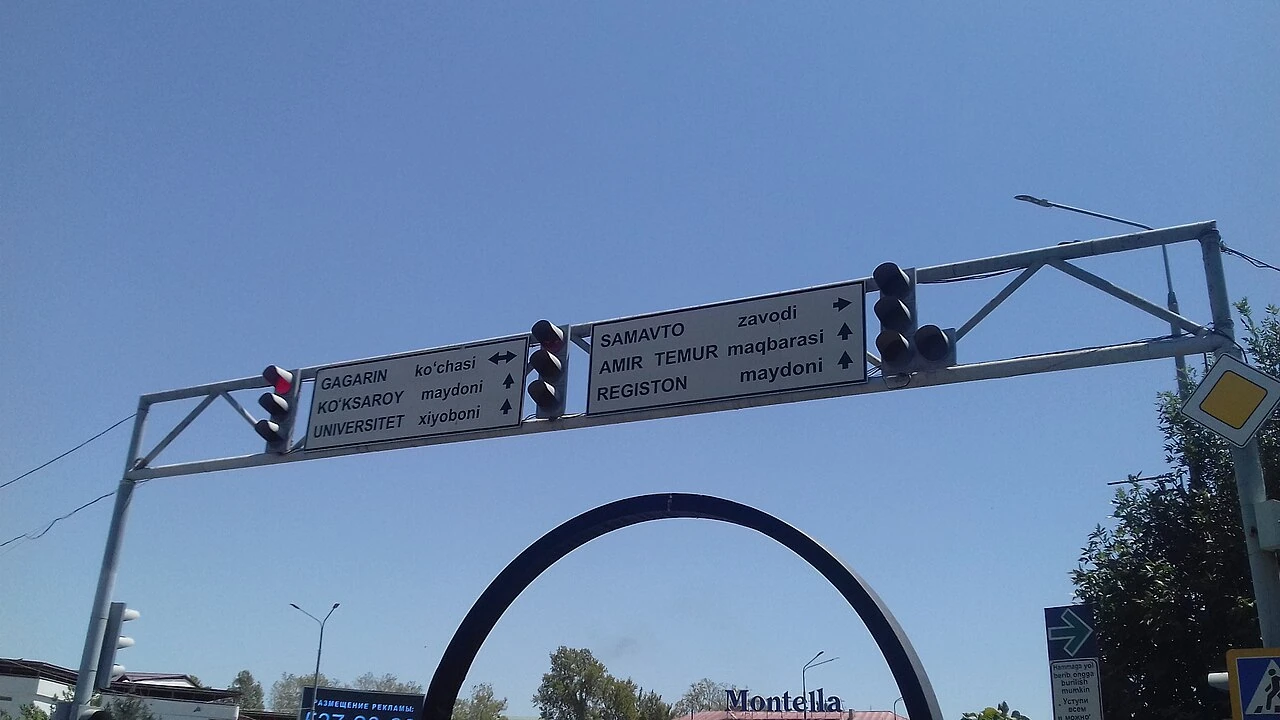
Uzbek in Latin script on a road sign in Samarkand, photographed in 2018. Language identification follows Commons descriptions or categories; not independently transcribed.
Saved in Babelbook · resized display copy. Select the image to open it independently of its source.
Akhemen · Source ↗CC BY-SA 4.0 ↗View the local visual field note
Representative reference points from Glottolog. Historical entries show reference locations, not current speakers. 1 point.
Reference & context ↗Babelbook · original editorial illustration · CC BY 4.0 · Glottolog locations; public-domain Natural Earth land
Source excerpts, selected, shortened and where noted editorially corrected from Uzbek language by Wikipedia contributors. Retrieved 2026-10-05. CC BY-SA 4.0. These excerpts are not an independently verified scholarly history; missing accounts are identified above.
Read further in the source
Number of speakers
Uzbek, being the most widely spoken indigenous language in Central Asia, is as well spoken by smaller ethnic groups in Uzbekistan and in neighbouring countries. The language is spoken by other ethnic groups outside Uzbekistan. The popularity of Uzbek media, including Uzbekfilm and RizanovaUz, has spread among the post-Soviet states, particularly in Central Asia in recent years. Since Uzbek is the dominant language in the Osh Region of Kyrgyzstan (and mothertongue of the city Osh), like the rest of Eastern, Southern and South-Eastern Kyrgyzstan (Jalal-Abad Region), the ethnic Kyrgyz are, too, exposed to Uzbek, and some speak it fluently. This is a common situation in the rest of Central Asian republics, including: the Turkistan region of Kazakhstan, northern Daşoguz Welaýat of Turkmenistan, Sughd region and other regions of Tajikistan. The Uzbek language has a special status in countries that are common destination for immigration for Uzbekistani citizens. Other than Uzbekistan and other Central Asian Republics, the ethnic Uzbeks most commonly choose the Russian Federation in search of work. Most of them however, are seasonal workers, whose numbers vary greatly among residency within the Russian Federation. According to Russian government statistics, 4.5 million workers from Uzbekistan, 2.4 million from Tajikistan, and 920,000 from Kyrgyzstan were working in Russia in 2021, with around 5 million being ethnic Uzbeks. Estimates of the number of native speakers of Uzbek vary widely, from 35 up to 40 million. Ethnologue estimates put the number of native speakers at 33 million across all the recognized dialects. The Swedish national encyclopedia, Nationalencyklopedin, estimates the number of native speakers to be 38 million, and the CIA World Factbook estimates 30 million. Other sources estimate the number of speakers of Uzbek to be 34 million in Uzbekistan, 4.5 million in Afghanistan, 1.63 million in Pakistan, 1.5 million in Tajikistan, about 1 million in Kyrgyzstan, 600,000 in Kazakhstan, 600,000 in Turkmenistan, and 300,000 in Russia. The Uzbek language is taught in more than fifty higher education institutions around the world.
History
Turkic speakers probably settled the Amu Darya, Syr Darya, and Zarafshon river basins from at least 600–650 AD, gradually ousting or assimilating the speakers of the Eastern Iranian languages who had previously inhabited Sogdia, Bactria, and Khwarazm. The first Turkic dynasty in the region was the Kara-Khanid Khanate from the 9th to the 12th centuries, a confederation of Karluks, Chigils, Yagma, and other tribes. Uzbek (along with Uyghur) can be considered the direct descendant of Chagatai, the language of great Turkic Central Asian literary development in the realm of Chagatai Khan, Timur (Tamerlane), and the Timurid dynasty (including the early Mughal rulers of the Mughal Empire). Chagatai contained a large number of Persian and Arabic loanwords. By the 19th century, it was rarely used for literary composition and had disappeared by the early 20th century. Muhammad Shaybani (c. 1451 – 2 December 1510), the first Khan of Bukhara, wrote poetry under the pseudonym 'Shibani'. A collection of Chagatai poems by Muhammad Shaybani is currently held in the Topkapı Palace Museum manuscript collection in Istanbul. The manuscript of his philosophical and religious work, Bahr al-Khudā, written in 1508, is located in London. Shaybani's nephew Ubaydullah Khan (1486–1540) recited the Quran skilfully and provided it with commentaries in Chagatai. Ubaydullah himself wrote poetry in Chagatai, Classical Persian, and Arabic under the literary pseudonym Ubaydiy. For the Uzbek political elite of the 16th century, Chagatai was their native language. For example, the leader of the semi‑nomadic Uzbeks, Sheibani Khan (1451–1510), wrote poems in Chagatai. The poet Turdiy (17th century) in his poems called for the unification of the divided Uzbek tribes: "Although our people are divided, these are all Uzbeks of ninety‑two tribes. We have different names – we all have the same blood. We are one people, and we should have one law. Sleeves, collars, and floors – it is all one robe. So the Uzbek people are united, may they be at peace." Sufi Allayar (1633–1721) was an outstanding theologian and one of the Sufi leaders of the Khanate of Bukhara. He demonstrated his level of knowledge by writing a book entitled Sebâtü'l-Âcizîn. Sufi Allayar was widely read and highly appreciated in Central Asia. The term Uzbek as applied to language has meant different things at different times:
Uzbek was a vowel‑harmonised Kipchak language spoken by descendants of those who arrived in Transoxiana and who lived mainly around Bukhara and Samarkand. Chagatai was a Karluk language spoken by the older settled Turkic populations ('Sarts') of the region in the Fergana Valley and the Qashqadaryo Region, and in some parts of what is now the Samarqand Region; it contained a heavier admixture of Persian and Arabic and did not have vowel harmony. During the 18th and 19th centuries, Chagatai remained the main literary language in most of Central Asia, but it underwent a period of decline. Eventually, Chagatai was mostly referred to as the language of the Sarts, the settled Turkic‑speaking populations of the Fergana Valley, although the definition of this term shifted over the decades. According to the Kazakh scholar Serali Lapin, who lived at the end of the 19th and beginning of the 20th century, "there is no special Sart language different from Uzbek". Russian researchers of the second half of the 19th century, such as L. N. Sobolev, believed that "Sart is not a special tribe, as many have tried to prove. Sart is indifferently applied to both Uzbeks and Tajiks who live in the city and are engaged in trade". As part of the preparations for the 1924 establishment of the Soviet Republic of Uzbekistan, Chagatai was officially renamed 'Old Uzbek', which Edward A. Allworth argued "badly distorted the literary history of the region" and was used to give authors such as Ali-Shir Nava'i an Uzbek identity. After Uzbekistan's independence, the Uzbek government opted to reform Northern Uzbek by changing its alphabet from Cyrillic to Latin in an attempt to stimulate the growth of Uzbek in the new independent state. However, the reform was never fully implemented, and as of 2025, both alphabets are widely used, from daily life to government publications and television news. Uzbek has not eclipsed Russian in the governmental sector, as Russian remains widely used in science, politics, and by the upper class of the country. However, the Uzbek internet, including the Uzbek Wikipedia, is growing rapidly.
Writing systems
Uzbek has been written in a variety of scripts throughout history:
1000–1920s: The traditional Arabic script, first in the Qarakhanid standard and next in the Chagatai standard. This is seen as the golden age of the Uzbek language and literary history. 1920–1928: the Arabic-based Yaña imlâ alphabet. 1928–1940: the Latin-based Yañalif was imposed officially. 1940–1992: the Cyrillic script was used officially. Since 1992: Switch to Latin script, with heavy holdover usage of Cyrillic. The Senate approved the amendments to the alphabet on the 10th of September 2026; intended to simplify the writing and digital processing of Uzbek by replacing digraphs with individual letters (Oʻ oʻ, Gʻ gʻ, Sh sh, Ç ç are replaced by Ö ö, Ğ ğ, Ş ş, Ç ç, in addition to the inclusion of the apostrophe ʼ). The reform also provides for a gradual transition in order to avoid the immediate replacement of existing documents, signs and other materials. Documents, national currency and securities issued under the previous alphabet retain their validity during the transition period.
Despite the official status of the Latin script in Uzbekistan, the use of Cyrillic is still widespread, especially in advertisements and signs. In newspapers, scripts may be mixed, with headlines in Latin and articles in Cyrillic.
In regions with Uzbek minority presence like the western Chinese region of Xinjiang, in northern Afghanistan and in Pakistan, the Arabic-based script is still used since the 11th century. Agencies websites like BBC and TRT continue to publish in the Arabic script. On the other hand, the Arabic script is no longer used in Uzbekistan except symbolically in limited texts or for the academic studies of Chagatai (the ancestor of both Uzbek and Uyghur).
Dialects
Uzbek can be roughly divided into three dialect groups. The Karluk dialects, centred on Tashkent, Samarkand, Bukhara, and the Ferghana Valley, form the basis of the standard Uzbek language. This dialect group shows the greatest influence of Persian vocabulary, particularly in the Tajik‑dominated cities of Bukhara and Samarkand. The Kipchak dialect, spoken from the Surxondaryo region through north‑central Uzbekistan into Karakalpakstan, shows significant influence from the Kipchak Turkic languages, particularly in the mutation of [j] to [ʑ] as in Kazakh and Kyrgyz. The Oghuz dialect, spoken mainly in Khorezm along the Turkmenistan border, is notable for the mutation of word‑initial [k] to [g].