Vietnamese
Vietnamese (tiếng Việt) is an Austroasiatic language primarily spoken throughout Vietnam where it is the official language. It belongs to the Vietic subgroup of the Austroasiatic language family. Vietnamese is spoken natively by around 86 million people, and as a second language by 11 million people, several times as many as the rest of the Austroasiatic family combined. It is the native language of the Viet people and functions as the second or first language for other ethnicities in Vietnam; it is also used by the Vietnamese diaspora worldwide. Like many languages in Southeast Asia and East Asia, Vietnamese is an isolating language (highly analytic) and is tonal. Structurally, Vietnamese is mixed between head-initial and head-final directionalities: head-initial is more prominent in clausal structures while head-final may appear more in compounds, and modifiers generally follow the words they modify but sometimes precede them as well. Syntactically, Vietnamese is topic-prominent and strictly subject–verb–object. It also uses noun classifiers. Vietnamese morphemes and phonological words are predominantly monosyllabic; however, many multisyllabic words do occur, usually as a result of compounding and reduplication. This aspect of Vietnamese allows for great efficiency in day-to-day writing, communication, and much more. Borrowings from Middle Chinese, known as Sino-Vietnamese vocabulary, make up a significant and important part of the lexicon.
Translate in Vietnamese ↗As a result of emigration, Vietnamese speakers are also found in other parts of Southeast Asia, East Asia, North America, Europe, and Australia. Vietnamese has also been officially recognized as a minority language in the Czech Republic. As the national language, Vietnamese is the lingua franca in Vietnam. It is also spoken by the Jing people traditionally residing on three islands (now joined to the mainland) off Dongxing in southern Guangxi Province, China. A large number of Vietnamese speakers also reside in neighboring countries of Cambodia and Laos. In the United States, Vietnamese is the sixth most spoken language, with over 1.5 million speakers, who are concentrated in a handful of states. It is the third-most spoken language in Texas and Washington; fourth-most in Georgia, Louisiana, and Virginia; and fifth-most in Arkansas and California. Vietnamese is the third most spoken language in Australia other than English, after Mandarin and Arabic. In France, it is the most spoken Asian language and the eighth most spoken immigrant language at home. Vietnamese is the sole official and national language of Vietnam. It is the first language of the majority of the Vietnamese population, as well as a first or second language for the country's ethnic minority groups. In the Czech Republic, Vietnamese has been recognized as one of 14 minority languages, on the basis of communities that have resided in the country either traditionally or on a long-term basis. This status grants the Vietnamese community in the country a representative on the Government Council for Nationalities, an advisory body of the Czech Government for matters of policy towards national minorities and their members. It also grants the community the right to use Vietnamese with public authorities and in courts anywhere in the country. Vietnamese was also recognized as a national minority language in Slovakia in 2023. In the U.S.
Southeast Asia
Present-day use
During French Indochina, a large number of new vocabulary items were introduced into Vietnamese, including ones from Japanese wasei-kango for Western-originated concepts, adopted through Sino-Vietnamese pronunciation. Following the defeat of South Vietnam in 1975 by North Vietnam in the Vietnam War, the Vietnamese language within Vietnam has gradually shifted towards the Northern dialect. Hanoi, the largest city in Northern Vietnam was made the capital of Vietnam in 1976. A study stated that "The gap in vocabulary use between speakers in North and South Vietnam is now much narrower than before. There is little to distinguish between how the generations that were born and grew up in the South after 1975 now speak, compared to their peers in the North. This gap is almost non-existent in newspapers, on radio and television, and in websites." However, this convergence does not apply to emigrants, in which the study states represent "culture freeze", a phenomenon that describes when culture among emigrants is frozen in time and does not evolve with culture in their home country once they move to a new country. Here, culture freeze describes that the use of the language of emigrants from Vietnam has been "frozen" in both vocabulary and pronunciation, and as languages gradually evolve over time, has come to differ slightly from than the present Vietnamese language in Vietnam. Additionally, as immigration to the United States following the Vietnam war was primarily driven due to political reasons, the Southern Vietnamese dialect was initially strongly linked to social identity. During and after the Vietnam War, thousands of Southern Vietnamese immigrated to the United States with the partnership between Saigon and the US. In contrast, during and following the Vietnam War, thousands of Northern Vietnamese moved to the Czech Republic due to Hanoi's partnership with the now obsolete Czechoslovak Socialist Republic.
Origins
Proto-Vietic did not have tones. Tones developed later in some of the daughter languages from distinctions in the initial and final consonants. Vietnamese tones developed as follows: Glottal-ending syllables ended with a glottal stop /ʔ/, while fricative-ending syllables ended with /s/ or /h/. Both types of syllables could co-occur with a resonant (e.g. /m/ or /n/). At some point, a tone split occurred, as in many other mainland Southeast Asian languages. Essentially, an allophonic distinction developed in the tones whereby those in syllables with voiced initials were pronounced differently from those with voiceless initials. (Approximately speaking, the voiced allotones were pronounced with additional breathy voice or creaky voice and with lowered pitch. The quality difference predominates in today's northern varieties, e.g., in Hanoi, while in the southern varieties the pitch difference predominates, as in Ho Chi Minh City.) Later the plain-voiced stops became voiceless and the allotones became new phonemic tones. The implosive stops (ɓ, ɗ and ʄ) were unaffected, and in fact developed tonally as if they were unvoiced. (This behavior is common to all East Asian languages with implosive stops.) These stops merged with the corresponding nasals (m, n and ɲ) before the Old Vietnamese period. As noted above, consonants following minor syllables became voiced fricatives. The minor syllables were eventually lost, but not until the tone split had occurred. As a result, words in modern Vietnamese with voiced fricatives occur in all six tones, and the tonal register reflects the voicing of the minor-syllable prefix and not the voicing of the Proto-Vietic main-syllable stop that produced the fricative. For similar reasons, words beginning with /l/ and /ŋ/ occur in both registers.
Development
Austroasiatic is believed to have dispersed around 2000 BC. The arrival of the agricultural Phùng Nguyên culture in the Red River Delta at that time may correspond to the Vietic branch. This ancestral Vietic was typologically very different from later Vietnamese. In addition to monosyllabic roots, it had sesquisyllabic roots consisting of a reduced syllable followed by a full syllable, and featured many consonant clusters. Both of these features are found elsewhere in Austroasiatic and in modern conservative Vietic languages south of the Red River area. The language was non-tonal, but featured glottal stop and voiceless fricative codas. Borrowed vocabulary indicates early contact with speakers of Tai languages in the last millennium BCE, which is consistent with genetic evidence from Dong Son culture sites. Extensive contact with Chinese began during the Han dynasty (2nd century BCE). At this time, Vietic groups began to expand south from the Red River Delta and into the adjacent uplands, possibly to escape Chinese encroachment. The oldest layer of loans from Chinese into northern Vietic (which would become the Viet–Mường subbranch) date from this period. The northern Vietic varieties thus became part of the Mainland Southeast Asia linguistic area, in which languages from genetically unrelated families converged toward characteristics such as isolating morphology and similar syllable structure. Many languages in this area, including Viet–Mường, underwent a process of tonogenesis, in which distinctions formerly expressed by final consonants became phonemic tonal distinctions when those consonants disappeared.
Writing
After ending a millennium of Chinese rule in 939, the Vietnamese state adopted Literary Chinese (called văn ngôn 文言 or Hán văn 漢文 in Vietnamese) for official purposes. Up to the late 19th century (except for two brief interludes), all formal writing, including government business, scholarship and formal literature, was done in Literary Chinese, written with Chinese characters (chữ Hán). Although the writing system is now mostly in chữ Quốc ngữ (Latin script), Chinese script known as chữ Hán in Vietnamese as well as chữ Nôm (together, Hán-Nôm) is still present in such activities as Vietnamese calligraphy. Tiếng Việt speak date in the format "day month year". Each month's name is just the ordinal of that month appended after the word tháng, which means "month". Traditional Vietnamese, however, assigns other names to some months; these names are mostly used in the lunar calendar and in poetry. When written in the short form, "DD/MM/YYYY" is preferred. Example: English: 2(nd) September, 2025 Vietnamese long form: Ngày hai Tháng chín Năm hai nghìn không trăm hai mươi lăm Vietnamese short form: 2 September 2025 The Vietnamese prefer writing numbers with a comma as the decimal separator in lieu of dots, and either spaces or dots to group the digits. An example is 1 629,15 (one thousand six hundred twenty-nine-point one five). Because a comma is used as the decimal separator, a semicolon is used to separate two numbers instead. DeFrancis, John (1977). Colonialism and language policy in Viet Nam. Mouton. ISBN 978-90-279-7643-7. Haudricourt, André-Georges (1949). "Origine des particularités de l'alphabet vietnamien". Dân Việt-Nam. 3: 61–68. English translation: Michaud, Alexis; Haudricourt, André-Georges (2010). "The origin of the peculiarities of the Vietnamese alphabet". Mon-Khmer Studies. 39: 89–104. Archived from the original on 14 August 2021. Retrieved 28 December 2017. Nguyễn, Đình-Hoà (1955). Quốc-ngữ: The modern writing system in Vietnam.
Beyond the typeface.
Signs, manuscripts, published pages and contextual photographs, with their place, period, source and reuse terms. Captions identify historical spellings, regional examples, community references and character imagery.
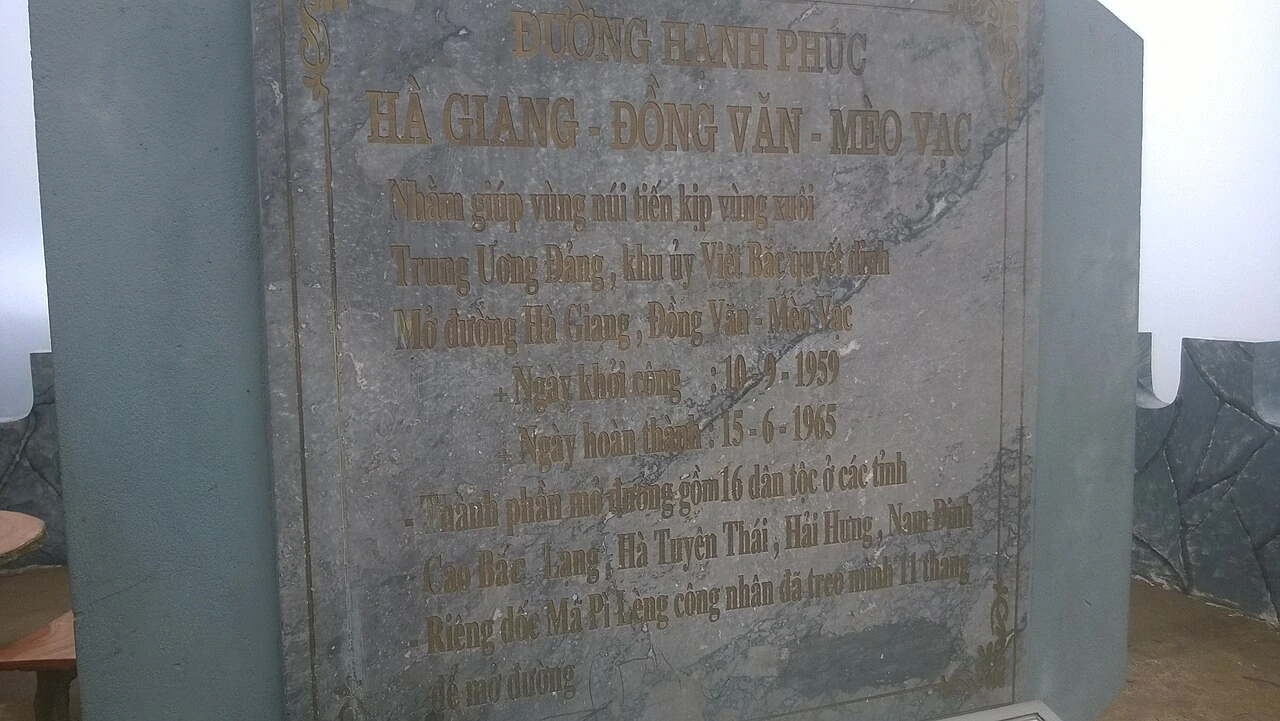
Vietnamese information plaque at Meo Vac outpost, photographed in 2014. Source-identified language; displayed without additional cropping.
Saved in Babelbook · resized display copy. Select the image to open it independently of its source.
Vuong Tri Binh · Source ↗CC BY-SA 4.0 ↗View the local visual field note
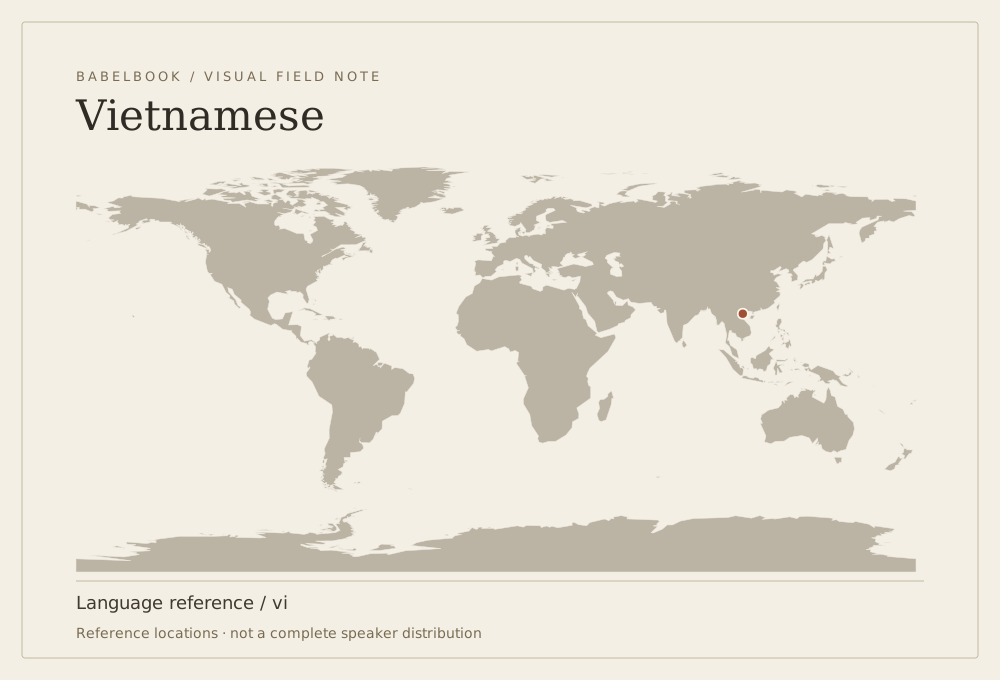
Representative reference points from Glottolog. Historical entries show reference locations, not current speakers. 1 point.
Reference & context ↗Babelbook · original editorial illustration · CC BY 4.0 · Glottolog locations; public-domain Natural Earth land
Source excerpts, selected, shortened and where noted editorially corrected from Vietnamese language by Wikipedia contributors. Retrieved 2026-10-05. CC BY-SA 4.0. These excerpts are not an independently verified scholarly history; missing accounts are identified above.
Read further in the source
History
Austroasiatic is believed to have dispersed around 2000 BC. The arrival of the agricultural Phùng Nguyên culture in the Red River Delta at that time may correspond to the Vietic branch. This ancestral Vietic was typologically very different from later Vietnamese. In addition to monosyllabic roots, it had sesquisyllabic roots consisting of a reduced syllable followed by a full syllable, and featured many consonant clusters. Both of these features are found elsewhere in Austroasiatic and in modern conservative Vietic languages south of the Red River area. The language was non-tonal, but featured glottal stop and voiceless fricative codas. Borrowed vocabulary indicates early contact with speakers of Tai languages in the last millennium BCE, which is consistent with genetic evidence from Dong Son culture sites. Extensive contact with Chinese began during the Han dynasty (2nd century BCE). At this time, Vietic groups began to expand south from the Red River Delta and into the adjacent uplands, possibly to escape Chinese encroachment. The oldest layer of loans from Chinese into northern Vietic (which would become the Viet–Mường subbranch) date from this period. The northern Vietic varieties thus became part of the Mainland Southeast Asia linguistic area, in which languages from genetically unrelated families converged toward characteristics such as isolating morphology and similar syllable structure. Many languages in this area, including Viet–Mường, underwent a process of tonogenesis, in which distinctions formerly expressed by final consonants became phonemic tonal distinctions when those consonants disappeared. These characteristics have become part of many of the genetically unrelated languages of Southeast Asia; for example, Tsat (a member of the Malayo-Polynesian group within Austronesian) and Vietnamese each developed tones as a phonemic feature.
After the split from Mường around the end of the first millennium CE, the following stages of Vietnamese are commonly identified as Ancient, Middle, and Modern:
Ancient (or Old) Vietnamese (to c. 1500) Sources include the Ming glossary Ānnánguó yìyǔ (安南國譯語, c. 15th century) from the Huayi yiyu series, and a Buddhist sutra recorded in an early form of chữ Nôm, variously dated to the 12th and 15th centuries. Compared with Proto-Vietic, the language had lost the voicing distinction on stop initials, giving rise to a tone split, and implosive initials had become nasals. Most of the minor syllables of Proto-Vietic were still present. Middle Vietnamese (16th to 19th centuries) Middle Vietnamese is the language found in Dictionarium Annamiticum Lusitanum et Latinum (1651) of the Jesuit missionary Alexandre de Rhodes. Another famous dictionary of this period was written by Pierre Pigneau de Behaine in 1773 and published by Jean-Louis Taberd in 1838. Modern Vietnamese (from the 19th century) After expelling the Chinese at the beginning of the 10th century, the Ngô dynasty adopted Classical Chinese as the formal medium of government, scholarship, and literature. With the dominance of Chinese came wholesale importation of Chinese vocabulary. The resulting Sino-Vietnamese vocabulary makes up about a third of the Vietnamese lexicon in all realms, and may account for as much as 60% of the vocabulary used in formal texts. Vietic languages were confined to the northern third of modern Vietnam until the "southward advance" (Nam tiến) from the late 15th century. The conquest of the ancient nation of Champa and of the Mekong Delta led to an expansion of the Vietnamese people and language, with distinctive local variations emerging. After France invaded Vietnam in the late 19th century, French gradually replaced Literary Chinese as the official language in education and government. Vietnamese adopted many French terms, such as đầm ('dame', from madame), ga ('train station', from gare), sơ mi ('shirt', from chemise), and búp bê ('doll', from poupée), resulting in a language that was Austroasiatic but with major Chinese influences and relatively minor French influences from the French colonial era.
Origin of tones
Proto-Vietic did not have tones. Tones developed later in some of the daughter languages from distinctions in the initial and final consonants. Vietnamese tones developed as follows:
Glottal-ending syllables ended with a glottal stop /ʔ/, while fricative-ending syllables ended with /s/ or /h/. Both types of syllables could co-occur with a resonant (e.g. /m/ or /n/). At some point, a tone split occurred, as in many other mainland Southeast Asian languages. Essentially, an allophonic distinction developed in the tones whereby those in syllables with voiced initials were pronounced differently from those with voiceless initials. (Approximately speaking, the voiced allotones were pronounced with additional breathy voice or creaky voice and with lowered pitch. The quality difference predominates in today's northern varieties, e.g., in Hanoi, while in the southern varieties the pitch difference predominates, as in Ho Chi Minh City.) Later the plain-voiced stops became voiceless and the allotones became new phonemic tones. The implosive stops (ɓ, ɗ and ʄ) were unaffected, and in fact developed tonally as if they were unvoiced. (This behavior is common to all East Asian languages with implosive stops.) These stops merged with the corresponding nasals (m, n and ɲ) before the Old Vietnamese period. As noted above, consonants following minor syllables became voiced fricatives. The minor syllables were eventually lost, but not until the tone split had occurred. As a result, words in modern Vietnamese with voiced fricatives occur in all six tones, and the tonal register reflects the voicing of the minor-syllable prefix and not the voicing of the Proto-Vietic main-syllable stop that produced the fricative. For similar reasons, words beginning with /l/ and /ŋ/ occur in both registers. (Thompson 1976 reconstructed voiceless resonants to account for outcomes where resonants occur with a first-register tone, but this is no longer considered necessary, at least by Ferlus.) A large number of words were borrowed from Middle Chinese, forming part of the Sino-Vietnamese vocabulary. These caused the original introduction of the retroflex sounds /ʂ/ and /ʈ/ (modern s, tr) into the language.
Geographic distribution
As a result of emigration, Vietnamese speakers are also found in other parts of Southeast Asia, East Asia, North America, Europe, and Australia. Vietnamese has also been officially recognized as a minority language in the Czech Republic. As the national language, Vietnamese is the lingua franca in Vietnam. It is also spoken by the Jing people traditionally residing on three islands (now joined to the mainland) off Dongxing in southern Guangxi Province, China. A large number of Vietnamese speakers also reside in neighboring countries of Cambodia and Laos.
In the United States, Vietnamese is the sixth most spoken language, with over 1.5 million speakers, who are concentrated in a handful of states. It is the third-most spoken language in Texas and Washington; fourth-most in Georgia, Louisiana, and Virginia; and fifth-most in Arkansas and California. Vietnamese is the third most spoken language in Australia other than English, after Mandarin and Arabic. In France, it is the most spoken Asian language and the eighth most spoken immigrant language at home.
Official status
Vietnamese is the sole official and national language of Vietnam. It is the first language of the majority of the Vietnamese population, as well as a first or second language for the country's ethnic minority groups. In the Czech Republic, Vietnamese has been recognized as one of 14 minority languages, on the basis of communities that have resided in the country either traditionally or on a long-term basis. This status grants the Vietnamese community in the country a representative on the Government Council for Nationalities, an advisory body of the Czech Government for matters of policy towards national minorities and their members. It also grants the community the right to use Vietnamese with public authorities and in courts anywhere in the country. Vietnamese was also recognized as a national minority language in Slovakia in 2023. In the U.S. city of San Francisco, municipal services began to be offered in Vietnamese starting in 2024.
Austroasiatic origins
Many early studies hypothesized Vietnamese language-origins to have been either Kra-Dai, Sino-Tibetan, or Austroasiatic. Austroasiatic origins are so far the most tenable to date, with some of the oldest words in Vietnamese being Austroasiatic in origin. Vietnamese shares a large amount of vocabulary with the Mường languages, a close relative of the Vietnamese language.
Other compound words, such as nước non (chữ Nôm: 渃𡽫, "country/nation", lit. "water and mountains"), appear to be of purely Vietnamese origin and used to be inscribed in chữ Nôm characters (compounded, self-coined Chinese characters) but are now written in the Vietnamese alphabet.
Writing systems
After ending a millennium of Chinese rule in 939, the Vietnamese state adopted Literary Chinese (called văn ngôn 文言 or Hán văn 漢文 in Vietnamese) for official purposes. Up to the late 19th century (except for two brief interludes), all formal writing, including government business, scholarship and formal literature, was done in Literary Chinese, written with Chinese characters (chữ Hán). Although the writing system is now mostly in chữ Quốc ngữ (Latin script), Chinese script known as chữ Hán in Vietnamese as well as chữ Nôm (together, Hán-Nôm) is still present in such activities as Vietnamese calligraphy.
Dates and numbers writing formats
Tiếng Việt speak date in the format "day month year". Each month's name is just the ordinal of that month appended after the word tháng, which means "month". Traditional Vietnamese, however, assigns other names to some months; these names are mostly used in the lunar calendar and in poetry.
When written in the short form, "DD/MM/YYYY" is preferred. Example:
English: 2(nd) September, 2025 Vietnamese long form: Ngày hai Tháng chín Năm hai nghìn không trăm hai mươi lăm Vietnamese short form: 2 September 2025 The Vietnamese prefer writing numbers with a comma as the decimal separator in lieu of dots, and either spaces or dots to group the digits. An example is 1 629,15 (one thousand six hundred twenty-nine-point one five). Because a comma is used as the decimal separator, a semicolon is used to separate two numbers instead.
Orthography
DeFrancis, John (1977). Colonialism and language policy in Viet Nam. Mouton. ISBN 978-90-279-7643-7. Haudricourt, André-Georges (1949). "Origine des particularités de l'alphabet vietnamien". Dân Việt-Nam. 3: 61–68. English translation: Michaud, Alexis; Haudricourt, André-Georges (2010). "The origin of the peculiarities of the Vietnamese alphabet". Mon-Khmer Studies. 39: 89–104. Archived from the original on 14 August 2021. Retrieved 28 December 2017. Nguyễn, Đình-Hoà (1955). Quốc-ngữ: The modern writing system in Vietnam. Washington, DC: Nguyễn Đình-Hoà. Nguyễn, Đình-Hoà (1990). "Graphemic borrowing from Chinese: The case of chữ nôm, Vietnam's demotic script". Bulletin of the Institute of History and Philology, Academia Sinica. 61: 383–432. Nguyễn, Đình-Hoà (1996). "Vietnamese". In Daniels, P. T.; Bright, W. (eds.). The world's writing systems. New York: Oxford University Press. pp. 691–699. ISBN 978-0-19-507993-7.