Volapük
Volapük (English: ; Volapük: [volaˈpyk], 'Language of the World', or lit. 'World Speak') is a constructed language created in 1879 and 1880 by Johann Martin Schleyer, a Roman Catholic priest in Baden, Germany. Notable as the first major constructed international auxiliary language, it primarily drew from Germanic languages. Its grammar is inspired largely by German, although it was heavily regularized by Schleyer, while its lexicon is rooted mostly in English, with additional influence from German, the Romance languages, and Russian. Despite some roots remaining recognizable, many words were altered beyond recognition, as Schleyer sought to make most of the vocabulary monosyllabic. Volapük conventions took place in 1884 (Friedrichshafen), 1887 (Munich) and 1889 (Paris). The first two conventions used German, and the last conference used only Volapük. By 1889, there were an estimated 283 clubs, 25 periodicals in or about Volapük, and 316 textbooks in 25 languages; at that time the language claimed nearly a million adherents. Volapük experienced a small revival in the 1930s due to Arie de Jong's reforms of the language, which became called Volapük nulik. This form simplified the language and became the commonly accepted form of it. Volapük was largely displaced between the late 19th and early 20th century by Esperanto, as many Volapükists switched to Esperanto due to the internal conflicts within the Volapükist movement. Volapük still maintains a small userbase to this day, and it has seen a small revival in the 21st century.
Translate in Volapük ↗Volapük (English: ; Volapük: [volaˈpyk], 'Language of the World', or lit. 'World Speak') is a constructed language created in 1879 and 1880 by Johann Martin Schleyer, a Roman Catholic priest in Baden, Germany. Notable as the first major constructed international auxiliary language, it primarily drew from Germanic languages. Its grammar is inspired largely by German, although it was heavily regularized by Schleyer, while its lexicon is rooted mostly in English, with additional influence from German, the Romance languages, and Russian. Despite some roots remaining recognizable, many words were altered beyond recognition, as Schleyer sought to make most of the vocabulary monosyllabic. Volapük conventions took place in 1884 (Friedrichshafen), 1887 (Munich) and 1889 (Paris). The first two conventions used German, and the last conference used only Volapük. By 1889, there were an estimated 283 clubs, 25 periodicals in or about Volapük, and 316 textbooks in 25 languages; at that time the language claimed nearly a million adherents. Volapük experienced a small revival in the 1930s due to Arie de Jong's reforms of the language, which became called Volapük nulik. This form simplified the language and became the commonly accepted form of it. Volapük was largely displaced between the late 19th and early 20th century by Esperanto, as many Volapükists switched to Esperanto due to the internal conflicts within the Volapükist movement. Volapük still maintains a small userbase to this day, and it has seen a small revival in the 21st century.
Global / other
Present-day use
In the 1920s, Arie de Jong, with the consent of the leaders of the small remnant of Volapük speakers, made a revision of Volapük which was published in 1931 (now called Volapük Nulik "New Volapük" as opposed to the Volapük Rigik 'Original Volapük' of Schleyer). This revision was accepted by the few speakers of the language. De Jong simplified the grammar, eliminating some rarely used verb forms, and eliminated some gendered pronouns and gendered verb endings. He also rehabilitated the phoneme /r/ and used it to make some morphemes more recognizable. For instance, lömib "rain" became rein. These reforms made the language simpler overall. Volapük enjoyed a brief renewal of popularity in the Netherlands and Germany under de Jong's leadership, but was suppressed (along with other constructed languages) in countries under Nazi rule and never recovered. Regarding the success of this constructed language, the Spanish scientist Santiago Ramón y Cajal wrote in the first edition of his Tonics of Willingness, in 1898: Nowadays, many scientific papers are published in more than six languages. To the likely attempt of restoring Latin or using Esperanto as the universal language of science, wise men have responded by multiplying the number of languages in which scientific works are published. We have to acknowledge that Volapük or Esperanto are practically one more language to be learnt. This result was predictable because neither the essentially popularized and democratic tendencies of modern knowledge, nor the economic views of authors and editors consent in a different way. However, some years later (1920), in the third edition of the same book, he added the following footnote to the former assertion: "As it was presumable, nowadays -1920-, the brand new Volapük has been forgotten definitively. We forecast the same for Esperanto." Volapük has experienced a small revival in the 21st century, although often as a hobby language.
Origins
The captured article does not contain a separate origins section. See the historical account and linked source.
Development
Volapük was first created by Johann Martin Schleyer, who was a Roman Catholic priest. As Schleyer met an old German peasant who could not write to his son due to the linguistic barrier, he was very symphathetic, causing him to decide that there should be a means of international communication. He first created a "National alphabet", which could express the sounds of every language in the world. However, his alphabet system did not gain any recognition, which caused him to develop insomnia. During one sleepless night, he believed that God told him not to despair, and had called him to create an international auxiliary language. Schleyer first published a sketch of Volapük in May 1879 in Sionsharfe, a Catholic poetry magazine of which he was editor. This was followed in 1880 by a full-length book in German. Schleyer himself did not write books on Volapük in other languages, but other authors soon did, such as Comprehensive Volapük Grammar by Alfred A. Post, A Complete Grammar of Volapük by A. K. Linderfelt, and A Handbook of Volapük by Andrew Drummond. André Cherpillod writes of the third Volapük convention, In August 1889 the third convention was held in Paris. About two hundred people from many countries attended. And, unlike in the first two conventions, people spoke only Volapük. For the first time in the history of mankind, sixteen years before the Boulogne convention, an international convention spoke an international language.Volapük experienced a short period of very high success, spreading first to France, and then elsewhere. At one point there were perhaps up to even one million students of Volapük, but later began to decline.
Writing
The phonology of Volapük is as follows: Additionally, ⟨x⟩ represents the sequence /ks/. The letters ⟨C⟩, ⟨J⟩, ⟨S⟩ and ⟨Z⟩ are pronounced voiced after voiced consonants and unvoiced otherwise. There are no diphthongs; each vowel letter is pronounced separately. Polysyllabic words are always stressed on the final vowel; for example, neai "never" is pronounced [ne.a.ˈi]. Exceptionally, the question clitic "-li" does not shift the stress of the word it attaches to. When words are compounded together, secondary stress is retained on the final syllables of the compounded elements, as long as that does not result in adjacent stressed syllables. The letters ä, ö, and ü do not have alternative forms such as the ae, oe, and ue of German, but Schleyer proposed alternative forms ꞛ, ꞝ, and ꞟ for them, all of which are part of Unicode since version 7.0 released in June 2014: U+A79A Ꞛ LATIN CAPITAL LETTER VOLAPUK AE U+A79B ꞛ LATIN SMALL LETTER VOLAPUK AE U+A79C Ꞝ LATIN CAPITAL LETTER VOLAPUK OE U+A79D ꞝ LATIN SMALL LETTER VOLAPUK OE U+A79E Ꞟ LATIN CAPITAL LETTER VOLAPUK UE U+A79F ꞟ LATIN SMALL LETTER VOLAPUK UE
Beyond the typeface.
Signs, manuscripts, published pages and contextual photographs, with their place, period, source and reuse terms. Captions identify historical spellings, regional examples, community references and character imagery.
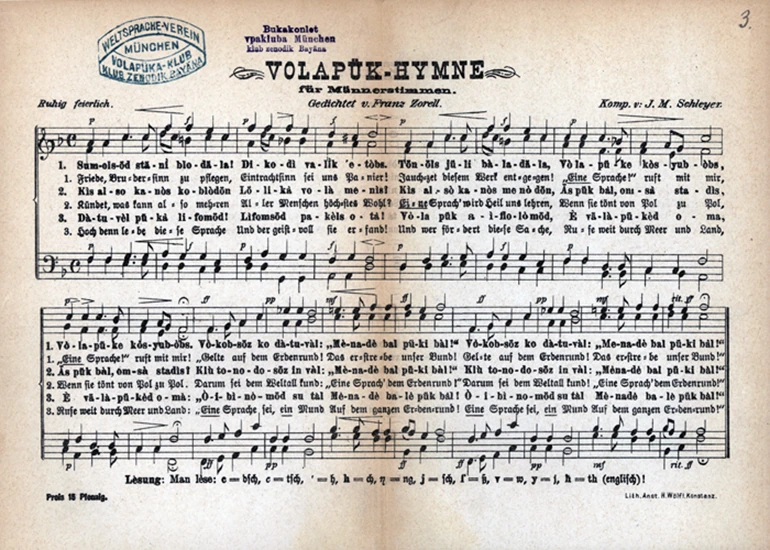
Sheet music published in 1885 with text in Volapük and German, explicitly identified in the Commons description.
Saved in Babelbook · resized display copy. Select the image to open it independently of its source.
Franz Zorell (lyrics); Johann Martin Schleyer (music); scan Bayerische Staatsbibliothek · Source ↗Public domain ↗View the local visual field note
This constructed-language or category entry has no geographic reference points in the collection.
Reference & context ↗Babelbook · original editorial illustration · Babelbook original illustration
Source excerpts, selected, shortened and where noted editorially corrected from Volapük by Wikipedia contributors. Retrieved 2026-10-05. CC BY-SA 4.0. These excerpts are not an independently verified scholarly history; missing accounts are identified above.
Read further in the source
History
Volapük was first created by Johann Martin Schleyer, who was a Roman Catholic priest. As Schleyer met an old German peasant who could not write to his son due to the linguistic barrier, he was very symphathetic, causing him to decide that there should be a means of international communication. He first created a "National alphabet", which could express the sounds of every language in the world. However, his alphabet system did not gain any recognition, which caused him to develop insomnia. During one sleepless night, he believed that God told him not to despair, and had called him to create an international auxiliary language. Schleyer first published a sketch of Volapük in May 1879 in Sionsharfe, a Catholic poetry magazine of which he was editor. This was followed in 1880 by a full-length book in German. Schleyer himself did not write books on Volapük in other languages, but other authors soon did, such as Comprehensive Volapük Grammar by Alfred A. Post, A Complete Grammar of Volapük by A. K. Linderfelt, and A Handbook of Volapük by Andrew Drummond. André Cherpillod writes of the third Volapük convention,
In August 1889 the third convention was held in Paris. About two hundred people from many countries attended. And, unlike in the first two conventions, people spoke only Volapük. For the first time in the history of mankind, sixteen years before the Boulogne convention, an international convention spoke an international language.Volapük experienced a short period of very high success, spreading first to France, and then elsewhere. At one point there were perhaps up to even one million students of Volapük, but later began to decline.
20th century temporary revival
In the 1920s, Arie de Jong, with the consent of the leaders of the small remnant of Volapük speakers, made a revision of Volapük which was published in 1931 (now called Volapük Nulik "New Volapük" as opposed to the Volapük Rigik 'Original Volapük' of Schleyer). This revision was accepted by the few speakers of the language. De Jong simplified the grammar, eliminating some rarely used verb forms, and eliminated some gendered pronouns and gendered verb endings. He also rehabilitated the phoneme /r/ and used it to make some morphemes more recognizable. For instance, lömib "rain" became rein. These reforms made the language simpler overall. Volapük enjoyed a brief renewal of popularity in the Netherlands and Germany under de Jong's leadership, but was suppressed (along with other constructed languages) in countries under Nazi rule and never recovered. Regarding the success of this constructed language, the Spanish scientist Santiago Ramón y Cajal wrote in the first edition of his Tonics of Willingness, in 1898:
Nowadays, many scientific papers are published in more than six languages. To the likely attempt of restoring Latin or using Esperanto as the universal language of science, wise men have responded by multiplying the number of languages in which scientific works are published. We have to acknowledge that Volapük or Esperanto are practically one more language to be learnt. This result was predictable because neither the essentially popularized and democratic tendencies of modern knowledge, nor the economic views of authors and editors consent in a different way. However, some years later (1920), in the third edition of the same book, he added the following footnote to the former assertion: "As it was presumable, nowadays -1920-, the brand new Volapük has been forgotten definitively. We forecast the same for Esperanto."
Phonology and orthography
The phonology of Volapük is as follows:
Additionally, ⟨x⟩ represents the sequence /ks/. The letters ⟨C⟩, ⟨J⟩, ⟨S⟩ and ⟨Z⟩ are pronounced voiced after voiced consonants and unvoiced otherwise. There are no diphthongs; each vowel letter is pronounced separately. Polysyllabic words are always stressed on the final vowel; for example, neai "never" is pronounced [ne.a.ˈi]. Exceptionally, the question clitic "-li" does not shift the stress of the word it attaches to. When words are compounded together, secondary stress is retained on the final syllables of the compounded elements, as long as that does not result in adjacent stressed syllables. The letters ä, ö, and ü do not have alternative forms such as the ae, oe, and ue of German, but Schleyer proposed alternative forms ꞛ, ꞝ, and ꞟ for them, all of which are part of Unicode since version 7.0 released in June 2014:
U+A79A Ꞛ LATIN CAPITAL LETTER VOLAPUK AE U+A79B ꞛ LATIN SMALL LETTER VOLAPUK AE U+A79C Ꞝ LATIN CAPITAL LETTER VOLAPUK OE U+A79D ꞝ LATIN SMALL LETTER VOLAPUK OE U+A79E Ꞟ LATIN CAPITAL LETTER VOLAPUK UE U+A79F ꞟ LATIN SMALL LETTER VOLAPUK UE