Walloon
Walloon (; natively walon; French: wallon, Belgian French pronunciation: [walõ] ) is a Romance language that is spoken in much of Wallonia and, to a very small extent, in Brussels, Belgium; some villages near Givet, northern France; and a clutch of communities in northeastern Wisconsin, United States. It belongs to the langues d'oïl dialect continuum, the most prominent member of which is French. The historical background of its formation was the territorial extension since 980 of the Principality of Liège to the south and west. Walloon is classified as "definitely endangered" by the UNESCO Atlas of the World's Languages in Danger. Despite its rich literature, beginning anonymously in the 16th century and with well-known authors since 1756, the use of Walloon has decreased markedly since France's annexation of Wallonia in 1794. This period definitively established French as the language of social promotion, far more than it was before. After World War I, public schools provided French-speaking education to all children, inducing a denigration of Walloon, especially when accompanied by official orders in 1952 to punish its use in schools. Subsequently, since the middle of the 20th century, generational transmission of the language has decreased, resulting in Walloon almost becoming a dead language. Today it is scarcely spoken among younger people, with the vast majority of its native speakers being the elderly (aged 65 and over).
Translate in Walloon ↗Walloon (; natively walon; French: wallon, Belgian French pronunciation: [walõ] ) is a Romance language that is spoken in much of Wallonia and, to a very small extent, in Brussels, Belgium; some villages near Givet, northern France; and a clutch of communities in northeastern Wisconsin, United States. It belongs to the langues d'oïl dialect continuum, the most prominent member of which is French. The historical background of its formation was the territorial extension since 980 of the Principality of Liège to the south and west. Walloon is classified as "definitely endangered" by the UNESCO Atlas of the World's Languages in Danger. Despite its rich literature, beginning anonymously in the 16th century and with well-known authors since 1756, the use of Walloon has decreased markedly since France's annexation of Wallonia in 1794. This period definitively established French as the language of social promotion, far more than it was before. After World War I, public schools provided French-speaking education to all children, inducing a denigration of Walloon, especially when accompanied by official orders in 1952 to punish its use in schools. Subsequently, since the middle of the 20th century, generational transmission of the language has decreased, resulting in Walloon almost becoming a dead language. Today it is scarcely spoken among younger people, with the vast majority of its native speakers being the elderly (aged 65 and over). In 2007, the number of people with knowledge of the language was estimated at 600,000. Numerous associations, especially theatre companies, are working to keep the language alive.
Global / other
Present-day use
The captured source does not contain a separate current-use account.
Origins
The captured article does not contain a separate origins section. See the historical account and linked source.
Development
Latin /k/ before /a/ and /ɡ/ before /e/, /i/, or /a/ gave Walloon affricate phonemes spelled tch /t͡ʃ/ and dj /d͡ʒ/: vatche (vs. French vache "cow"), djambe (Fr. jambe "leg"). Latin [s] persisted in clusters: spene (Fr. épine "thorn, spine"), fistu "wisp of straw", mwaîsse (Fr. maître "master"), fiesse (Fr. fête "party, feast"), tchestea (Fr. château "castle"), and so on. Final obstruent devoicing: rodje "red" is pronounced exactly as rotche "rock". Nasal vowels may be followed by nasal consonants, as in djonne "young", crinme "cream", mannet "dirty", etc. Vowel length has a phonological value. It allows distinguishing cu "arse" and cû "cooked", i l' hosse "he cradles her" and i l' hôsse "he increases it", messe "mass" and mêsse "master", etc. From a linguistic point of view, Louis Remacle has shown that a good number of the developments that we now consider typical of Walloon appeared between the 8th and 12th centuries. Walloon "had a clearly defined identity from the beginning of the 13th century". In any case, linguistic texts from the time do not mention the language, although they mention others in the langue d'oïl family, such as Picard and Lorrain. During the 15th century, scribes in the region called the language "Roman" when they needed to distinguish it. It is not until the beginning of the 16th century that first occurrence of the word "Walloon" appeared in the current linguistic sense. In 1510 or 1511, Jean Lemaire de Belges made the connection between Rommand to Vualon: Et ceux cy [les habitants de Nivelles] parlent le vieil langage Gallique que nous appellons Vualon ou Rommand (...).
Writing
The Walloon alphabet generally consists of the basic ISO Latin Alphabet, and six types of diacritic. It also makes frequent use of digraphs. Various orthographies have been used, most notably the Feller system (sistinme Feller) and Unified Walloon (rifondou walon or rfondou walon).
Beyond the typeface.
Signs, manuscripts, published pages and contextual photographs, with their place, period, source and reuse terms. Captions identify historical spellings, regional examples, community references and character imagery.
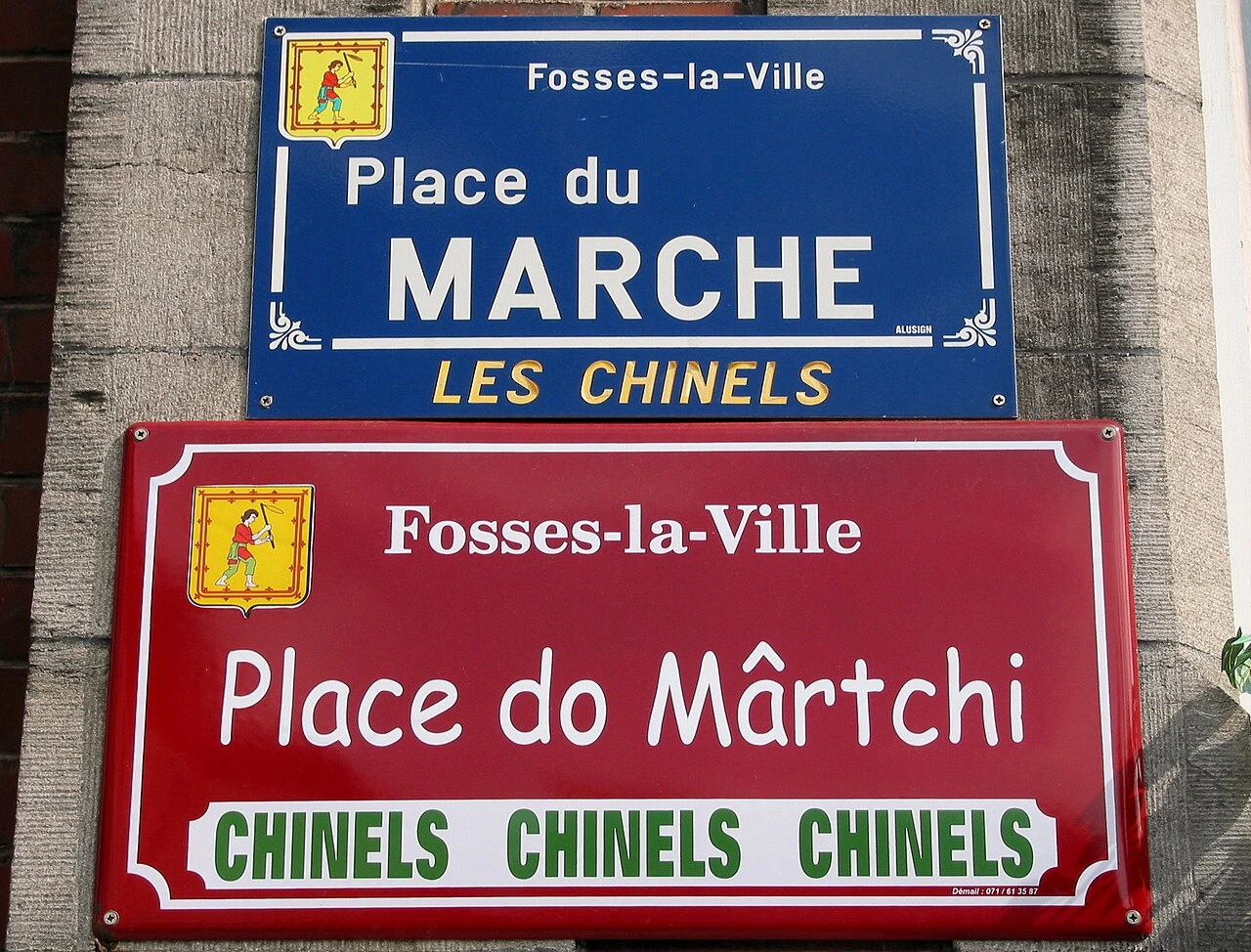
An enameled Walloon street sign in Fosses-la-Ville, Belgium, photographed in 2005. Commons explicitly identifies its language as Walloon.
Saved in Babelbook · resized display copy. Select the image to open it independently of its source.
Jean-Pol GRANDMONT · Source ↗CC BY 3.0 ↗View the local visual field note
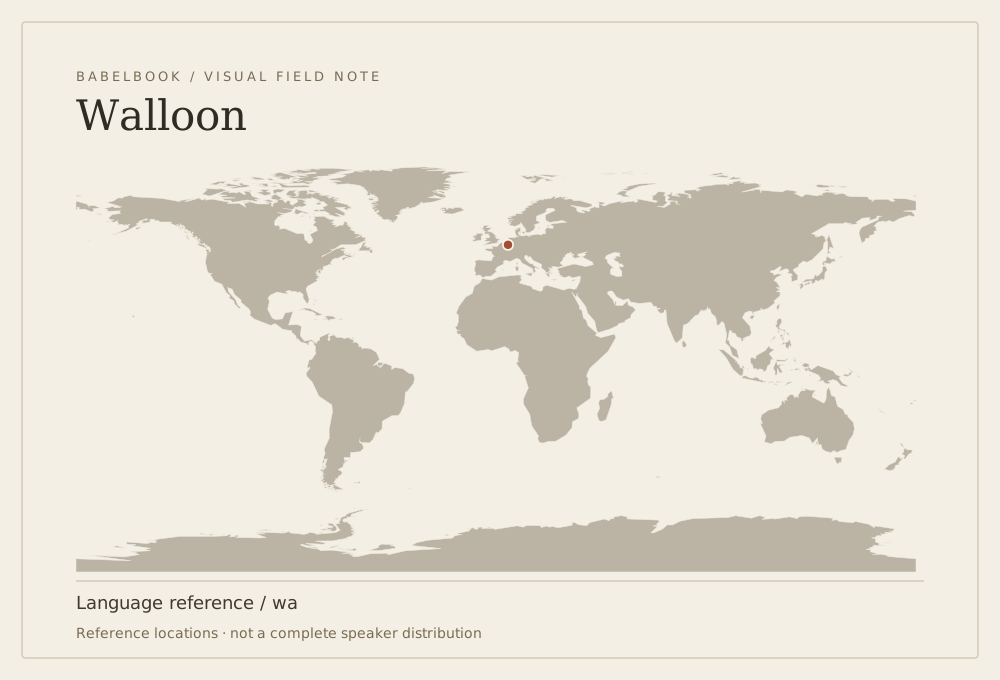
Representative reference points from Glottolog. Historical entries show reference locations, not current speakers. 1 point.
Reference & context ↗Babelbook · original editorial illustration · CC BY 4.0 · Glottolog locations; public-domain Natural Earth land
Source excerpts, selected, shortened and where noted editorially corrected from Walloon language by Wikipedia contributors. Retrieved 2026-10-05. CC BY-SA 4.0. These excerpts are not an independently verified scholarly history; missing accounts are identified above.
Read further in the source
Dialects
Four dialects of Walloon developed in four distinct zones of Wallonia:
Central, spoken in Namur (Nameur), the Wallon capital, and the cities of Wavre (Åve) and Dinant; Eastern – in many respects the most conservative and idiosyncratic of the dialects, spoken in Liège (Lidje), Verviers (Vervî), Malmedy (Måmdi), Huy (Hu), and Waremme (Wareme); Western – the dialect closest to French proper and with a strong Picard influence, spoken in Charleroi (Tchårlerwè), Nivelles (Nivele), and Philippeville (Flipvile); and Southern – close to the Lorrain and to a lesser extent Champenois languages, spoken in Bastogne, Marche-en-Famenne (Måtche-el-Fåmene), and Neufchâteau (Li Tchestea), all in the Ardennes region. Despite local phonetic differences, there is a regional movement towards the adoption of a common spelling, called the Rifondou walon. This orthography is diasystemic, reflecting different pronunciations for different readers, a concept inspired by the spelling of Breton. The written forms attempt to reconcile current phonetic uses with ancient traditions (notably the reintroduction of xh and oi that were used for writing Walloon until the late 19th century) and the language's own phonological logic.
Dialectal variation
The following is a table of phonemes varying based on dialects:
If there is a Rifondou grapheme for the sound, the source is. Otherwise, it is precised. These last two sounds are written as ⟨i⟩ and ⟨ou⟩ in Rifondou, as in rifondou. /kw~k/ is normalised as kw.
Evolution from Latin
Latin /k/ before /a/ and /ɡ/ before /e/, /i/, or /a/ gave Walloon affricate phonemes spelled tch /t͡ʃ/ and dj /d͡ʒ/: vatche (vs. French vache "cow"), djambe (Fr. jambe "leg"). Latin [s] persisted in clusters: spene (Fr. épine "thorn, spine"), fistu "wisp of straw", mwaîsse (Fr. maître "master"), fiesse (Fr. fête "party, feast"), tchestea (Fr. château "castle"), and so on. Final obstruent devoicing: rodje "red" is pronounced exactly as rotche "rock". Nasal vowels may be followed by nasal consonants, as in djonne "young", crinme "cream", mannet "dirty", etc. Vowel length has a phonological value. It allows distinguishing cu "arse" and cû "cooked", i l' hosse "he cradles her" and i l' hôsse "he increases it", messe "mass" and mêsse "master", etc.
Orthography
The Walloon alphabet generally consists of the basic ISO Latin Alphabet, and six types of diacritic. It also makes frequent use of digraphs. Various orthographies have been used, most notably the Feller system (sistinme Feller) and Unified Walloon (rifondou walon or rfondou walon).
History
From a linguistic point of view, Louis Remacle has shown that a good number of the developments that we now consider typical of Walloon appeared between the 8th and 12th centuries. Walloon "had a clearly defined identity from the beginning of the 13th century". In any case, linguistic texts from the time do not mention the language, although they mention others in the langue d'oïl family, such as Picard and Lorrain. During the 15th century, scribes in the region called the language "Roman" when they needed to distinguish it. It is not until the beginning of the 16th century that first occurrence of the word "Walloon" appeared in the current linguistic sense. In 1510 or 1511, Jean Lemaire de Belges made the connection between Rommand to Vualon:
Et ceux cy [les habitants de Nivelles] parlent le vieil langage Gallique que nous appellons Vualon ou Rommand (...). Et de ladite ancienne langue Vualonne, ou Rommande, nous usons en nostre Gaule Belgique: Cestadire en Haynau, Cambresis, Artois, Namur, Liège, Lorraine, Ardenne et le Rommanbrabant, et est beaucoup differente du François, lequel est plus moderne, et plus gaillart. And those people [the inhabitants of Nivelles] speak the old Gallic language which we call Vualon or Rommand (...). And we use the said old Vualon or Rommand language in our Belgian Gaul: That is to say in Hainaut, Cambrai, Artois, Namur, Liège, Lorraine, Ardennes and Rommand Brabant, and it is very different from French, which is more fashionable and courtly. The word "Walloon" thus came closer to its current meaning: the vernacular of the Roman part of the Low Countries. One might say that the period which saw the establishment of the unifying supremacy of the Burgundians in the Walloon country was a turning-point in their linguistic history. The crystallization of a Walloon identity, as opposed to that of the thiois (i.e. Dutch-speaking) regions of the Low Countries, established "Walloon" as a word for designating its people. Somewhat later, the vernacular of these people became more clearly distinct from central French and other neighbouring langues d'oïl, prompting the abandonment of the vague term "Roman" as a linguistic, ethnic, and political designator for "Walloon". Also at this time, following the Ordinance of Villers-Cotterêts in 1539, the French language replaced Latin for all administrative purposes in France. Established as the academic language, French became the object of a political effort at normalization; La Pléiade posited the view that when two languages of the same language family coexist, each can be defined only in opposition to the other. Around the year 1600, the French writing system became dominant in the Wallonia. From this time, too, dates a tradition of texts written in a language marked by traces of spoken Walloon. The written language of the preceding centuries, scripta, was a composite language with some Walloon characteristics but it did not attempt to be a systematic reproduction of the spoken language.