Wolof
Wolof ( WOH-lof; Wolof làkk, وࣷلࣷفْ لࣵکّ) is a Niger–Congo language spoken by the Wolof people in much of the West African subregion of Senegambia that is split between the countries of Senegal, the Gambia and Mauritania. Like the neighbouring languages Serer and Fula, it belongs to the Senegambian branch of the Niger–Congo language family. Unlike most other languages of its family, Wolof is not a tonal language. Wolof is the most widely spoken language in Senegal, spoken natively by the Wolof people (40% of the population) but also by most other Senegalese as a second language. Wolof dialects vary geographically and between rural and urban areas. The principal dialect of Dakar, for instance, is an urban mixture of Wolof, French, and Arabic. Wolof is the standard spelling and may also refer to the Wolof ethnicity or culture. Variants include the older French Ouolof, Jollof, or Jolof, which now typically refers either to the Jolof Empire or to jollof rice. Now-archaic forms include Volof and Olof. English is believed to have adopted some Wolof loanwords, such as banana, via Spanish or Portuguese, and nyam, used also in Spanish: ñam as an onomatopoeia for eating or chewing, in several Caribbean English Creoles meaning 'to eat' (compare Seychellois Creole nyanmnyanm, also meaning 'to eat').
Translate in Wolof ↗Wolof is spoken by 18 million people and about 40% (8.2 million people) of Senegal's population speak Wolof as their native language. Increased mobility, and especially the growth of the capital Dakar, created the need for a common language: today, an additional 40 percent of the population speak Wolof as a second or acquired language. In the whole region from Dakar to Saint-Louis, and also west and southwest of Kaolack, Wolof is spoken by the vast majority of people. Typically when various ethnic groups in Senegal come together in cities and towns, they speak Wolof. It is therefore spoken in almost every regional and departmental capital in Senegal. Nevertheless, the official language of Senegal is French. In the Gambia, although about 20–25 percent of the population speak Wolof as a first language, it has a disproportionate influence because of its prevalence in Banjul, the Gambian capital, where 75 percent of the population use it as a first language. Furthermore, in Serekunda, the Gambia's largest town, although only a tiny minority are ethnic Wolofs, approximately 70 percent of the population speaks or understands Wolof. In Mauritania, about seven percent of the population (approximately 185,000 people) speak Wolof. Most live near or along the Senegal River that Mauritania shares with Senegal.
Sub-Saharan Africa
Present-day use
The captured source does not contain a separate current-use account.
Origins
The captured article does not contain a separate origins section. See the historical account and linked source.
Development
The captured article does not contain a distinct historical account. No chronology has been invented.
Writing
The Latin orthography of Wolof in Senegal was set by government decrees between 1971 and 1985. The language institute "Centre de linguistique appliquée de Dakar" (CLAD) is widely acknowledged as an authority when it comes to spelling rules for Wolof. The complete alphabet is A, À, B, C, D, E, É, Ë, F, G, I, J, K, L, M, N, Ñ, Ŋ, O, Ó, P, Q, R, S, T, U, W, X, Y. The letters H, V, and Z are only used in foreign words. Wolof is most often written in this orthography, in which phonemes have a clear one-to-one correspondence to graphemes. Table below is the Wolof Latin alphabet and the corresponding phoneme. Highlighted letters are only used for loanwords and are not included in native Wolof words. The Arabic-based script of Wolof, referred to as Wolofal, was set by the government as well, between 1985 and 1990, although never adopted by a decree, as the effort by the Senegalese ministry of education was to be part of a multi-national standardization effort. This alphabet has been used since pre-colonial times, as the first writing system to be adopted for Wolof, and is still used by many people, mainly Imams and their students in Quranic and Islamic schools. Additionally, another script exists: Garay, an alphabetic script invented by Assane Faye in 1961, which has been adopted by a small number of Wolof speakers. The first syllable of words is stressed; long vowels are pronounced with more time but are not automatically stressed, as they are in English.
Beyond the typeface.
Signs, manuscripts, published pages and contextual photographs, with their place, period, source and reuse terms. Captions identify historical spellings, regional examples, community references and character imagery.
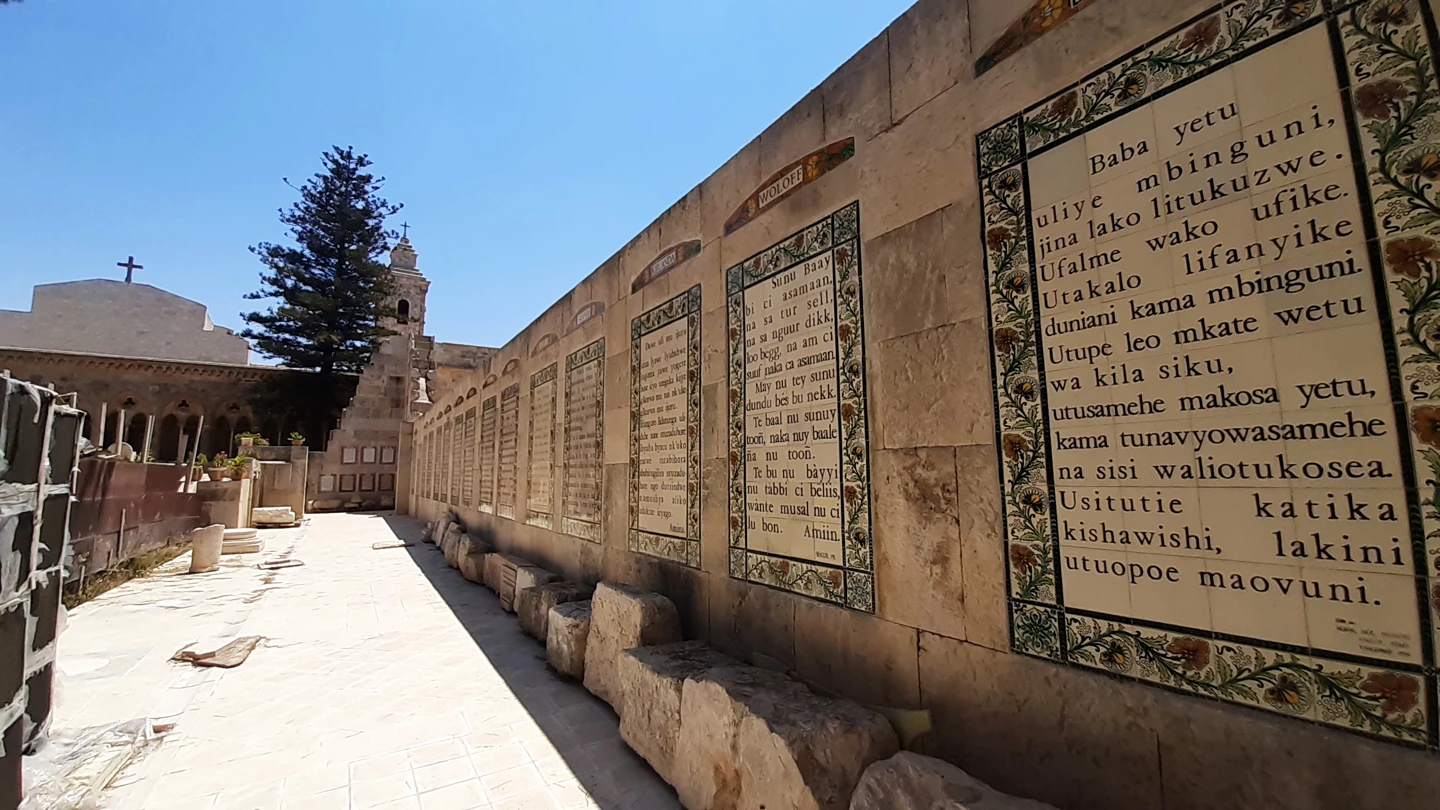
Prayer tablets at the Pater Noster church in Jerusalem, photographed on 1 August 2024. Commons explicitly classifies the photograph under Wolof, Sotho and Swahili signs. Multiple language panels share this image; not independently transcribed.
Saved in Babelbook · resized display copy. Select the image to open it independently of its source.
Zeller Zalmanson Pikiwiki Israel · Source ↗CC BY 2.5 ↗View the local visual field note
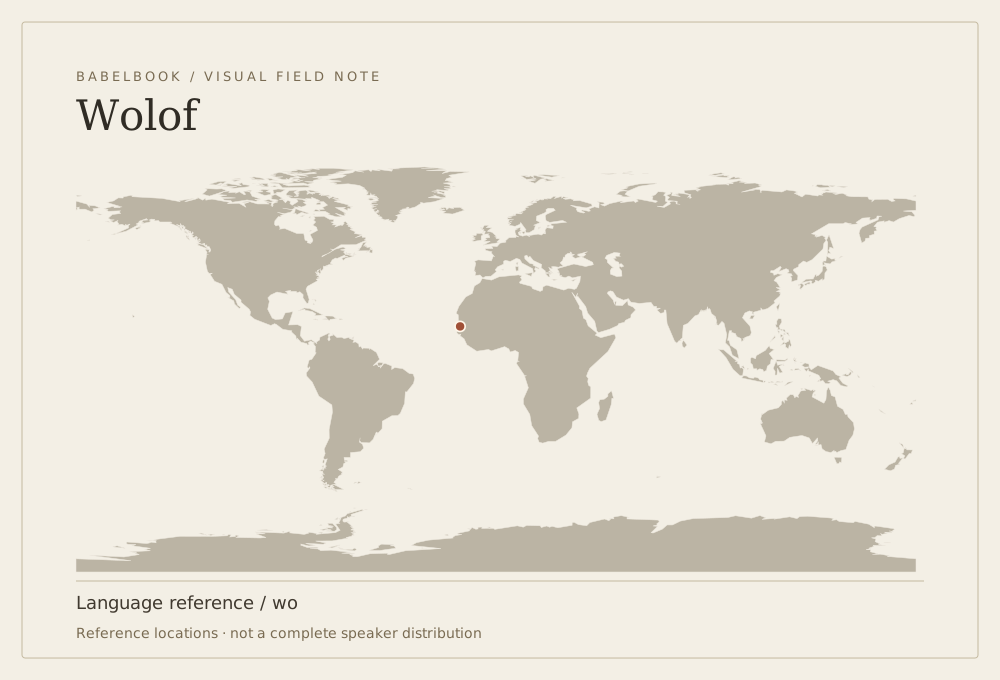
Representative reference points from Glottolog. Historical entries show reference locations, not current speakers. 1 point.
Reference & context ↗Babelbook · original editorial illustration · CC BY 4.0 · Glottolog locations; public-domain Natural Earth land
Source excerpts, selected, shortened and where noted editorially corrected from Wolof language by Wikipedia contributors. Retrieved 2026-10-05. CC BY-SA 4.0. These excerpts are not an independently verified scholarly history; missing accounts are identified above.
Read further in the source
Geographical distribution
Wolof is spoken by 18 million people and about 40% (8.2 million people) of Senegal's population speak Wolof as their native language. Increased mobility, and especially the growth of the capital Dakar, created the need for a common language: today, an additional 40 percent of the population speak Wolof as a second or acquired language. In the whole region from Dakar to Saint-Louis, and also west and southwest of Kaolack, Wolof is spoken by the vast majority of people. Typically when various ethnic groups in Senegal come together in cities and towns, they speak Wolof. It is therefore spoken in almost every regional and departmental capital in Senegal. Nevertheless, the official language of Senegal is French. In the Gambia, although about 20–25 percent of the population speak Wolof as a first language, it has a disproportionate influence because of its prevalence in Banjul, the Gambian capital, where 75 percent of the population use it as a first language. Furthermore, in Serekunda, the Gambia's largest town, although only a tiny minority are ethnic Wolofs, approximately 70 percent of the population speaks or understands Wolof. In Mauritania, about seven percent of the population (approximately 185,000 people) speak Wolof. Most live near or along the Senegal River that Mauritania shares with Senegal.
Orthography
The Latin orthography of Wolof in Senegal was set by government decrees between 1971 and 1985. The language institute "Centre de linguistique appliquée de Dakar" (CLAD) is widely acknowledged as an authority when it comes to spelling rules for Wolof. The complete alphabet is A, À, B, C, D, E, É, Ë, F, G, I, J, K, L, M, N, Ñ, Ŋ, O, Ó, P, Q, R, S, T, U, W, X, Y. The letters H, V, and Z are only used in foreign words. Wolof is most often written in this orthography, in which phonemes have a clear one-to-one correspondence to graphemes. Table below is the Wolof Latin alphabet and the corresponding phoneme. Highlighted letters are only used for loanwords and are not included in native Wolof words.
The Arabic-based script of Wolof, referred to as Wolofal, was set by the government as well, between 1985 and 1990, although never adopted by a decree, as the effort by the Senegalese ministry of education was to be part of a multi-national standardization effort. This alphabet has been used since pre-colonial times, as the first writing system to be adopted for Wolof, and is still used by many people, mainly Imams and their students in Quranic and Islamic schools.
Additionally, another script exists: Garay, an alphabetic script invented by Assane Faye in 1961, which has been adopted by a small number of Wolof speakers. The first syllable of words is stressed; long vowels are pronounced with more time but are not automatically stressed, as they are in English.