Classical Armenian
Classical Armenian (Armenian: գրաբար, romanized: grabar, Eastern Armenian pronunciation [ɡəɾɑˈpʰɑɾ], Western Armenian pronunciation [kʰəɾɑˈpʰɑɾ]; meaning "literary [language]"; also Old Armenian or Liturgical Armenian) is the oldest attested form of the Armenian language. It was first written down at the beginning of the 5th century, and most Armenian literature from then through the 18th century is in Classical Armenian. Many ancient manuscripts originally written in Ancient Greek, Hebrew, Syriac and Latin survive only in Armenian translation. Classical Armenian itself, in turn, was heavily influenced by the Iranian languages, in particular by Parthian. Classical Armenian continues to be the liturgical language of the Armenian Apostolic Church and the Armenian Catholic Church and is often learned by Biblical, Intertestamental, and Patristic scholars dedicated to textual studies. Classical Armenian is also important for the reconstruction of the Proto-Indo-European language.
Translate in Classical Armenian ↗Classical Armenian (Armenian: գրաբար, romanized: grabar, Eastern Armenian pronunciation [ɡəɾɑˈpʰɑɾ], Western Armenian pronunciation [kʰəɾɑˈpʰɑɾ]; meaning "literary [language]"; also Old Armenian or Liturgical Armenian) is the oldest attested form of the Armenian language. It was first written down at the beginning of the 5th century, and most Armenian literature from then through the 18th century is in Classical Armenian. Many ancient manuscripts originally written in Ancient Greek, Hebrew, Syriac and Latin survive only in Armenian translation. Classical Armenian itself, in turn, was heavily influenced by the Iranian languages, in particular by Parthian. Classical Armenian continues to be the liturgical language of the Armenian Apostolic Church and the Armenian Catholic Church and is often learned by Biblical, Intertestamental, and Patristic scholars dedicated to textual studies. Classical Armenian is also important for the reconstruction of the Proto-Indo-European language.
Europe
Present-day use
The captured source does not contain a separate current-use account.
Origins
The captured article does not contain a separate origins section. See the historical account and linked source.
Development
The captured article does not contain a distinct historical account. No chronology has been invented.
Writing
Armenian (catalog classification; see the source for context).
Beyond the typeface.
Signs, manuscripts, published pages and contextual photographs, with their place, period, source and reuse terms. Captions identify historical spellings, regional examples, community references and character imagery.
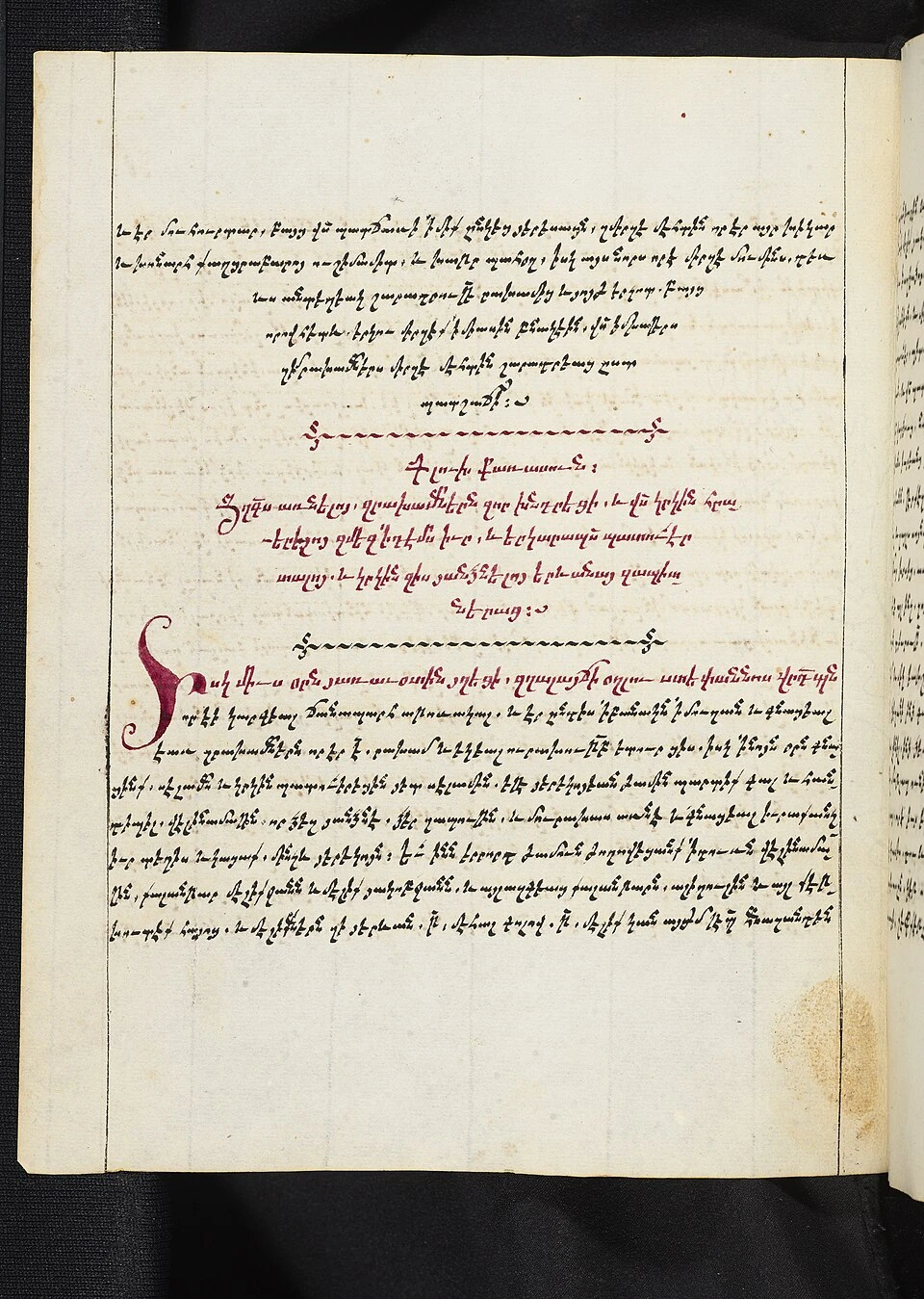
History by Abraham Kretac‘i, dated 1734–1736, Bodleian MS Arm. d.24. The source explicitly identifies Classical Armenian. The Commons derivative is cropped horizontally.
Saved in Babelbook · resized display copy. Select the image to open it independently of its source.
Abraham Kretac‘i; digitization Bodleian Libraries, University of Oxford; Commons crop LouisAragon · Source ↗CC BY 4.0 ↗View the local visual field note
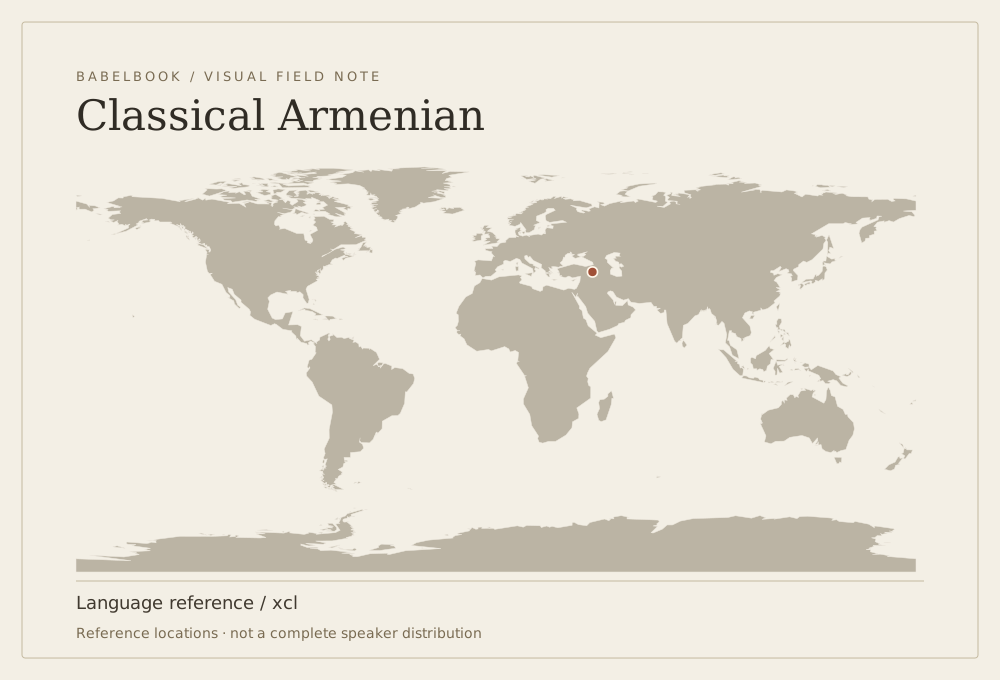
Representative reference points from Glottolog. Historical entries show reference locations, not current speakers. 1 point.
Reference & context ↗Babelbook · original editorial illustration · CC BY 4.0 · Glottolog locations; public-domain Natural Earth land
Source excerpts, selected, shortened and where noted editorially corrected from Classical Armenian by Wikipedia contributors. Retrieved 2026-10-05. CC BY-SA 4.0. These excerpts are not an independently verified scholarly history; missing accounts are identified above.