Xhosa
Xhosa ( KOH-sə, Xhosa: [ᵏǁʰôːsa] ), formerly spelled Xosa and also known by its endonym isiXhosa, is a Bantu language, indigenous to Southern Africa and one of the official languages of South Africa and Zimbabwe. Xhosa is spoken as a first language by approximately 8 million people and as a second language in South Africa, particularly in Eastern Cape, Western Cape, Northern Cape and Gauteng, and also in parts of Zimbabwe and Lesotho. It has perhaps the heaviest functional load of click consonants in a Bantu language (approximately tied with Yeyi), with one count finding that 10% of basic vocabulary items contained a click.
Translate in Xhosa ↗Xhosa is the most widely distributed African language in South Africa, though the most commonly spoken South African language is Zulu. Xhosa is the second most common Bantu home language in South Africa. As of 2003 approximately 5.3 million Xhosa-speakers, the majority, live in the Eastern Cape, followed by the Western Cape (approximately 1 million), Gauteng (671,045), the Free State (246,192), KwaZulu-Natal (219,826), North West (214,461), Mpumalanga (46,553), the Northern Cape (51,228), and Limpopo (14,225). There is a small but significant Xhosa community of about 200,000 in Zimbabwe. Also, a small community of Xhosa speakers (18,000) live in Quthing District, Lesotho.
Sub-Saharan Africa
Present-day use
The role of indigenous languages in South Africa is complex and ambiguous. Their use in education has been governed by legislation, beginning with the Bantu Education Act, 1953. At present, Xhosa is used as the main language of instruction in many primary schools and some secondary schools, but is largely replaced by English after the early primary grades, even in schools mainly serving Xhosa-speaking communities. The language is also studied as a subject in such schools. The language of instruction at universities in South Africa is English (or Afrikaans, to a diminishing extent), while Xhosa is taught as a subject, both for native and for non-native speakers. Literary works, including prose and poetry, are available in Xhosa, as are newspapers and magazines. The South African Broadcasting Corporation broadcasts in Xhosa on both radio (on Umhlobo Wenene FM) and television, and films, plays and music are also produced in the language. The best-known performer of Xhosa songs outside South Africa was Miriam Makeba, whose Click Song #1 (Xhosa Qongqothwane) and "Click Song #2" (Baxabene Ooxam) are known for their large number of click sounds. In 1996, the literacy rate for first-language Xhosa speakers was estimated at 50%.
Origins
The captured article does not contain a separate origins section. See the historical account and linked source.
Development
Xhosa-speaking people have inhabited coastal regions of southeastern Africa since before the 16th century. They refer to themselves as the amaXhosa and their language as isiXhosa. Ancestors of the Xhosa migrated to the east coast of Africa and came across Khoisan-speaking people; "as a result of this contact, the Xhosa people borrowed some Khoisan words along with their pronunciation, for instance, the click sounds of the Khoisan languages". The Bantu ancestor of Xhosa did not have clicks, which attests to a strong historical contact with a Khoisan language that did. An estimated 15% of Xhosa vocabulary is of Khoisan origin. Unlike many Khoisan languages, which have four places of click articulation, Xhosa has only three, missing the palatal clicks. However, and unusually for an Nguni language, Xhosa also has a full set of palatal pulmonic consonants. This inventory is similar to many of the Kalahari Khoe languages, especially in the east, which have a full set of palatal pulmonic consonants, and several of which have lost their palatal clicks as well. John Bennie was a Scottish Presbyterian missionary and early Xhosa linguist. Bennie, along with John Ross (another missionary), set up a printing press in the Tyhume Valley and the first printed works in Xhosa came out in 1823 from the Lovedale Press in the Alice region of the Eastern Cape. But, as with any language, Xhosa had a rich history of oral traditions from which the society taught, informed, and entertained one another. The first Bible translation was in 1859, produced in part by Henry Hare Dugmore.
Writing
The Xhosa language uses the 26 basic letters of the Latin alphabet, with digraphs, trigraphs, and even tetragraphs being used to represent some sounds. Tone, stress, and vowel length are generally not indicated in writing. For further details, see the phonology section below.
Beyond the typeface.
Signs, manuscripts, published pages and contextual photographs, with their place, period, source and reuse terms. Captions identify historical spellings, regional examples, community references and character imagery.
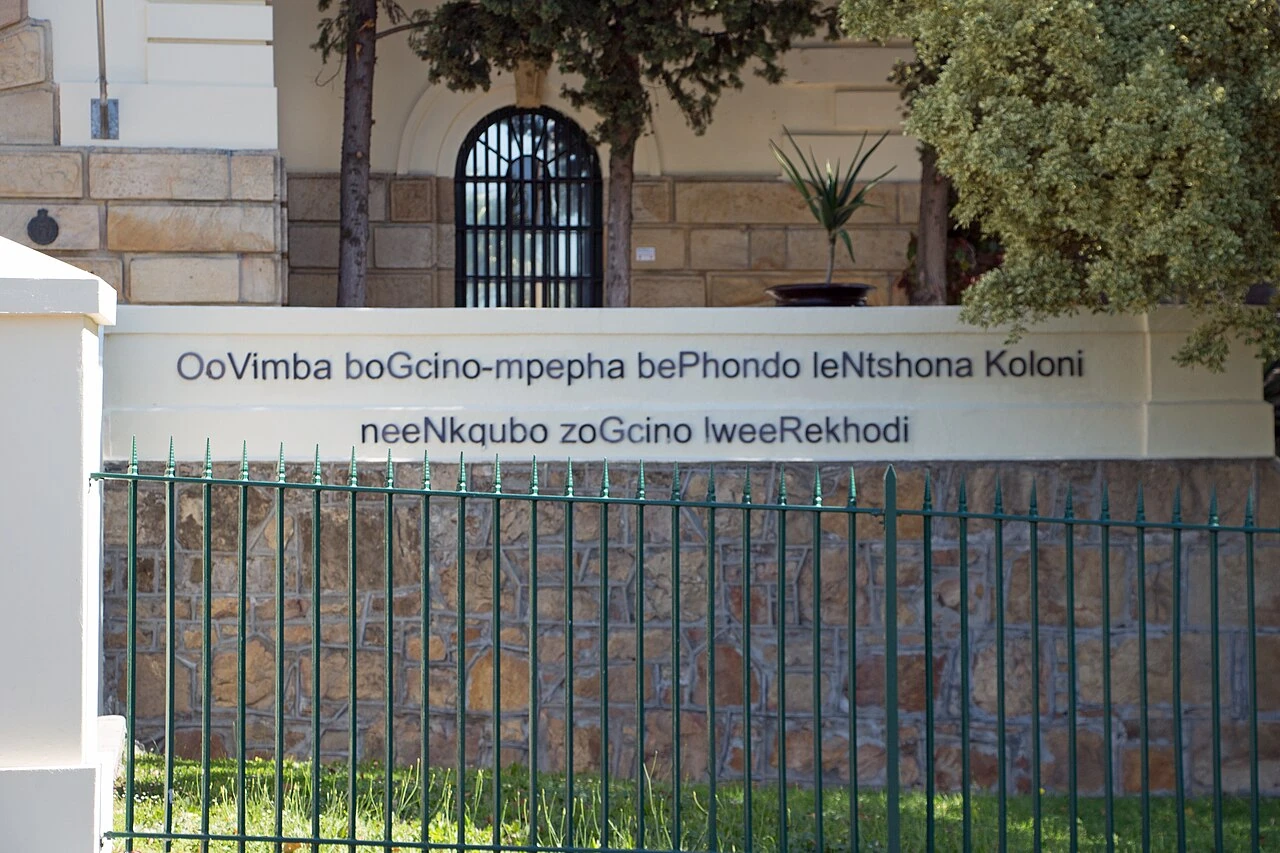
Signage at the Western Cape Archives and Records Service in Cape Town, catalogued as Xhosa-language signage.
Saved in Babelbook · resized display copy. Select the image to open it independently of its source.
HelenOnline (Helen Riding) · Source ↗CC BY-SA 4.0 ↗View the local visual field note
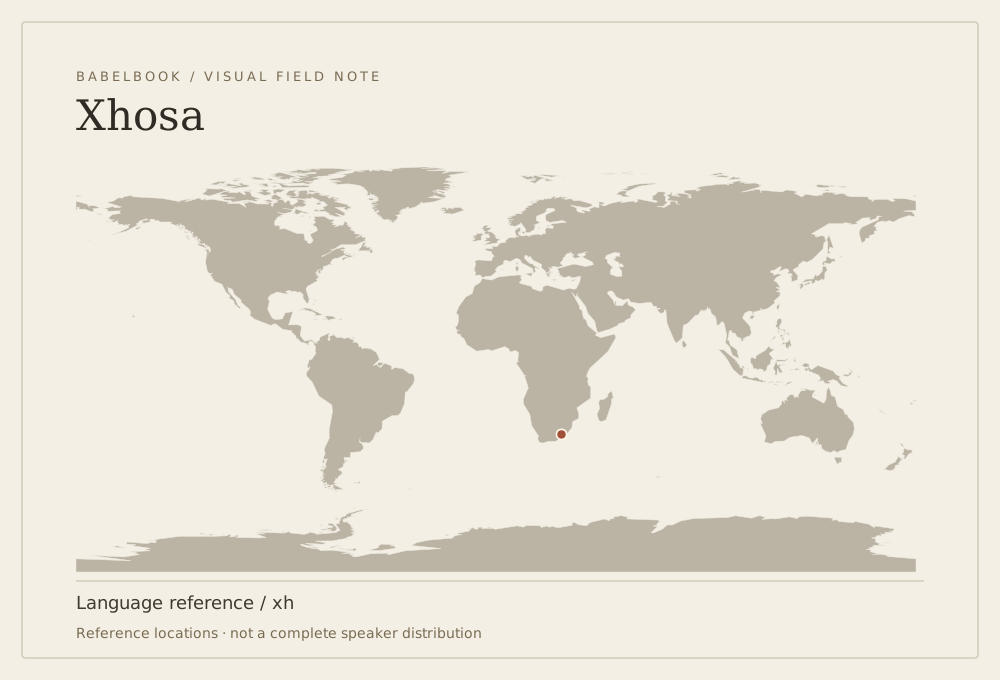
Representative reference points from Glottolog. Historical entries show reference locations, not current speakers. 1 point.
Reference & context ↗Babelbook · original editorial illustration · CC BY 4.0 · Glottolog locations; public-domain Natural Earth land
Source excerpts, selected, shortened and where noted editorially corrected from Xhosa language by Wikipedia contributors. Retrieved 2026-10-05. CC BY-SA 4.0. These excerpts are not an independently verified scholarly history; missing accounts are identified above.
Read further in the source
Geographical distribution
Xhosa is the most widely distributed African language in South Africa, though the most commonly spoken South African language is Zulu. Xhosa is the second most common Bantu home language in South Africa. As of 2003 approximately 5.3 million Xhosa-speakers, the majority, live in the Eastern Cape, followed by the Western Cape (approximately 1 million), Gauteng (671,045), the Free State (246,192), KwaZulu-Natal (219,826), North West (214,461), Mpumalanga (46,553), the Northern Cape (51,228), and Limpopo (14,225). There is a small but significant Xhosa community of about 200,000 in Zimbabwe. Also, a small community of Xhosa speakers (18,000) live in Quthing District, Lesotho.
History
Xhosa-speaking people have inhabited coastal regions of southeastern Africa since before the 16th century. They refer to themselves as the amaXhosa and their language as isiXhosa. Ancestors of the Xhosa migrated to the east coast of Africa and came across Khoisan-speaking people; "as a result of this contact, the Xhosa people borrowed some Khoisan words along with their pronunciation, for instance, the click sounds of the Khoisan languages". The Bantu ancestor of Xhosa did not have clicks, which attests to a strong historical contact with a Khoisan language that did. An estimated 15% of Xhosa vocabulary is of Khoisan origin. Unlike many Khoisan languages, which have four places of click articulation, Xhosa has only three, missing the palatal clicks. However, and unusually for an Nguni language, Xhosa also has a full set of palatal pulmonic consonants. This inventory is similar to many of the Kalahari Khoe languages, especially in the east, which have a full set of palatal pulmonic consonants, and several of which have lost their palatal clicks as well. John Bennie was a Scottish Presbyterian missionary and early Xhosa linguist. Bennie, along with John Ross (another missionary), set up a printing press in the Tyhume Valley and the first printed works in Xhosa came out in 1823 from the Lovedale Press in the Alice region of the Eastern Cape. But, as with any language, Xhosa had a rich history of oral traditions from which the society taught, informed, and entertained one another. The first Bible translation was in 1859, produced in part by Henry Hare Dugmore.