Yiddish
Yiddish, historically referred to as Judeo-German or Jewish German, is a West Germanic language and Jewish ethnolect historically spoken by Ashkenazi Jews. It originated in the Holy Roman Empire during the Middle Ages, and provided the nascent Ashkenazi community with a vernacular based on High German, fused with many elements taken from Hebrew (notably Mishnaic Hebrew) and to some extent Aramaic. Most varieties of Yiddish include elements of Slavic languages and the vocabulary contains traces of Romance languages. Yiddish has traditionally been written using the Hebrew alphabet. For centuries, Yiddish was the vernacular of Ashkenazi communities. Starting in the late 18th century, under the sway of the Haskalah (Jewish Enlightenment), the language suffered decreasing prestige, being stigmatized by assimilationists and later also by Zionists, in favor of national languages and Hebrew. Efforts by the Yiddishist movement to counter that trend had limited success. Nevertheless, before World War II, the language still counted 11–13 million speakers. Some 85% of the approximately six million Jews who were murdered in the Holocaust were Yiddish speakers, resulting in a massive decline in use of the language. This, together with further assimilation following World War II, along with aliyah (immigration to Israel), sped up the process of language shift to national tongues and Modern Hebrew, particularly among secular Jews. The number of Yiddish speakers is, however, on the rise in Haredi (ultra-Orthodox) communities.
Translate in Yiddish ↗On the eve of World War II, there were 11 to 13 million Yiddish speakers. The Holocaust, however, led to a dramatic, sudden decline in the use of Yiddish, as the eastern and central-European Jewish communities, both secular and religious, that extensively used Yiddish in their day-to-day life were largely destroyed. Around five million of those killed – 85 percent of the Jews murdered in the Holocaust – were speakers of Yiddish. Although millions of Yiddish speakers survived the war (including nearly all Yiddish speakers in the Americas), further assimilation in countries such as the United States and the Soviet Union, in addition to the strictly monolingual stance of the Haskalah and later Zionist movements, led to a decline in the use of Eastern Yiddish. However, the number of speakers within the widely dispersed Haredi (mainly Hasidic) communities is now increasing. Although used in various countries, Yiddish has attained official recognition as a minority language only in the Jewish Autonomous Oblast of Russia, Moldova, Bosnia and Herzegovina, the Netherlands, and Sweden. Reports of the number of current Yiddish speakers vary significantly. Ethnologue estimates, based on publications through 1991, that there were at that time 1.5 million speakers of Eastern Yiddish, of which 40% lived in Ukraine, 15% in Israel, and 10% in the United States. The Modern Language Association agrees with fewer than 200,000 in the United States. Western Yiddish is reported by Ethnologue to have had an ethnic population of 50,000 in 2000, and an undated speaking population of 5,400, mostly in Germany. A 1996 report by the Council of Europe estimates a worldwide Yiddish-speaking population of about two million.
Europe
Present-day use
Historically, there have been frequent debates about the extent of the linguistic independence of Yiddish from the languages that it absorbed. There has been periodic assertion that Yiddish is a dialect of German, or even "just broken German, more of a linguistic mishmash than a true language". Even when recognized as an autonomous language, it has occasionally been referred to, typically by people foreign to the language, as Judeo-German, along the lines of other Jewish languages like Judeo-Persian, Judeo-Spanish or Judeo-French. A widely cited summary of attitudes in the 1930s was published by Max Weinreich, quoting a remark by an auditor of one of his lectures: אַ שפּראַך איז אַ דיאַלעקט מיט אַן אַרמיי און פֿלאָט (a shprakh iz a dialekt mit an armey un flot — "A language is a dialect with an army and navy"). Today's speakers consider Yiddish a separate language, officially recognized as such in the USSR (where it was viewed as "the Jewish language"), post-Soviet Russia and Sweden, thus complying to Max Weinreich's notion of official state recognition. Virtually all specialists working in the field of Yiddish view it as a separate language, including researchers and teachers who study and teach Yiddish in German-speaking countries. For centuries, Yiddish has been developing in countries separated from the German language space and has its own system of dialects. Contemporary debates on this subject are almost exclusively limited to the nature of medieval and early modern texts written in Western Yiddish dialects that seem much closer to varieties of German than today's Eastern Yiddish. There has been a resurgence in Yiddish learning in recent times among many from around the world with Jewish ancestry. The language which had lost many of its native speakers during the Holocaust has been making something of a comeback. In Poland, which traditionally had Yiddish speaking communities, a museum has begun to revive Yiddish education and culture.
Origins
By the 10th century, a distinctive Jewish culture had formed in Central Europe. By the high medieval period, their area of settlement, centered on the Rhineland (Mainz) and the Palatinate (notably Worms and Speyer), came to be known as Ashkenaz, a term also used for Scythia, and later of various areas of Eastern Europe and Anatolia. In the medieval Hebrew of Rashi (d. 1105), Ashkenaz becomes a term for Germany and Ashkenazi (אשכּנזי) for the Jews settling in this area. Ashkenaz bordered on the area inhabited by another distinctive Jewish cultural group, the Sephardi Jews, who ranged into southern France. Ashkenazi culture later spread into Eastern Europe with large-scale population migrations. Nothing is known with certainty about the vernacular of the earliest Jews in Germany, but several theories have been put forward. As noted above, the first language of the Ashkenazim may have been Aramaic, the vernacular of the Jews in Roman-era Judea and ancient and early medieval Mesopotamia. The widespread use of Aramaic among the large non-Jewish Syrian trading population of the Roman provinces, including those in Europe, would have reinforced the use of Aramaic among Jews engaged in trade. In Roman times, many of the Jews living in Rome and Southern Italy appear to have been Greek-speakers, and this is reflected in some Ashkenazi personal names (such as Kalonymos and Yiddish Todres). Hebrew, on the other hand, was regarded as a holy language reserved for ritual and spiritual purposes and not for common use. The established view is that, as with other Jewish languages, Jews speaking distinct languages learned new co-territorial vernaculars, which they then Judaized. In the case of Yiddish, this scenario sees it as emerging when speakers of Zarphatic (Judeo-French) and other Judeo-Romance languages began to acquire varieties of Middle High German, and from these groups the Ashkenazi community took shape.
Development
The captured article does not contain a distinct historical account. No chronology has been invented.
Writing
Yiddish orthography developed towards the end of the High Medieval period. It is first recorded in 1272, with the oldest surviving literary document in Yiddish, a blessing found in the Worms machzor (a Hebrew prayer book). This brief rhyme is decoratively embedded in an otherwise purely Hebrew text. Nonetheless, it indicates that the Yiddish of that day was a more or less regular Middle High German written in the Hebrew alphabet into which Hebrew words – מַחֲזוֹר, makhzor (prayerbook for the High Holy Days) and בֵּיתֿ הַכְּנֶסֶתֿ, 'synagogue' (read in Yiddish as beis hakneses) – had been included. The niqqud appears as though it might have been added by a second scribe, in which case it may need to be dated separately and may not be indicative of the pronunciation of the rhyme at the time of its initial annotation. Over the 14th and 15th centuries, songs and poems in Yiddish, and macaronic pieces in Hebrew and German, began to appear. These were collected in the late 15th century by Menahem ben Naphtali Oldendorf. During the same period, a tradition seems to have emerged of the Jewish community's adapting its own versions of German secular literature. The earliest Yiddish epic poem of this sort is the Dukus Horant, which survives in the famous Cambridge Codex T.-S.10.K.22. This 14th-century manuscript was discovered in the Cairo Geniza in 1896, and also contains a collection of narrative poems on themes from the Hebrew Bible and the Haggadah. Yiddish is written in the Hebrew alphabet, but its orthography differs significantly from that of Hebrew. In Hebrew, many vowels are represented only optionally by diacritical marks called niqqud whereas Yiddish uses letters to represent all vowels. Several Yiddish letters consist of another letter combined with a niqqud mark resembling a Hebrew letter–niqqud pair, but each of those combinations is an inseparable unit representing a vowel alone, not a consonant–vowel sequence.
Beyond the typeface.
Signs, manuscripts, published pages and contextual photographs, with their place, period, source and reuse terms. Captions identify historical spellings, regional examples, community references and character imagery.
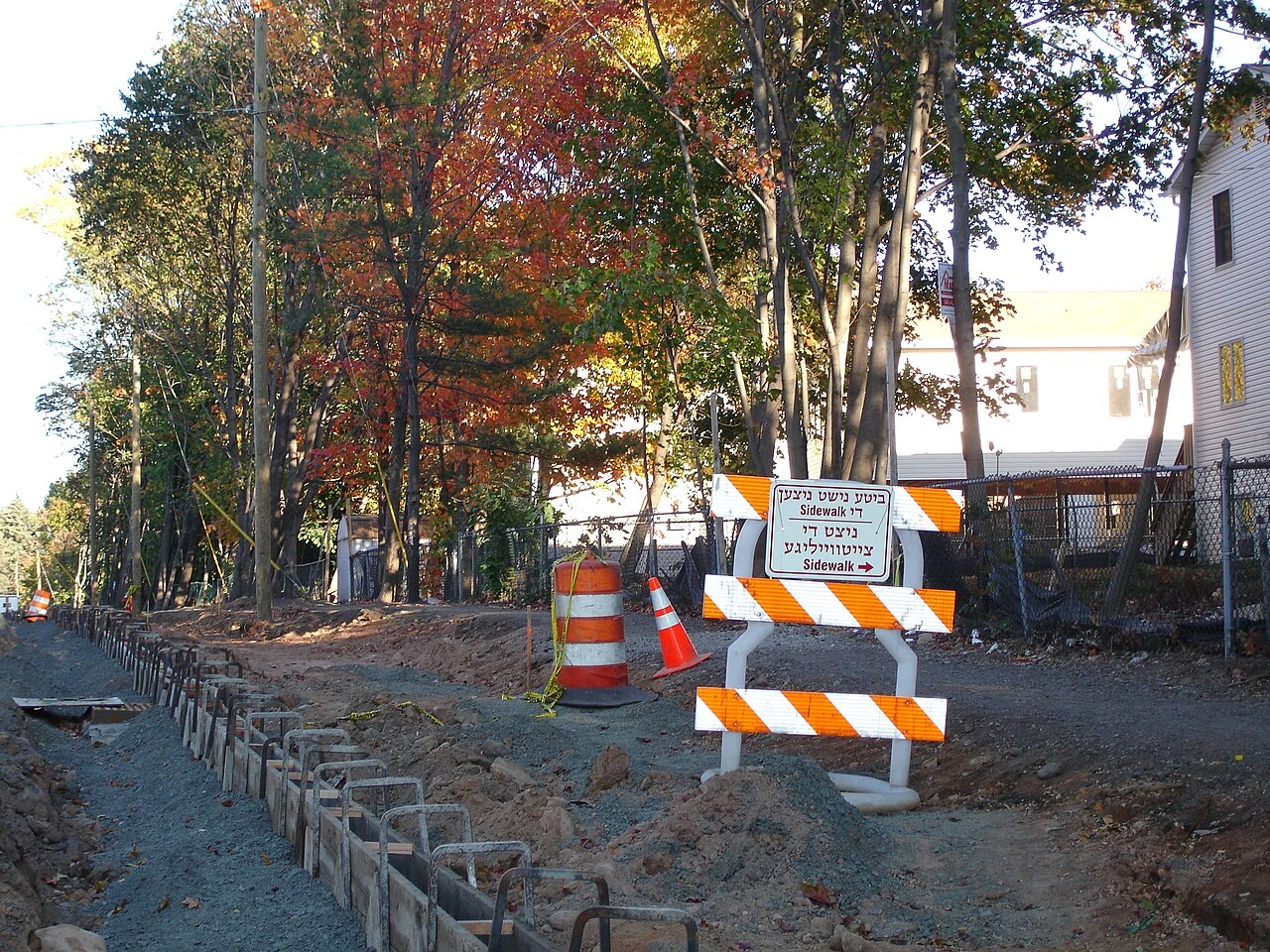
Yiddish sidewalk-diversion notice at a construction site in Monsey, New York, photographed in October 2008. Language identification follows Commons descriptions or categories; not independently transcribed.
Saved in Babelbook · resized display copy. Select the image to open it independently of its source.
History craver · Source ↗Public domain — author release ↗View the local visual field note
Representative reference points from Glottolog. Historical entries show reference locations, not current speakers. 2 points.
Reference & context ↗Babelbook · original editorial illustration · CC BY 4.0 · Glottolog locations; public-domain Natural Earth land
Source excerpts, selected, shortened and where noted editorially corrected from Yiddish by Wikipedia contributors. Retrieved 2026-10-05. CC BY-SA 4.0. These excerpts are not an independently verified scholarly history; missing accounts are identified above.
Read further in the source
Origins
By the 10th century, a distinctive Jewish culture had formed in Central Europe. By the high medieval period, their area of settlement, centered on the Rhineland (Mainz) and the Palatinate (notably Worms and Speyer), came to be known as Ashkenaz, a term also used for Scythia, and later of various areas of Eastern Europe and Anatolia. In the medieval Hebrew of Rashi (d. 1105), Ashkenaz becomes a term for Germany and Ashkenazi (אשכּנזי) for the Jews settling in this area. Ashkenaz bordered on the area inhabited by another distinctive Jewish cultural group, the Sephardi Jews, who ranged into southern France. Ashkenazi culture later spread into Eastern Europe with large-scale population migrations. Nothing is known with certainty about the vernacular of the earliest Jews in Germany, but several theories have been put forward. As noted above, the first language of the Ashkenazim may have been Aramaic, the vernacular of the Jews in Roman-era Judea and ancient and early medieval Mesopotamia. The widespread use of Aramaic among the large non-Jewish Syrian trading population of the Roman provinces, including those in Europe, would have reinforced the use of Aramaic among Jews engaged in trade. In Roman times, many of the Jews living in Rome and Southern Italy appear to have been Greek-speakers, and this is reflected in some Ashkenazi personal names (such as Kalonymos and Yiddish Todres). Hebrew, on the other hand, was regarded as a holy language reserved for ritual and spiritual purposes and not for common use. The established view is that, as with other Jewish languages, Jews speaking distinct languages learned new co-territorial vernaculars, which they then Judaized. In the case of Yiddish, this scenario sees it as emerging when speakers of Zarphatic (Judeo-French) and other Judeo-Romance languages began to acquire varieties of Middle High German, and from these groups the Ashkenazi community took shape. Exactly what German substrate underlies the earliest form of Yiddish is disputed. The Jewish community in the Rhineland would have encountered the Middle High German dialects from which the Rhenish German dialects of the modern period would emerge. Jewish communities of the high medieval period would have been speaking their own versions of these German dialects, mixed with linguistic elements that they themselves brought into the region, including many Hebrew and Aramaic words, but there is also Romance. In Max Weinreich's model, Jewish speakers of Old French or Old Italian who were literate in either liturgical Hebrew or Aramaic, or both, migrated through Southern Europe to settle in the Rhine Valley in an area known as Lotharingia (later known in Yiddish as Loter) extending over parts of Germany and France. There, they encountered and were influenced by Jewish speakers of High German languages and several other German dialects. Both Weinreich and Solomon Birnbaum developed this model further in the mid-1950s. In Weinreich's view, this Old Yiddish substrate later bifurcated into two distinct versions of the language, Western and Eastern Yiddish. They retained the Semitic vocabulary and constructions needed for religious purposes and created a Judeo-German form of speech, sometimes not accepted as a fully autonomous language.
Later linguistic research has refined the Weinreich model or provided alternative approaches to the language's origins, with points of contention being the characterization of its Germanic base, the source of its Hebrew/Aramaic adstrata, and the means and location of this fusion. Some theorists argue that the fusion occurred with a Bavarian dialect base. The two main candidates for the germinal matrix of Yiddish, the Rhineland and Bavaria, are not necessarily incompatible. There may have been parallel developments in the two regions, seeding the Western and Eastern dialects of Modern Yiddish. Dovid Katz proposes that Yiddish emerged from contact between speakers of High German and Aramaic-speaking Jews from the Middle East. The lines of development proposed by the different theories do not necessarily rule out the others (at least not entirely); an article in The Forward argues that "in the end, a new 'standard theory' of Yiddish's origins will probably be based on the work of Weinreich and his challengers alike." Paul Wexler proposed a model in 1991 that took Yiddish, by which he means primarily eastern Yiddish, not to be genetically grounded in a Germanic language at all, but rather as "Judeo-Sorbian" (a proposed West Slavic language) that had been relexified by High German. In more recent work, Wexler has argued that Eastern Yiddish is unrelated genetically to Western Yiddish. Wexler's model has been met with little academic support, and strong critical challenges, especially among historical linguists.
Written evidence
Yiddish orthography developed towards the end of the High Medieval period. It is first recorded in 1272, with the oldest surviving literary document in Yiddish, a blessing found in the Worms machzor (a Hebrew prayer book).
This brief rhyme is decoratively embedded in an otherwise purely Hebrew text. Nonetheless, it indicates that the Yiddish of that day was a more or less regular Middle High German written in the Hebrew alphabet into which Hebrew words – מַחֲזוֹר, makhzor (prayerbook for the High Holy Days) and בֵּיתֿ הַכְּנֶסֶתֿ, 'synagogue' (read in Yiddish as beis hakneses) – had been included. The niqqud appears as though it might have been added by a second scribe, in which case it may need to be dated separately and may not be indicative of the pronunciation of the rhyme at the time of its initial annotation. Over the 14th and 15th centuries, songs and poems in Yiddish, and macaronic pieces in Hebrew and German, began to appear. These were collected in the late 15th century by Menahem ben Naphtali Oldendorf. During the same period, a tradition seems to have emerged of the Jewish community's adapting its own versions of German secular literature. The earliest Yiddish epic poem of this sort is the Dukus Horant, which survives in the famous Cambridge Codex T.-S.10.K.22. This 14th-century manuscript was discovered in the Cairo Geniza in 1896, and also contains a collection of narrative poems on themes from the Hebrew Bible and the Haggadah.
Dialectal variation
Stressed vowels in the Yiddish dialects may be understood by considering their common origins in the Proto-Yiddish sound system. Yiddish linguistic scholarship uses a system developed by Max Weinreich in 1960 to indicate the descendent diaphonemes of the Proto-Yiddish stressed vowels. Each Proto-Yiddish vowel is given a unique two-digit identifier, and its reflexes use it as a subscript, for example, Southeastern o11 is the vowel /o/, descended from Proto-Yiddish */a/. The first digit indicates Proto-Yiddish quality (1-=*[a], 2-=*[e], 3-=*[i], 4-=*[o], 5-=*[u]), and the second refers to quantity or diphthongization (−1=short, −2=long, −3=short but lengthened early in the history of Yiddish, −4=diphthong, −5=special length occurring only in Proto-Yiddish vowel 25). Vowels 23, 33, 43 and 53 have the same reflexes as 22, 32, 42 and 52 in all Yiddish dialects, but they developed distinct values in Middle High German; Katz (1987) argues that they should be collapsed with the −2 series, leaving only 13 in the −3 series.
Writing system
Yiddish is written in the Hebrew alphabet, but its orthography differs significantly from that of Hebrew. In Hebrew, many vowels are represented only optionally by diacritical marks called niqqud whereas Yiddish uses letters to represent all vowels. Several Yiddish letters consist of another letter combined with a niqqud mark resembling a Hebrew letter–niqqud pair, but each of those combinations is an inseparable unit representing a vowel alone, not a consonant–vowel sequence. The niqqud marks have no phonetic value on their own. In most varieties of Yiddish, however, words borrowed from Hebrew are written in their native forms without application of Yiddish orthographical conventions.
Numbers of speakers
On the eve of World War II, there were 11 to 13 million Yiddish speakers. The Holocaust, however, led to a dramatic, sudden decline in the use of Yiddish, as the eastern and central-European Jewish communities, both secular and religious, that extensively used Yiddish in their day-to-day life were largely destroyed. Around five million of those killed – 85 percent of the Jews murdered in the Holocaust – were speakers of Yiddish. Although millions of Yiddish speakers survived the war (including nearly all Yiddish speakers in the Americas), further assimilation in countries such as the United States and the Soviet Union, in addition to the strictly monolingual stance of the Haskalah and later Zionist movements, led to a decline in the use of Eastern Yiddish. However, the number of speakers within the widely dispersed Haredi (mainly Hasidic) communities is now increasing. Although used in various countries, Yiddish has attained official recognition as a minority language only in the Jewish Autonomous Oblast of Russia, Moldova, Bosnia and Herzegovina, the Netherlands, and Sweden. Reports of the number of current Yiddish speakers vary significantly. Ethnologue estimates, based on publications through 1991, that there were at that time 1.5 million speakers of Eastern Yiddish, of which 40% lived in Ukraine, 15% in Israel, and 10% in the United States. The Modern Language Association agrees with fewer than 200,000 in the United States. Western Yiddish is reported by Ethnologue to have had an ethnic population of 50,000 in 2000, and an undated speaking population of 5,400, mostly in Germany. A 1996 report by the Council of Europe estimates a worldwide Yiddish-speaking population of about two million. Further demographic information about the recent status of what is treated as an Eastern–Western dialect continuum is provided in the YIVO Language and Cultural Atlas of Ashkenazic Jewry. In a study in the first half of 2024, the German media association Internationale Medienhilfe (IMH) found that the number of Yiddish media is increasing again, due to an increase in the Yiddish-speaking population, especially in the USA. According to IMH estimates, the number of speakers worldwide is approaching two million. In 2024, more than 40 print media were published worldwide in Yiddish - and the trend is rising. The 1922 census of Palestine lists 1,946 Yiddish speakers in Mandatory Palestine (9 in the Southern District, 1,401 in Jerusalem-Jaffa, 4 in Samaria, and 532 in the Northern District), including 1,759 in municipal areas (999 in Jerusalem, 356 in Jaffa, 332 in Haifa, 5 in Gaza, 4 in Hebron, 3 in Nazareth, 7 in Ramleh, 33 in Tiberias, and 4 in Jenin). In the Hasidic communities of Israel, boys speak more Yiddish amongst themselves, while girls use Hebrew more often. This is probably due to the tendency of girls to learn more secular subjects, thus increasing their contact with the Hebrew language, while boys are usually taught religious subjects in Yiddish.
Status as a language
Historically, there have been frequent debates about the extent of the linguistic independence of Yiddish from the languages that it absorbed. There has been periodic assertion that Yiddish is a dialect of German, or even "just broken German, more of a linguistic mishmash than a true language". Even when recognized as an autonomous language, it has occasionally been referred to, typically by people foreign to the language, as Judeo-German, along the lines of other Jewish languages like Judeo-Persian, Judeo-Spanish or Judeo-French. A widely cited summary of attitudes in the 1930s was published by Max Weinreich, quoting a remark by an auditor of one of his lectures: אַ שפּראַך איז אַ דיאַלעקט מיט אַן אַרמיי און פֿלאָט (a shprakh iz a dialekt mit an armey un flot — "A language is a dialect with an army and navy"). Today's speakers consider Yiddish a separate language, officially recognized as such in the USSR (where it was viewed as "the Jewish language"), post-Soviet Russia and Sweden, thus complying to Max Weinreich's notion of official state recognition. Virtually all specialists working in the field of Yiddish view it as a separate language, including researchers and teachers who study and teach Yiddish in German-speaking countries. For centuries, Yiddish has been developing in countries separated from the German language space and has its own system of dialects. Contemporary debates on this subject are almost exclusively limited to the nature of medieval and early modern texts written in Western Yiddish dialects that seem much closer to varieties of German than today's Eastern Yiddish.
Present U.S. speaker population
In the 2000 United States census, 178,945 people in the United States reported speaking Yiddish at home. Of these speakers, 113,515 lived in New York (63.43% of American Yiddish speakers); 18,220 in Florida (10.18%); 9,145 in New Jersey (5.11%); and 8,950 in California (5.00%). The remaining states with speaker populations larger than 1,000 are Pennsylvania (5,445), Ohio (1,925), Michigan (1,945), Massachusetts (2,380), Maryland (2,125), Illinois (3,510), Connecticut (1,710), and Arizona (1,055). The population is largely elderly: 72,885 of the speakers were older than 65, 66,815 were between 18 and 64, and only 39,245 were age 17 or lower. In the six years since the 2000 census, the 2006 American Community Survey reflected an estimated 15 percent decline of people speaking Yiddish at home in the U.S. to 152,515. In 2011, the number of persons in the United States above the age of five speaking Yiddish at home was 160,968. 88% of them were living in four metropolitan areas – New York City and another metropolitan area just north of it, Miami, and Los Angeles. There are a few predominantly Hasidic communities in the United States in which Yiddish remains the majority language including concentrations in the Crown Heights, Borough Park, and Williamsburg neighborhoods of Brooklyn. In Kiryas Joel in Orange County, New York, in the 2000 census, nearly 90% of residents of Kiryas Joel reported speaking Yiddish at home.