Yoruba
Yoruba (; Yor. Èdè Yorùbá [èdè jōɾùbá]) is an Atlantic–Congo language that is spoken in West Africa, primarily in South West Nigeria, Benin, and parts of Togo. It is spoken by the Yoruba people. Yoruba speakers number roughly 50 million, including around 2 million second-language or L2 speakers. As a pluricentric language, it is primarily spoken in a dialectal area spanning Nigeria, Benin, and Togo with smaller migrated communities in Côte d'Ivoire, Sierra Leone and Gambia. Yoruba vocabulary is also used in African diaspora religions such as the Afro-Brazilian religions of Candomblé and Umbanda, the Caribbean religion of Santería in the form of the liturgical Lucumí language, and various Afro-American religions of North America. Among modern practitioners of these religions in the Americas, Yorùbá-derived lexicon is used as a liturgical language, as almost all practitioners of these Diaspora manifestations are not fluent in it, yet they still use Yorùbá words and phrases for songs or chants, which are rooted in cultural traditions. For such practitioners, the Yorùbá-derived lexicon is especially common for ritual purposes, and these modern manifestations have taken new forms that do not depend on vernacular fluency. As the principal Yoruboid language, Yoruba is most closely related to Itsekiri (spoken in the Niger Delta) and Igala (spoken in central Nigeria).
Translate in Yoruba ↗Yoruba (; Yor. Èdè Yorùbá [èdè jōɾùbá]) is an Atlantic–Congo language that is spoken in West Africa, primarily in South West Nigeria, Benin, and parts of Togo. It is spoken by the Yoruba people. Yoruba speakers number roughly 50 million, including around 2 million second-language or L2 speakers. As a pluricentric language, it is primarily spoken in a dialectal area spanning Nigeria, Benin, and Togo with smaller migrated communities in Côte d'Ivoire, Sierra Leone and Gambia. Yoruba vocabulary is also used in African diaspora religions such as the Afro-Brazilian religions of Candomblé and Umbanda, the Caribbean religion of Santería in the form of the liturgical Lucumí language, and various Afro-American religions of North America. Among modern practitioners of these religions in the Americas, Yorùbá-derived lexicon is used as a liturgical language, as almost all practitioners of these Diaspora manifestations are not fluent in it, yet they still use Yorùbá words and phrases for songs or chants, which are rooted in cultural traditions. For such practitioners, the Yorùbá-derived lexicon is especially common for ritual purposes, and these modern manifestations have taken new forms that do not depend on vernacular fluency. As the principal Yoruboid language, Yoruba is most closely related to Itsekiri (spoken in the Niger Delta) and Igala (spoken in central Nigeria).
Sub-Saharan Africa
Present-day use
The captured source does not contain a separate current-use account.
Origins
The captured article does not contain a separate origins section. See the historical account and linked source.
Development
Yoruba is classified among the Edekiri languages, which together with Itsekiri and the isolate Igala form the Yoruboid group of languages within the Volta–Niger branch of the Niger–Congo family. The linguistic unity of the Niger–Congo family dates to deep pre-history, with estimates ranging around 11,000 years ago (the end of the Upper Paleolithic). In present-day Nigeria, it is estimated that there are around 50 million Yoruba primary and secondary language speakers, as well as several other millions of speakers outside Nigeria, making it the most widely spoken African language outside of the continent. There is a substantial body of literature in the Yoruba language, including books, newspapers, and pamphlets. Yoruba is used in radio and television broadcasting and is taught at primary, secondary, and tertiary levels. Historically, Yoruba was spoken by many slaves trafficked to the Americas, particularly Latin America, during the latter period of the Atlantic slave trade.
Writing
The earliest evidence of the presence of Islam in Yorubaland goes back to the 14th century. The earliest documented history of the people, traced to the latter part of the 17th century, was in Yoruba but in the Arabic script called Ajami. This makes Yoruba one of the oldest African languages with an attested history of Ajami (Cf. Mumin & Versteegh 2014; Hofheinz 2018). However, the oldest extant Yoruba Ajami exemplar is a 19th-century Islamic verse (waka) by Badamasi Agbaji (d. 1895– Hunwick 1995). There are several items of Yoruba Ajami in poetry, personal notes, and esoteric knowledge (Cf. Bang 2019). Nevertheless, Yoruba Ajami remained idiosyncratic and not socially diffused, as no standardized orthography existed. The plethora of dialects and the absence of a central promotional institution, among others, are responsible. In the 17th century, Yoruba was written in the Ajami script, a form of Arabic script. It is still written in the Ajami writing script in some Islamic circles. Standard Yoruba orthography originated in the early work of Church Mission Society missionaries working among the Aku (Yoruba) of Freetown. One of their informants was Crowther, who later would proceed to work on his native language himself. In early grammar primers and translations of portions of the English Bible, Crowther used the Latin alphabet largely without tone markings. The only diacritic used was a dot below certain vowels to signify their open variants [ɛ] and [ɔ], viz. ⟨ẹ⟩ and ⟨ọ⟩. Over the years, the orthography was revised to represent tone, among other things.
Beyond the typeface.
Signs, manuscripts, published pages and contextual photographs, with their place, period, source and reuse terms. Captions identify historical spellings, regional examples, community references and character imagery.
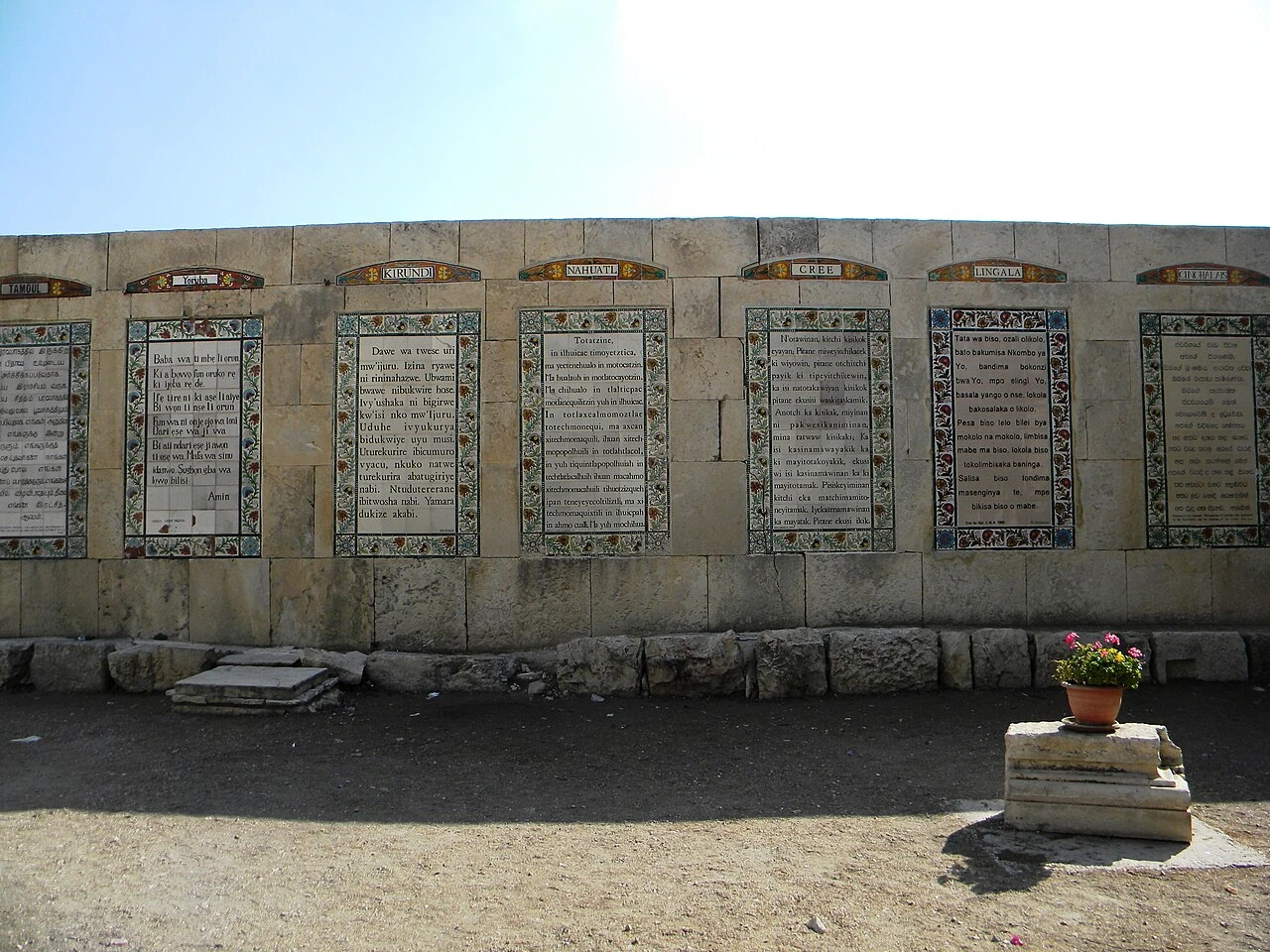
Multilingual prayer tablets at the Pater Noster church in Jerusalem, photographed on 23 October 2014. Commons explicitly classifies the photograph as containing Yoruba writing. Not independently transcribed; multiple language panels share the image.
Saved in Babelbook · resized display copy. Select the image to open it independently of its source.
Britchi Mirela · Source ↗CC BY-SA 4.0 ↗View the local visual field note
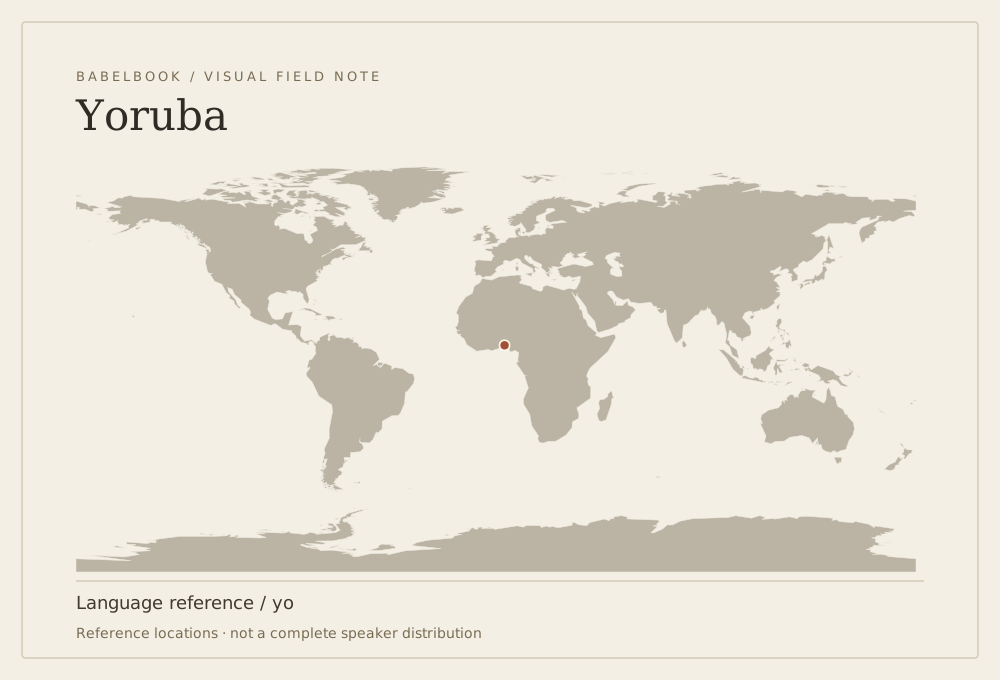
Representative reference points from Glottolog. Historical entries show reference locations, not current speakers. 1 point.
Reference & context ↗Babelbook · original editorial illustration · CC BY 4.0 · Glottolog locations; public-domain Natural Earth land
Source excerpts, selected, shortened and where noted editorially corrected from Yoruba language by Wikipedia contributors. Retrieved 2026-10-05. CC BY-SA 4.0. These excerpts are not an independently verified scholarly history; missing accounts are identified above.
Read further in the source
History
Yoruba is classified among the Edekiri languages, which together with Itsekiri and the isolate Igala form the Yoruboid group of languages within the Volta–Niger branch of the Niger–Congo family. The linguistic unity of the Niger–Congo family dates to deep pre-history, with estimates ranging around 11,000 years ago (the end of the Upper Paleolithic). In present-day Nigeria, it is estimated that there are around 50 million Yoruba primary and secondary language speakers, as well as several other millions of speakers outside Nigeria, making it the most widely spoken African language outside of the continent. There is a substantial body of literature in the Yoruba language, including books, newspapers, and pamphlets. Yoruba is used in radio and television broadcasting and is taught at primary, secondary, and tertiary levels. Historically, Yoruba was spoken by many slaves trafficked to the Americas, particularly Latin America, during the latter period of the Atlantic slave trade.
Writing systems
The earliest evidence of the presence of Islam in Yorubaland goes back to the 14th century. The earliest documented history of the people, traced to the latter part of the 17th century, was in Yoruba but in the Arabic script called Ajami. This makes Yoruba one of the oldest African languages with an attested history of Ajami (Cf. Mumin & Versteegh 2014; Hofheinz 2018). However, the oldest extant Yoruba Ajami exemplar is a 19th-century Islamic verse (waka) by Badamasi Agbaji (d. 1895– Hunwick 1995). There are several items of Yoruba Ajami in poetry, personal notes, and esoteric knowledge (Cf. Bang 2019). Nevertheless, Yoruba Ajami remained idiosyncratic and not socially diffused, as no standardized orthography existed. The plethora of dialects and the absence of a central promotional institution, among others, are responsible. In the 17th century, Yoruba was written in the Ajami script, a form of Arabic script. It is still written in the Ajami writing script in some Islamic circles. Standard Yoruba orthography originated in the early work of Church Mission Society missionaries working among the Aku (Yoruba) of Freetown. One of their informants was Crowther, who later would proceed to work on his native language himself. In early grammar primers and translations of portions of the English Bible, Crowther used the Latin alphabet largely without tone markings. The only diacritic used was a dot below certain vowels to signify their open variants [ɛ] and [ɔ], viz. ⟨ẹ⟩ and ⟨ọ⟩. Over the years, the orthography was revised to represent tone, among other things. In 1875, the Church Missionary Society (CMS) organized a conference on Yoruba Orthography; the standard devised there was the basis for the orthography of the steady flow of religious and educational literature over the next seventy years. The current orthography of Yoruba derives from a 1966 report of the Yoruba Orthography Committee, along with Ayọ Bamgboṣe's 1965 Yoruba Orthography, a study of the earlier orthographies and an attempt to bring Yoruba orthography in line with actual speech as much as possible. Still similar to the older orthography, it employs the Latin alphabet modified by the use of the digraph ⟨gb⟩ and certain diacritics, including the underdots under the letters ⟨ẹ⟩, ⟨ọ⟩, and ⟨ṣ⟩. Previously, the vertical line had been used to avoid the mark being fully covered by an underline, as in ⟨e̩⟩, ⟨o̩⟩, ⟨s̩⟩; however, that usage is no longer common.
The Latin letters ⟨c⟩, ⟨q⟩, ⟨v⟩, ⟨x⟩, ⟨z⟩ are not used as part of the official orthography of Standard Yoruba and only occur in loan words from English. However, ⟨z⟩ is used in certain Yoruba dialects, like the Ao dialect. The pronunciation of the letters without diacritics corresponds more or less to their International Phonetic Alphabet equivalents, except for the labial–velar consonant [k͡p] (written ⟨p⟩) and [ɡ͡b] (written ⟨gb⟩), in which both consonants are pronounced simultaneously rather than sequentially. The diacritic underneath vowels indicates an open vowel, pronounced with the root of the tongue retracted (so ⟨ẹ⟩ is pronounced [ɛ̙] and ⟨ọ⟩ is [ɔ̙]). ⟨ṣ⟩ represents a postalveolar consonant [ʃ] like the English ⟨sh⟩, ⟨y⟩ represents a palatal approximant like English ⟨y⟩, and ⟨j⟩ a voiced palatal stop [ɟ], as is common in many African orthographies. In addition to the underdots, three further diacritics are used on vowels and syllabic nasal consonants to indicate the language's tones: an acute accent ⟨´⟩ for the high tone, a grave accent ⟨`⟩ for the low tone, and an optional macron ⟨¯⟩ for the middle tone. These are used in addition to the underdots in ⟨ẹ⟩ and ⟨ọ⟩. When more than one tone is used in one syllable, the vowel can either be written once for each tone (for example, *⟨òó⟩ for a vowel [o] with tone rising from low to high) or, more rarely in current usage, combined into a single accent. In this case, a caron ⟨ˇ⟩ is used for the rising tone (so the previous example would be written ⟨ǒ⟩), and a circumflex ⟨ˆ⟩ for the falling tone.
In Benin, Yoruba uses a different orthography. The Yoruba alphabet was standardized along with other Benin languages in the National Languages Alphabet by the National Language Commission in 1975, and revised in 1990 and 2008 by the National Center for Applied Linguistics.
In 2011, a Beninese priest-chief by the name of Tolúlàṣẹ Ògúntósìn devised a new script for Yoruba, based on a vision received in his sleep which he believed to have been granted by Oduduwa. This Oduduwa script has also received support from other prominent chiefs in the Yorubaland region of both countries.
Written literature
Samuel Ajayi Crowther Wande Abimbola Reverend Samuel Johnson Yemi Elebuibon Femi Osofisan Daniel Olorunfemi Fagunwa Adebayo Faleti Akinwunmi Isola Obo Aba Hisanjani Duro Ladipo J.F. Odunjo Afolabi Olabimtan Wole Soyinka Amos Tutuola Lawuyi Ogunniran Kola Tubosun As of 2024, the Yoruba Wikipedia is the most visited website in Yoruba.