Zhuang
The Zhuang languages (; autonym: Vahcuengh [βa˧ɕuːŋ˧], Sawndip: 話僮) are more than a dozen Tai languages spoken by the Zhuang people of Southern China in the province of Guangxi and adjacent parts of Yunnan and Guangdong. The Zhuang languages do not form a monophyletic linguistic unit, as northern and southern Zhuang languages are more closely related to other Tai languages than to each other. Northern Zhuang languages form a dialect continuum with Northern Tai varieties across the provincial border in Guizhou, which are designated as Bouyei, whereas Southern Zhuang languages form another dialect continuum with Central Tai varieties such as Nung, Tay and Caolan in Vietnam. Standard Zhuang is based on the Northern Zhuang dialect of Wuming. The Tai languages are believed to have been originally spoken in what is now southern China, with speakers of the Southwestern Tai languages, which include Thai (modern-day Thailand), Lao (modern-day Laos) and Shan (modern-day Shan State, Myanmar) having emigrated south in the face of Chinese expansion. Noting that both the Zhuang and Thai peoples have the same exonym for the Vietnamese, kɛɛuA1, from the Chinese commandery of Jiaozhi in northern Vietnam, Jerold A. Edmondson posited that the split between Zhuang and the Southwestern Tai languages happened no earlier than the founding of Jiaozhi in 112 BC. He also argues that the departure of the Thai from southern China must predate the 5th century AD, when the Tai who remained in China began to take family names.
Translate in Zhuang ↗The Zhuang languages (; autonym: Vahcuengh [βa˧ɕuːŋ˧], Sawndip: 話僮) are more than a dozen Tai languages spoken by the Zhuang people of Southern China in the province of Guangxi and adjacent parts of Yunnan and Guangdong. The Zhuang languages do not form a monophyletic linguistic unit, as northern and southern Zhuang languages are more closely related to other Tai languages than to each other. Northern Zhuang languages form a dialect continuum with Northern Tai varieties across the provincial border in Guizhou, which are designated as Bouyei, whereas Southern Zhuang languages form another dialect continuum with Central Tai varieties such as Nung, Tay and Caolan in Vietnam. Standard Zhuang is based on the Northern Zhuang dialect of Wuming. The Tai languages are believed to have been originally spoken in what is now southern China, with speakers of the Southwestern Tai languages, which include Thai (modern-day Thailand), Lao (modern-day Laos) and Shan (modern-day Shan State, Myanmar) having emigrated south in the face of Chinese expansion. Noting that both the Zhuang and Thai peoples have the same exonym for the Vietnamese, kɛɛuA1, from the Chinese commandery of Jiaozhi in northern Vietnam, Jerold A. Edmondson posited that the split between Zhuang and the Southwestern Tai languages happened no earlier than the founding of Jiaozhi in 112 BC. He also argues that the departure of the Thai from southern China must predate the 5th century AD, when the Tai who remained in China began to take family names.
East Asia
Present-day use
The captured source does not contain a separate current-use account.
Origins
The captured article does not contain a separate origins section. See the historical account and linked source.
Development
The captured article does not contain a distinct historical account. No chronology has been invented.
Writing
The Zhuang languages have been written in the ancient sawndip script for over a thousand years, possibly preceded by the sawgoek script. Sawndip is based on Chinese characters, similar to Vietnamese chữ Nôm. Some sawndip logograms were directly borrowed from Han characters, whereas others were created locally from components of Chinese characters. It has been used for writing songs, and more recently in public communications encouraging people to follow official family planning policy. There has also been the occasional use of a number of other scripts, including pictographic proto-writing. In 1957, a hybrid script based on the Latin script and expanded with Cyrillic- and IPA-derived letters was introduced to write Standard Zhuang. In 1982, it was updated to use only Latin letters. These are referred to as the "old" and "new" Zhuang, respectively. Bouyei is written in Latin script.
Beyond the typeface.
Signs, manuscripts, published pages and contextual photographs, with their place, period, source and reuse terms. Captions identify historical spellings, regional examples, community references and character imagery.
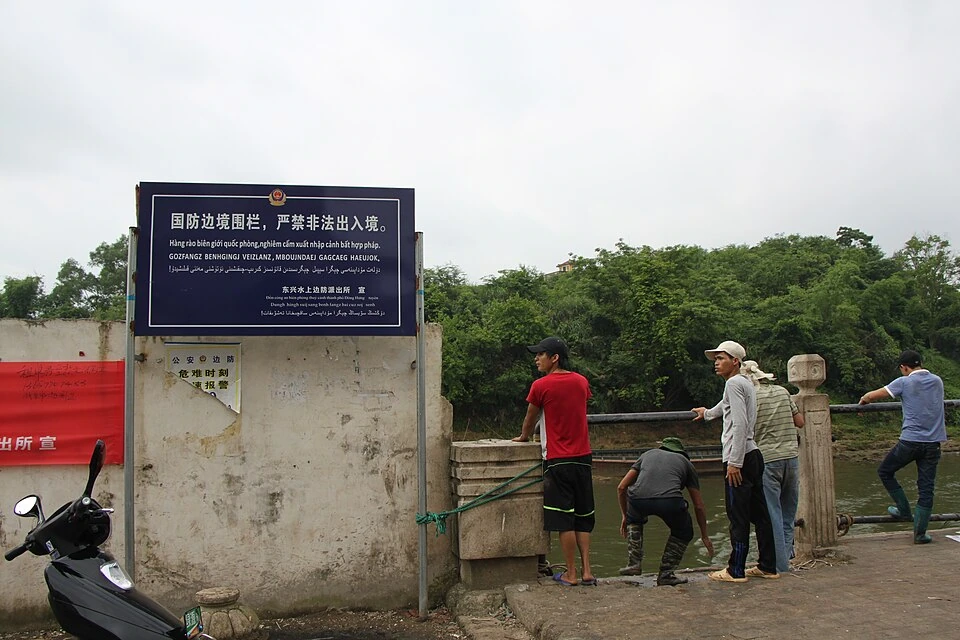
Border warning written in Chinese, Vietnamese, Zhuang and Uyghur on the Chinese side of the China–Vietnam border. Language identification follows Commons metadata; not independently transcribed.
Saved in Babelbook · resized display copy. Select the image to open it independently of its source.
Yp8080123 · Source ↗CC BY-SA 3.0 ↗View the local visual field note
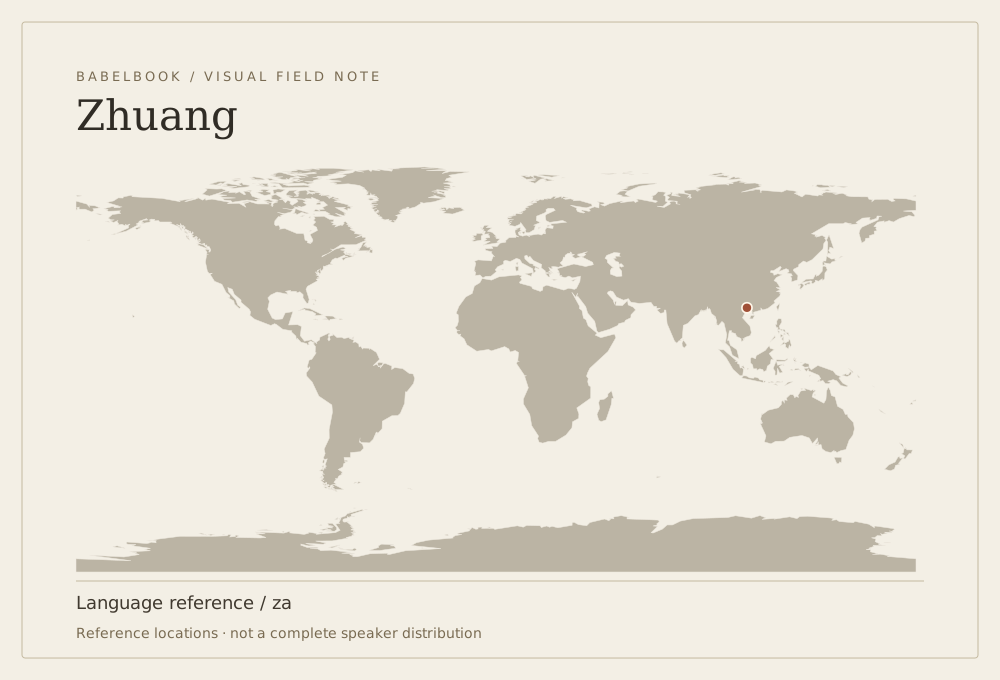
Representative reference points from Glottolog. Historical entries show reference locations, not current speakers. 1 point.
Reference & context ↗Babelbook · original editorial illustration · CC BY 4.0 · Glottolog locations; public-domain Natural Earth land
Source excerpts, selected, shortened and where noted editorially corrected from Zhuang languages by Wikipedia contributors. Retrieved 2026-10-05. CC BY-SA 4.0. These excerpts are not an independently verified scholarly history; missing accounts are identified above.
Read further in the source
Writing systems
The Zhuang languages have been written in the ancient sawndip script for over a thousand years, possibly preceded by the sawgoek script. Sawndip is based on Chinese characters, similar to Vietnamese chữ Nôm. Some sawndip logograms were directly borrowed from Han characters, whereas others were created locally from components of Chinese characters. It has been used for writing songs, and more recently in public communications encouraging people to follow official family planning policy. There has also been the occasional use of a number of other scripts, including pictographic proto-writing. In 1957, a hybrid script based on the Latin script and expanded with Cyrillic- and IPA-derived letters was introduced to write Standard Zhuang. In 1982, it was updated to use only Latin letters. These are referred to as the "old" and "new" Zhuang, respectively. Bouyei is written in Latin script.