Chinese
Chinese (spoken: simplified Chinese: 汉语; traditional Chinese: 漢語; pinyin: Hànyǔ, written: 中文; Zhōngwén) is a collection of language varieties containing almost all Sinitic languages except Macro-Bai languages, natively spoken by the Han Chinese and some ethnic minorities in Greater China, as well as by communities of the overseas Chinese. Approximately 1.39 billion people, or 17% of the global population, speak one of the varieties of Chinese as their first language. The different Chinese language varieties together form the largest branch of the Sino-Tibetan languages. While the Chinese government defines all spoken Chinese varieties as merely diverse dialects of a single language, the frequent lack of mutual intelligibility, especially among those outside of the dominant northern varieties, has led linguists to consider them as separate languages within a language family. Investigation of the historical relationships among the varieties of Chinese is ongoing. Currently, most classifications posit 7 to 13 main regional groups based on phonetic developments from Middle Chinese, of which the most spoken by far is Mandarin with 66%, or around 800 million speakers, followed by Min (75 million, e.g., Hokkien and Teochew), Wu (74 million, e.g., Shanghainese) and Yue (68 million, e.g., Cantonese). These groups are unintelligible to each other, and many of their subgroups are unintelligible with other subgroups within the same branch (e.g. Northern Min vs. Southern Min).
Translate in Chinese ↗Chinese (spoken: simplified Chinese: 汉语; traditional Chinese: 漢語; pinyin: Hànyǔ, written: 中文; Zhōngwén) is a collection of language varieties containing almost all Sinitic languages except Macro-Bai languages, natively spoken by the Han Chinese and some ethnic minorities in Greater China, as well as by communities of the overseas Chinese. Approximately 1.39 billion people, or 17% of the global population, speak one of the varieties of Chinese as their first language. The different Chinese language varieties together form the largest branch of the Sino-Tibetan languages. While the Chinese government defines all spoken Chinese varieties as merely diverse dialects of a single language, the frequent lack of mutual intelligibility, especially among those outside of the dominant northern varieties, has led linguists to consider them as separate languages within a language family. Investigation of the historical relationships among the varieties of Chinese is ongoing. Currently, most classifications posit 7 to 13 main regional groups based on phonetic developments from Middle Chinese, of which the most spoken by far is Mandarin with 66%, or around 800 million speakers, followed by Min (75 million, e.g., Hokkien and Teochew), Wu (74 million, e.g., Shanghainese) and Yue (68 million, e.g., Cantonese). These groups are unintelligible to each other, and many of their subgroups are unintelligible with other subgroups within the same branch (e.g. Northern Min vs. Southern Min).
East Asia
Present-day use
Modern neologisms are primarily translated into Chinese in one of three ways: free translation (calques), phonetic translation (by sound), or a combination of the two. Today, it is much more common to use existing Chinese morphemes to coin new words to represent imported concepts, such as technical expressions and international scientific vocabulary, wherein the Latin and Greek components are usually converted one-for-one into the corresponding Chinese characters. For example the word 'telephone' was initially loaned phonetically as 德律风; 德律風 (délǜfēng; Shanghainese télífon [təlɪfoŋ])—this word was widely used in Shanghai during the 1920s, but the later 电话; 電話 (diànhuà; 'electric speech'), built out of native Chinese morphemes became prevalent. Occasionally, compromises between the transliteration and translation approaches become accepted. Sometimes translations are designed so that they sound like the original while incorporating Chinese morphemes (phono-semantic matching). This is often done for commercial purposes, for example 奔腾; 奔騰 (bēnténg; 'dashing-leaping') for 'Pentium' and 赛百味; 賽百味 (Sàibǎiwèi; 'better-than hundred tastes') for 'Subway'. Foreign words, mainly proper nouns, continue to enter the Chinese language by transcription according to their pronunciations. This is done by employing Chinese characters with similar pronunciations. For example, 'Israel' becomes 以色列 (Yǐsèliè), and 'Paris' becomes 巴黎 (Bālí). A rather small number of direct transliterations have survived as common words. The bulk of these words were originally coined in Shanghai during the early 20th century and later loaned from there into Mandarin, hence their Mandarin pronunciations occasionally being quite divergent from the English. Western foreign words representing Western concepts have influenced Chinese since the 20th century through transcription. The influence of English is particularly pronounced: from the early 20th century, many English words were borrowed into Shanghainese.
Origins
The captured article does not contain a separate origins section. See the historical account and linked source.
Development
The first written records appeared over 3,000 years ago during the Shang dynasty. As the language evolved over this period, the various local varieties became mutually unintelligible. In reaction, central governments have repeatedly sought to promulgate a unified standard.
Writing
The complex relationship between spoken and written Chinese is an example of diglossia: as spoken, Chinese varieties have evolved at different rates, while the written language used throughout China changed comparatively little, crystallizing into a prestige form known as Classical or Literary Chinese. Literature written distinctly in the Classical form began to emerge during the Spring and Autumn period. Its use in writing remained nearly universal until the late 19th century, culminating with the widespread adoption of written vernacular Chinese with the May Fourth Movement beginning in 1919. The Chinese orthography centers on Chinese characters, which are written within imaginary square blocks, traditionally arranged in vertical columns, read from top to bottom down a column, and right to left across columns, with alternative arrangement with rows of characters from left to right within a row and from top to bottom across rows (like English and other Western writing systems) having become more popular since the 20th century. Chinese characters denote morphemes independent of phonetic variation in different languages. Thus the character 一 ('one') is pronounced as yī in Standard Chinese, yat1 in Cantonese and it in Hokkien, a form of Min. Most modern written Chinese is in the form of written vernacular Chinese, based on spoken Standard Chinese, regardless of dialectical background. Written vernacular Chinese largely replaced Literary Chinese in the early 20th century as the country's standard written language. However, vocabularies from different Chinese-speaking areas have diverged, and the divergence can be observed in written Chinese. Due to the divergence of variants, some unique morphemes are not found in Standard Chinese. Characters rarely used in Standard Chinese have also been created or inherited from archaic literary standards to represent these unique morphemes.
Beyond the typeface.
Signs, manuscripts, published pages and contextual photographs, with their place, period, source and reuse terms. Captions identify historical spellings, regional examples, community references and character imagery.
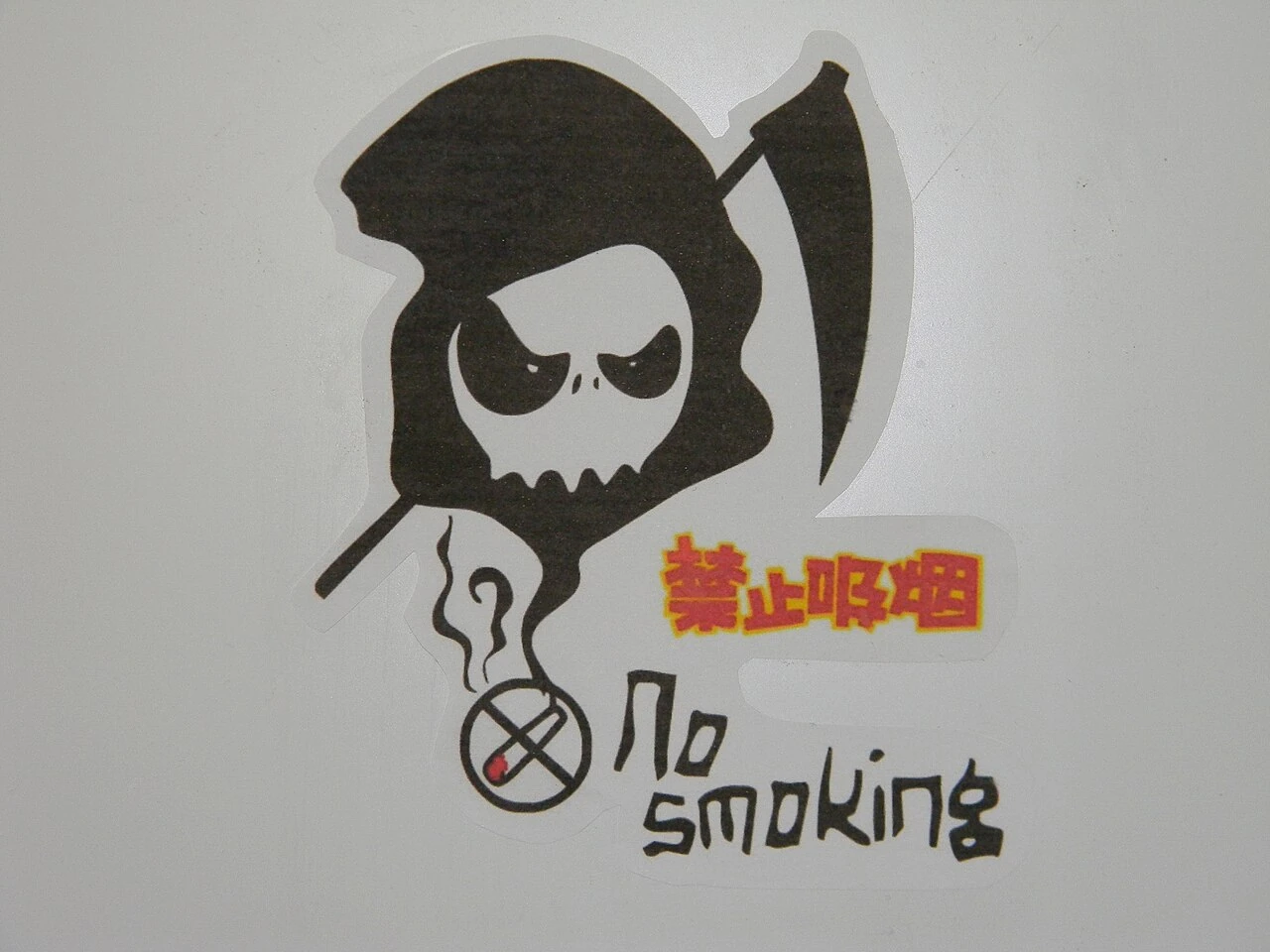
Bilingual written Chinese and English, photographed in 2012. The written sign does not identify a spoken Chinese variety. Displayed at reduced size; no additional crop.
Saved in Babelbook · resized display copy. Select the image to open it independently of its source.
Ecow · Source ↗CC0 1.0 ↗View the local visual field note
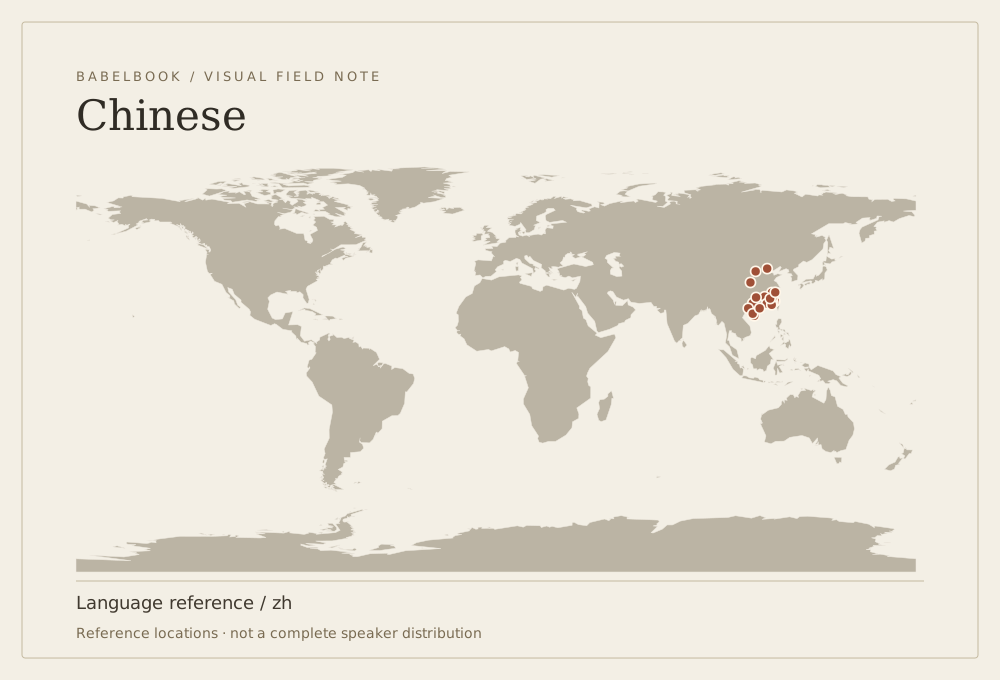
Representative reference points from Glottolog. Historical entries show reference locations, not current speakers. 19 points.
Reference & context ↗Babelbook · original editorial illustration · CC BY 4.0 · Glottolog locations; public-domain Natural Earth land
Source excerpts, selected, shortened and where noted editorially corrected from Chinese language by Wikipedia contributors. Retrieved 2026-10-05. CC BY-SA 4.0. These excerpts are not an independently verified scholarly history; missing accounts are identified above.
Read further in the source
History
The first written records appeared over 3,000 years ago during the Shang dynasty. As the language evolved over this period, the various local varieties became mutually unintelligible. In reaction, central governments have repeatedly sought to promulgate a unified standard.
Classical and vernacular written forms
The complex relationship between spoken and written Chinese is an example of diglossia: as spoken, Chinese varieties have evolved at different rates, while the written language used throughout China changed comparatively little, crystallizing into a prestige form known as Classical or Literary Chinese. Literature written distinctly in the Classical form began to emerge during the Spring and Autumn period. Its use in writing remained nearly universal until the late 19th century, culminating with the widespread adoption of written vernacular Chinese with the May Fourth Movement beginning in 1919.
Rise of northern dialects
After the fall of the Northern Song dynasty and subsequent reign of the Jurchen Jin and Mongol Yuan dynasties in northern China, a common speech (now called Old Mandarin) developed based on the dialects of the North China Plain around the capital. The 1324 Zhongyuan Yinyun was a dictionary that codified the rhyming conventions of new sanqu verse form in this language. Together with the slightly later Menggu Ziyun, this dictionary describes a language with many of the features characteristic of modern Mandarin dialects. Until the early 20th century, most Chinese people only spoke their local language. Thus, as a practical measure, officials of the Ming and Qing dynasties carried out the administration of the empire using a common language based on Mandarin varieties, known as 官话; 官話; Guānhuà; 'language of officials'. For most of this period, this language was a koiné based on dialects spoken in the Nanjing area, though not identical to any single dialect. By the middle of the 19th century, the Beijing dialect had become dominant and was essential for any business with the imperial court. In the 1930s, a standard national language (国语; 國語; Guóyǔ), was adopted. After much dispute between proponents of northern and southern languages and an abortive attempt at an artificial pronunciation, the National Language Unification Commission finally settled on the Beijing dialect in 1932. The People's Republic founded in 1949 retained this standard but renamed it 普通话; 普通話; pǔtōnghuà; 'common speech'. The national language is now used in education, the media, and formal situations in both mainland China and Taiwan. In Hong Kong and Macau, Cantonese is the dominant spoken language due to cultural influence from Guangdong immigrants and colonial-era policies, and is used in education, media, formal speech, and everyday life—though Mandarin is increasingly taught in schools due to the mainland's growing influence.
Standard Chinese
Standard Chinese is the standard language of China (where it is called 普通话; pǔtōnghuà) and Taiwan, and one of the four official languages of Singapore (where it is called either 华语; 華語; Huáyǔ or 汉语; 漢語; Hànyǔ). Standard Chinese is based on the Beijing dialect of Mandarin. The governments of both China and Taiwan intend for speakers of all Chinese speech varieties to use it as a common language of communication. Therefore, it is used in government agencies, in the media, and as a language of instruction in schools. Diglossia is common among Chinese speakers. For example, a Shanghai resident may speak both Standard Chinese and Shanghainese; if they grew up elsewhere, they are also likely fluent in the dialect of their home region. In addition to Standard Chinese, a majority of Taiwanese people also speak Taiwanese Hokkien (also called 台語; 'Taiwanese'), Hakka, or an Austronesian language. A speaker in Taiwan may mix pronunciations and vocabulary from Standard Chinese and other languages of Taiwan in everyday speech. In part due to traditional cultural ties with Guangdong, Cantonese is used as an everyday language in Hong Kong and Macau.
Writing system
The Chinese orthography centers on Chinese characters, which are written within imaginary square blocks, traditionally arranged in vertical columns, read from top to bottom down a column, and right to left across columns, with alternative arrangement with rows of characters from left to right within a row and from top to bottom across rows (like English and other Western writing systems) having become more popular since the 20th century. Chinese characters denote morphemes independent of phonetic variation in different languages. Thus the character 一 ('one') is pronounced as yī in Standard Chinese, yat1 in Cantonese and it in Hokkien, a form of Min.
Most modern written Chinese is in the form of written vernacular Chinese, based on spoken Standard Chinese, regardless of dialectical background. Written vernacular Chinese largely replaced Literary Chinese in the early 20th century as the country's standard written language. However, vocabularies from different Chinese-speaking areas have diverged, and the divergence can be observed in written Chinese. Due to the divergence of variants, some unique morphemes are not found in Standard Chinese. Characters rarely used in Standard Chinese have also been created or inherited from archaic literary standards to represent these unique morphemes. For example, characters like 冇 and 係 are actively used in Cantonese and Hakka, while being archaic or unused in standard written Chinese. The most prominent example of a non-Standard Chinese orthography is Written Cantonese, which is used in tabloids and on the internet among Cantonese speakers in Hong Kong and elsewhere. Chinese had no uniform system of phonetic transcription until the mid-20th century, although enunciation patterns were recorded in early rhyme dictionaries and dictionaries. Early Indian translators, working in Sanskrit and Pali, were the first to attempt to describe the sounds and enunciation patterns of Chinese in a foreign language. After the 15th century, the efforts of Jesuits and Western court missionaries resulted in some Latin character transcription/writing systems, based on various variants of Chinese languages. Some of these Latin character-based systems are still being used to write various Chinese variants in the modern era. In Hunan, women in certain areas write their local Chinese language variant in Nüshu, a syllabary derived from Chinese characters. The Dungan language, considered by many a dialect of Mandarin, is nowadays written in Cyrillic and was previously written in the Arabic script. The Dungan people are primarily Muslim and live mainly in Kazakhstan, Kyrgyzstan, and Russia; many Hui people, living mainly in China, also speak the language.