Zulu
Zulu ( ZOO-loo), also known by its endonym isiZulu, is a Southern Bantu language of the Nguni branch spoken in, and indigenous to, Southern Africa with about 13.56 million native speakers, who primarily inhabit the province of KwaZulu-Natal in South Africa. Zulu is the most widely spoken home language in South Africa (24% of the population), and it is understood by over 50% of its population. It became an official language of South Africa in 1994. According to Ethnologue, it is the second-most widely spoken of the Bantu languages, after Swahili. Like many other Bantu languages, it is written with the Latin alphabet. In South African English, the language is often referred to in its native form, isiZulu.
Translate in Zulu ↗Zulu migrant populations have taken it to adjacent regions, especially Zimbabwe, where the Northern Ndebele language (isiNdebele) is closely related to Zulu. Xhosa, the predominant language in the Eastern Cape, is often considered mutually intelligible with Zulu, as is Northern Ndebele. Maho (2009) lists four dialects: central KwaZulu-Natal Zulu, northern Transvaal Zulu, eastern coastal Qwabe, and western coastal Cele.
Sub-Saharan Africa
Present-day use
The captured source does not contain a separate current-use account.
Origins
The captured article does not contain a separate origins section. See the historical account and linked source.
Development
Like Xhosa and other Nguni people, the Zulu have lived in South Africa for hundreds of years. The Zulu language possesses several click sounds. Click languages also occur outside Southern Africa, including Sandawe in Tanzania. The Nguni people have coexisted with other Southern tribes like the San and Khoi. Zulu, like most indigenous Southern African languages, was not a written language until the arrival of European missionaries, who documented the language using the Latin script. The first grammar book of the Zulu language was published in Norway in 1850 by the Norwegian missionary Hans Schreuder. Written Zulu material predates the 1883 Bible; a Christian booklet appeared in 1837–38. In 1901, John Dube (1871–1946), a Zulu from Natal, created the Ohlange Institute, the first native educational institution in South Africa. He was also the author of Insila kaShaka, the first novel written in Zulu (1930). Another pioneering Zulu writer was Reginald Dhlomo, author of several historical novels of the 19th-century leaders of the Zulu nation: U-Dingane (1936), U-Shaka (1937), U-Mpande (1938), U-Cetshwayo (1952) and U-Dinizulu (1968). Other notable contributors to Zulu literature include Benedict Wallet Vilakazi and, more recently, Oswald Mbuyiseni Mtshali. The written form of Zulu was controlled by the Zulu Language Board of KwaZulu-Natal. This board has now been disbanded and superseded by the Pan South African Language Board which promotes the use of South Africa’s official languages.
Writing
Zulu is primarily written in a Latin alphabet, and occasionally in Ditema syllabics. In Malawi, Ngoni dialect may be written in Mwangwego script. Zulu employs the 26 letters of the ISO basic Latin alphabet. However, some of the letters have different pronunciations than in English. Additional phonemes are written using sequences of multiple letters. Tone, stress and vowel length are not indicated. Reference works and older texts may use additional letters. A common former practice was to indicate the implosive /ɓ/ using the special letter ɓ, while the digraph bh would then be simply written as b. Some references may also write h after letters to indicate that they are of the depressor variety, e.g. mh, nh, yh, a practice that is standard in Xhosa orthography. Very early texts, from the early 20th century or before, tend to omit the distinction between plain and aspirated voiceless consonants, writing the latter without the h. Nouns are written with their prefixes as one orthographical word. If the prefix ends with a vowel (as most do) and the noun stem also begins with a vowel, a hyphen is inserted in between, e.g. i-Afrika. This occurs only with loanwords.
Beyond the typeface.
Signs, manuscripts, published pages and contextual photographs, with their place, period, source and reuse terms. Captions identify historical spellings, regional examples, community references and character imagery.
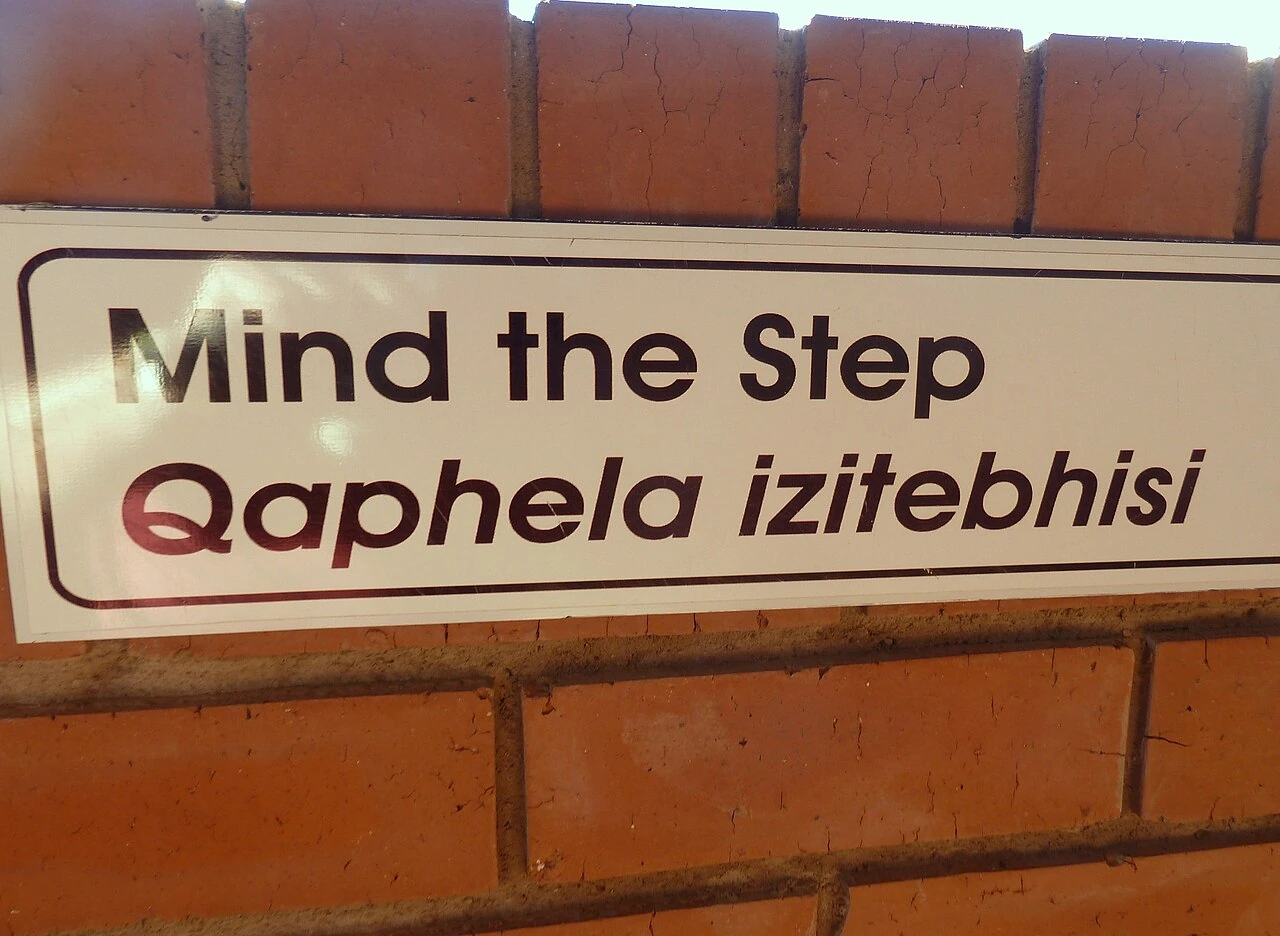
An English–Zulu warning sign at the Mgungundlovu Multimedia Centre.
Saved in Babelbook · resized display copy. Select the image to open it independently of its source.
JMK · Source ↗CC BY-SA 4.0 ↗View the local visual field note
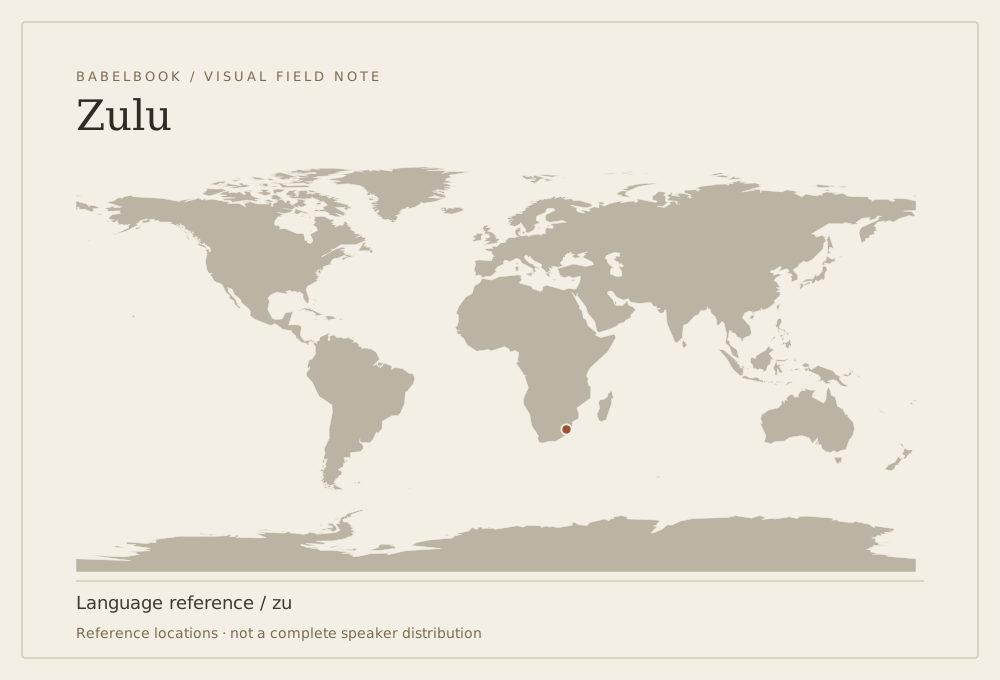
Representative reference points from Glottolog. Historical entries show reference locations, not current speakers. 1 point.
Reference & context ↗Babelbook · original editorial illustration · CC BY 4.0 · Glottolog locations; public-domain Natural Earth land
Source excerpts, selected, shortened and where noted editorially corrected from Zulu language by Wikipedia contributors. Retrieved 2026-10-05. CC BY-SA 4.0. These excerpts are not an independently verified scholarly history; missing accounts are identified above.
Read further in the source
Geographical distribution
Zulu migrant populations have taken it to adjacent regions, especially Zimbabwe, where the Northern Ndebele language (isiNdebele) is closely related to Zulu. Xhosa, the predominant language in the Eastern Cape, is often considered mutually intelligible with Zulu, as is Northern Ndebele. Maho (2009) lists four dialects: central KwaZulu-Natal Zulu, northern Transvaal Zulu, eastern coastal Qwabe, and western coastal Cele.
History
Like Xhosa and other Nguni people, the Zulu have lived in South Africa for hundreds of years. The Zulu language possesses several click sounds. Click languages also occur outside Southern Africa, including Sandawe in Tanzania. The Nguni people have coexisted with other Southern tribes like the San and Khoi. Zulu, like most indigenous Southern African languages, was not a written language until the arrival of European missionaries, who documented the language using the Latin script. The first grammar book of the Zulu language was published in Norway in 1850 by the Norwegian missionary Hans Schreuder. Written Zulu material predates the 1883 Bible; a Christian booklet appeared in 1837–38. In 1901, John Dube (1871–1946), a Zulu from Natal, created the Ohlange Institute, the first native educational institution in South Africa. He was also the author of Insila kaShaka, the first novel written in Zulu (1930). Another pioneering Zulu writer was Reginald Dhlomo, author of several historical novels of the 19th-century leaders of the Zulu nation: U-Dingane (1936), U-Shaka (1937), U-Mpande (1938), U-Cetshwayo (1952) and U-Dinizulu (1968). Other notable contributors to Zulu literature include Benedict Wallet Vilakazi and, more recently, Oswald Mbuyiseni Mtshali. The written form of Zulu was controlled by the Zulu Language Board of KwaZulu-Natal. This board has now been disbanded and superseded by the Pan South African Language Board which promotes the use of South Africa’s official languages.
Standard vs Urban Zulu
Standard Zulu as it is taught in schools, also called "deep Zulu" (isiZulu esijulile), differs in various respects from the language spoken by people living in cities (Urban Zulu, isiZulu sasedolobheni). Standard Zulu tends to be purist, using derivations from Zulu words for new concepts, whereas speakers of Urban Zulu use loan words abundantly, mainly from English. For example:
This situation has led to problems in education because standard Zulu is often not understood by young people.
Orthography
Zulu is primarily written in a Latin alphabet, and occasionally in Ditema syllabics. In Malawi, Ngoni dialect may be written in Mwangwego script. Zulu employs the 26 letters of the ISO basic Latin alphabet. However, some of the letters have different pronunciations than in English. Additional phonemes are written using sequences of multiple letters. Tone, stress and vowel length are not indicated.
Reference works and older texts may use additional letters. A common former practice was to indicate the implosive /ɓ/ using the special letter ɓ, while the digraph bh would then be simply written as b. Some references may also write h after letters to indicate that they are of the depressor variety, e.g. mh, nh, yh, a practice that is standard in Xhosa orthography. Very early texts, from the early 20th century or before, tend to omit the distinction between plain and aspirated voiceless consonants, writing the latter without the h. Nouns are written with their prefixes as one orthographical word. If the prefix ends with a vowel (as most do) and the noun stem also begins with a vowel, a hyphen is inserted in between, e.g. i-Afrika. This occurs only with loanwords.